Challenging Beijing in the South China Sea
Posted Tuesday, July 31st, 2012 at 7:49 pm
Hanoi and Manila Take Different Approaches
Vietnam and the Philippines are both angry at what they see as
Chinese bullying in the South China Sea, but Hanoi and Manila are taking
different approaches to the standoff over rival maritime claims.
Vietnam is strengthening military ties with the United States, India,
Singapore, Japan, Australia, and Russia, building what Joshua
Kurlantzick of the U.S. Council on Foreign Relations calls a “web of ad
hoc bilateral relationships to shore up their security.”
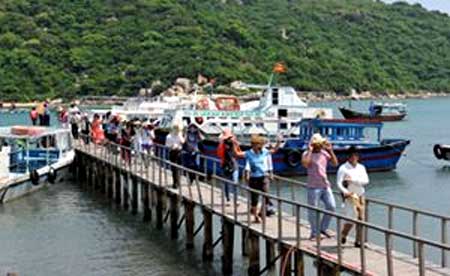
With Vice Admiral Viktor Chirkov in talks to return Russia’s navy to
Cam Ranh Bay, Kurlantzick says Hanoi is sending a clear signal to
Beijing that it is not alone in the South China Sea.

Philippines
President Benigno Aquino III tells his parliament July 25 that Manila
will stand firm against Chinese territorial claims on the Spratly
Islands in the South China Sea. Photo: AP
“It speaks to Vietnam’s utilization of many different partners in
order to back itself up,” says Kurlantzick, a Southeast Asia specialist.
“Vietnam is in a stronger position that the Philippines simply because
for years the Armed Forces of Philippines basically did nothing to
upgrade its navy.”
Filipino President Benigno Aquino III is trying to catch up, placing
an order for more attack helicopters after China opened a new base in
the Paracel Islands to patrol waters claimed by both Vietnam and the
Philippines.
Now, more powerful countries such as Vietnam are looking to other
solutions after China managed to stymie an attempt to address the
maritime claims through the Association of Southeast Asian Nations
(ASEAN). But weaker nations such as the Philippines are trying to
broaden the mediation effort by taking the dispute to the United
Nations.
ASEAN or the United Nations
That move has little support in Washington, says Bonnie Glaser, a
senior fellow on China studies at the Center for Strategic and
International Studies (CSIS). She says the Obama administration is
pushing instead for direct code-of-conduct talks between China and
ASEAN.
“The United States doesn’t view this as a U.S./China issue,” Glaser
says. “Taking it to the U.N. would make it seem like a U.S./China issue
because none of the other permanent Security Council members really have
any stake in this issue at all.”
“The Philippines is throwing everything at the wall because they are
in the weakest position and they want to see what sticks,” Kurlantzick
says. “You have senior Philippine national security officials coming
repeatedly to the U.S. and asking for certain types of upgrades. You
have them sort of trying to maneuver the U.S. into confirming that
because of our relationship with them in the past, the South China Sea
would come under that” Mutual Defense Treaty.
Though weaker militarily, Kurlantzick says the Philippines has a more
open and democratic political system than Vietnam and is less
susceptible to public anger over Chinese aggression.
“Certainly President Aquino has taken some strong steps, and he is
not going to back down on certain issues. But at the same time, it’s a
much more mature political system,” Kurlantzick says. “So I think public
pressure works a number of different ways, and the government is less
straightjacketed by nationalistic tendencies because its legitimacy can
rest on a number of different foundations.”

Demonstrators
march through Hanoi July 22 protesting China’s claims on South China
Sea territory also claimed by Vietnam. Photo: Reuters
With regular, carefully-guided Sunday protests against China in both
Hanoi and Ho Chi Minh City, the Vietnamese government is trying to stay
ahead of public opinion at a time when Glaser says nationalist
sentiments are running high in Vietnam, the Philippines, and China.
“This has certainly become imbued with a sense of, ‘These are our
rights.’ It has become a very sensitive issue,” Glaser says. “On the
blogosphere all over China, Chinese citizens, netizens, are calling for
their government to defend their interests. And I do believe that the
Chinese leadership is very wary of being seen as too soft and not
protecting Chinese sovereignty and territorial integrity.”
This is especially so as Washington makes its “Asia Pivot” in
military strategy, repositioning Marines and aircraft carrier task
forces in the Pacific.
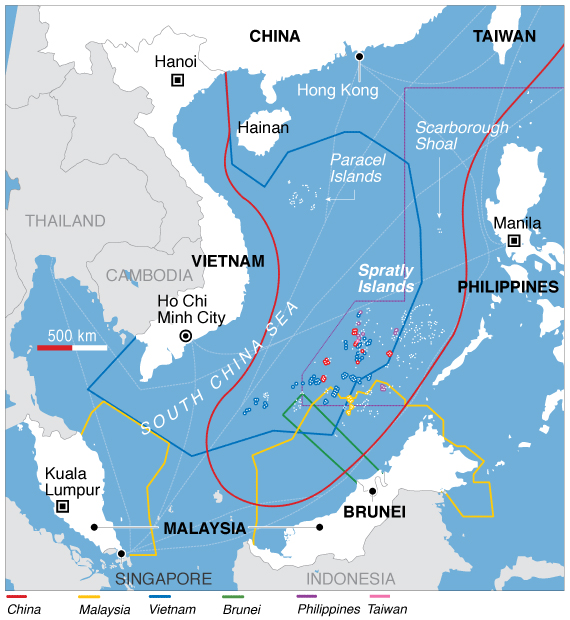
China
is pressing huge territorial claims, outlined in red, in the South
China Sea region. The Philippines, Vietnam and others are also making
claims.
Washington’s ‘Asia Pivot’
“Countries are worried about U.S. staying power, about whether or not
there will be a counter-weight to China,” Glaser says. “We are trying
to say, ‘Yes. We will be there to ensure peace and security in the
region.’ It’s problematic because we don’t want to embolden other
countries to engage in a confrontation with China.”
To the extent that they do, Glaser says that would be an unintended consequence of the Asia Pivot.
“Perhaps some of the actions taken by the Philippines might not have
been taken if this series of events had taken place at a time when the
United States was not seeking to refocus on Asia.
“When we are asked by President Aquino to say something more
forcefully about how we will defend the Philippines if it is attacked,
this puts the U.S. in a very difficult position,” the CSIS regional
expert says. “We don’t want to leave the Philippines in a weak position.
But at the same time we don’t want to tell the Philippines, ‘We’ve got
your back.’”


 Aaron Joel Santos, an American photographer who came to Vietnam for a lark five years ago and has stayed back