Showing posts with label Russia. Show all posts

Saturday, April 11, 2015

From Russia no love: ruble slump squeezes SE Asia tourism - All Vietnam


The ruble’s sharp decline is exacting a toll on Southeast Asian tourism as Russians think twice about doubling their budgets for their next beach holiday in Vietnam, Thailand or Cambodia.

A Thai street vendor waits for customers at Patong beach in Phuket
(Photo: reuters)
The rouble fell 43 percent last year against the dollar, hurt by plunging oil prices and Western sanctions imposed over Moscow’s role in the Ukraine political crisis. A Russian tourist now needs to fork out as much as 140,000 rubles ($2,479) for a trip to Vietnam, including plane tickets and accommodation, up from 60,000 rubles last year, a state-run Vietnamese newspaper estimated. For those who do make it to Vietnam, they are buying instant noodles instead of eating out, local media reported.
Russians account for billions of dollars in tourism revenue in Southeast Asia and rank second after Chinese travelers in number. Food menus in Russian are ubiquitous in Phuket. Street vendors in Vietnamese beach towns have picked up Russian words. In 2013, when Russian tourist arrivals in Vietnam more than doubled, national carrier Vietnam Airlines launched direct flights linking Moscow with the former U.S. airbase in Cam Ranh near the popular coastal town of Nha Trang.
In January-to-March, some 95,800 Russians visited Vietnam, down 27 percent from a year earlier and the first quarterly fall since 2012. Cambodia’s Tourism Ministry counted nearly 18,300 Russian tourists in the first two months of 2015, down 51 percent. Thailand drew 1.6 million Russian tourists in 2014, down 8.6 percent. Arrivals slumped 46 percent in January this year. In the same month, Russian visitors to the Philippines dropped 12 percent.
“Russian tourists have been steadily declining in Thailand since last year particularly because of the depreciation of the rouble,” said Surapong Techaruvichit, president of the Thai Hotels Association. “Destinations that have traditionally been popular with Russians, including Phuket and Pattaya, have been hit hard.”


From Russia no love: ruble slump squeezes SE Asia tourism - All Vietnam

Tuesday, July 31, 2012

Hanoi and Manila angry at Chinese bullying

Challenging Beijing in the South China Sea

Hanoi and Manila Take Different Approaches
Vietnam and the Philippines are both angry at what they see as Chinese bullying in the South China Sea, but Hanoi and Manila are taking different approaches to the standoff over rival maritime claims.
Vietnam is strengthening military ties with the United States, India, Singapore, Japan, Australia, and Russia, building what Joshua Kurlantzick of the U.S. Council on Foreign Relations calls a “web of ad hoc bilateral relationships to shore up their security.”
With Vice Admiral Viktor Chirkov in talks to return Russia’s navy to Cam Ranh Bay, Kurlantzick says Hanoi is sending a clear signal to Beijing that it is not alone in the South China Sea.
Philippines President Benigno Aquino III tells his parliament July 25 that Manila will stand firm against Chinese territorial claims on the Spratly Islands in the South China Sea. Photo: AP
“It speaks to Vietnam’s utilization of many different partners in order to back itself up,” says Kurlantzick, a Southeast Asia specialist. “Vietnam is in a stronger position that the Philippines simply because for years the Armed Forces of Philippines basically did nothing to upgrade its navy.”
Filipino President Benigno Aquino III is trying to catch up, placing an order for more attack helicopters after China opened a new base in the Paracel Islands to patrol waters claimed by both Vietnam and the Philippines.
Now, more powerful countries such as Vietnam are looking to other solutions after China managed to stymie an attempt to address the maritime claims through the Association of Southeast Asian Nations (ASEAN). But weaker nations such as the Philippines are trying to broaden the mediation effort by taking the dispute to the United Nations.

ASEAN or the United Nations
That move has little support in Washington, says Bonnie Glaser, a senior fellow on China studies at the Center for Strategic and International Studies (CSIS). She says the Obama administration is pushing instead for direct code-of-conduct talks between China and ASEAN.
“The United States doesn’t view this as a U.S./China issue,” Glaser says. “Taking it to the U.N. would make it seem like a U.S./China issue because none of the other permanent Security Council members really have any stake in this issue at all.”
“The Philippines is throwing everything at the wall because they are in the weakest position and they want to see what sticks,” Kurlantzick says. “You have senior Philippine national security officials coming repeatedly to the U.S. and asking for certain types of upgrades. You have them sort of trying to maneuver the U.S. into confirming that because of our relationship with them in the past, the South China Sea would come under that” Mutual Defense Treaty.
Though weaker militarily, Kurlantzick says the Philippines has a more open and democratic political system than Vietnam and is less susceptible to public anger over Chinese aggression.
“Certainly President Aquino has taken some strong steps, and he is not going to back down on certain issues. But at the same time, it’s a much more mature political system,” Kurlantzick says. “So I think public pressure works a number of different ways, and the government is less straightjacketed by nationalistic tendencies because its legitimacy can rest on a number of different foundations.”
Demonstrators march through Hanoi July 22 protesting China’s claims on South China Sea territory also claimed by Vietnam. Photo: Reuters
With regular, carefully-guided Sunday protests against China in both Hanoi and Ho Chi Minh City, the Vietnamese government is trying to stay ahead of public opinion at a time when Glaser says nationalist sentiments are running high in Vietnam, the Philippines, and China.
“This has certainly become imbued with a sense of, ‘These are our rights.’ It has become a very sensitive issue,” Glaser says. “On the blogosphere all over China, Chinese citizens, netizens, are calling for their government to defend their interests. And I do believe that the Chinese leadership is very wary of being seen as too soft and not protecting Chinese sovereignty and territorial integrity.”
This is especially so as Washington makes its “Asia Pivot” in military strategy, repositioning Marines and aircraft carrier task forces in the Pacific.
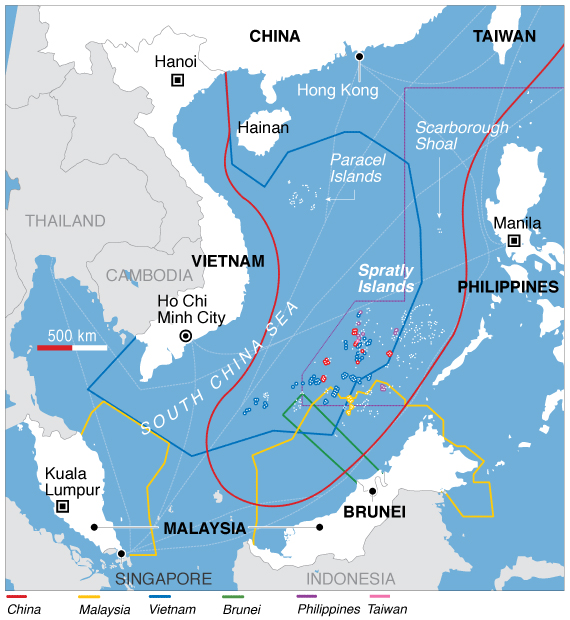
China is pressing huge territorial claims, outlined in red, in the South China Sea region. The Philippines, Vietnam and others are also making claims.

Washington’s ‘Asia Pivot’
“Countries are worried about U.S. staying power, about whether or not there will be a counter-weight to China,” Glaser says. “We are trying to say, ‘Yes. We will be there to ensure peace and security in the region.’ It’s problematic because we don’t want to embolden other countries to engage in a confrontation with China.”
To the extent that they do, Glaser says that would be an unintended consequence of the Asia Pivot.
“Perhaps some of the actions taken by the Philippines might not have been taken if this series of events had taken place at a time when the United States was not seeking to refocus on Asia.
“When we are asked by President Aquino to say something more forcefully about how we will defend the Philippines if it is attacked, this puts the U.S. in a very difficult position,” the CSIS regional expert says. “We don’t want to leave the Philippines in a weak position. But at the same time we don’t want to tell the Philippines, ‘We’ve got your back.’”

Saturday, April 28, 2012

S. China Sea–the next big power playground | The Jakarta Post

S. China Sea–the next big power playground

Kor Kian Beng, Asia News Network (The Straits Times), Beijing | Wed, 04/25/2012 12:39 PM
A | A | A |
Despite strenuous efforts by China to keep other global powers out of the South China Sea, recent movements suggest that Beijing has failed.
The United States, whom China is most keen to block, has boosted its presence there in the last week. It is holding military exercises with the Philippines and having a naval exchange with Vietnam.
As if that is not irritating enough for Beijing, even Russia has muscled in. Its state gas giant Gazprom signed a deal this month with Vietnam to explore reserves in the resource-rich sea.
It mirrored a similar exploration pact that India signed with Hanoi last year, and comes on the back of Japan's long-held influence in the region through years of infrastructure investments in ASEAN.
The waters China regards as its backyard are fast becoming the world's “next big power playground”, say observers.
And much like the Balkan states in the last century, when big countries fought proxy wars in the region, many fear that the sea could become a conflict zone.
Singapore’s Institute of Southeast Asian Studies senior fellow Ian Storey calls it a potential “focal point” of great power competition.
The big boys hunger for control over the sea lanes where one-third of the world's shipping trade passes through, he said.
“As tensions continue to simmer in the South China Sea, and the waters become increasingly crowded with new warships, I think it's just a question of time before we see a clash at sea leading to fatalities,” he added.
None of the global giants wants to give China free rein over such a precious piece of watery real estate. They have the support of smaller ASEAN countries that are contesting China's claims and seeking to bolster their claims by internationalizing the situation, say observers.
Foreign policy expert Yang Cheng from the East China Normal University said some claimants see merits in playing one major power against another.
Doing so could help the smaller players glean some benefits from the major powers clamoring for their support, he added.
“It seems like the tragedy of great power politics is now the smaller countries' comedy,” said Yang.
He said claimants could also become bolder in challenging China, believing that its army, the world's largest, would be restrained in its response so as to avoid conflicts with major powers.
This could be why Manila took a more hardline approach in the two-week stand-off with China over the Scarborough Shoal, which lies north of the Spratly Islands claimed by China, the Philippines and Vietnam, among others.
“But such mindsets could be dangerous. There is a limit to China's tolerance, especially as the solution to the territorial issues directly relates to the legitimacy of the authorities and many Chinese want the government to be more hardline now that the country is stronger,” said Yang.
Also, conflicts may occur if major powers misread conflicting signals and inconsistent policies emanating from China – a possible result of a struggle for money and power between agencies and local governments, said the International Crisis Group in a report this week.
The International Crisis Group’s Northeast Asia project director Stephanie Kleine-Ahlbrandt said: “Some agencies are acting assertively to compete for a slice of the budget pie, while others such as local governments are focused on economic growth, leading them to expand their activities into disputed waters.”
“Their motivations are domestic in nature, but the impact of their actions is increasingly international.”
To assert its primacy, Beijing has been on a public relations drive to win more ASEAN friends.
Thai Premier Yingluck Shinawatra met top-ranked Chinese leaders in Beijing last week, while China's fourth-ranked leader Jia Qinglin visited Brunei.
Analyst Li Mingjiang of the S. Rajaratnam School of International Studies believes the visits are examples of China reassuring its neighbors of its “benign and cooperative intention”.
“These efforts will partly be helpful in stabilizing the South China Sea contention,” he added.

Tuesday, April 17, 2012

India says oil, gas cooperation with Vietnam in the East Sea will continue  | Look At Vietnam

India says oil, gas cooperation with Vietnam in the East Sea will continue 

April 17, 2012
An Vietnamese oil rig in the East Sea
An Indian official has reiterated that India will not step back in face of China’s warnings against its collaboration with Vietnam in exploring oil and gas in the East Sea, the Vietnam News Agency reported Friday.
The East Sea is the world’s property, and no one has right to control it unilaterally, the report quoted Minister of State for Parliamentary Affairs and Planning Ashwani Kumar as saying.
India is fully capable of protecting its financial interests and national strategies, he said.
Earlier, on April 6, Indian External Affairs Minister S. M. Krishna made the same statement about the East Sea, saying that trade-ways must be free of any national interference, the news agency reported

RELATED CONTENT
Vietnam dismisses China’s objection to Russian oil exploration in East Sea
Like us on Facebook and scroll down to share your comment
Last September China warned Indian companies against entering oil and gas agreement with Vietnam in the East Sea, after learning that India planned a project to explore oil in two blocks offshore Vietnam.
In October, Vietnam and India signed an agreement on expanding oil exploration and production in the sea.
Recently China made the same objection after the Vietnam National Oil and Gas Group (PetroVietnam) signed an pact with the Russian energy giant Gazprom to set up a partnership to explore gas in the East Sea on April 5.
In response to China’s comment, Vietnamese Ministry of Foreign Affairs’ spokesman Luong Thanh Nghi on Thursday said all the oil and gas projects that Vietnam is cooperating with foreign partners on are within the country’s sovereign territories and in accordance with international laws.

Thursday, April 12, 2012

Vietnam to open PR center on nuclear power | Look At Vietnam

Vietnam to open PR center on nuclear power

April 12, 2012
LookAtVietnam – The first media center on nuclear power in Vietnam will be inaugurated this year to diffuse basic knowledge on nuclear power by pictures to the people.

The first nuclear power plant will be built in this site, Phuoc Dinh commune of Tay Ninh
Province in southeastern Vietnam.
Mr. Pham Quang Trung, Vice director of the Atomic Energy Department of the Ministry of Science and Technology, says that the center will be based inside the Hanoi University of Technology.
“This center will specialize in disseminating knowledge on nuclear power, a very new thing in Vietnam, in the context that Vietnam is preparing to build its first nuclear power plant,” Trung says.
This center will be equipped with modern machines and equipment. It will mainly serve students but anyone who is interested in nuclear power can also visit the center.
The center will be built under the sponsorship of Russia’s Rosatom group.
A similar center will be built in HCM City in the near future.
Experts say that providing information about nuclear power is a significant task in developing nuclear power infrastructure in Vietnam, particularly after the Fukushima incident in Japan last year.
Last year scientists of IAEA visited Vietnam to supply the country with knowledge and skills on PR activities for nuclear power.
The first two power plants of Vietnam will be built in Ninh Thuan province, central Vietnam, with a total capacity of 4,000 MW.
Construction of the first plant will start in 2014 and it will begin operating in 2020. This plant will use Russian technology.
S. Tung

Friday, June 3, 2011

Russian captain condemns cable destruction | Look At Vietnam - Vietnam news daily update

 ED NOTE: This and the following story of China bullying Vietnam in Vietnam's waters. What does this tell you about China? America, The World wake up, this is just the beginning of China's dominance and thirst to feed and protect 20 billion Chinese. 


Russian captain condemns cable destruction | Look At Vietnam - Vietnam news daily update: "-

Russian captain condemns cable destruction

June 3, 2011 about International, News


LookAtVietnam - The exploration ship Binh Minh 2, whose cable was cut by a Chinese vessel last week, returned to Nha Trang Port yesterday after completing seismic surveys in Vietnam’s territorial waters.


Alexander Belov, the Russian captain of the ship, spoke about the incident.
Have you ever seen anything like this case in which three Chinese vessels hindered the operations of the Binh Minh 2 and destroyed its equipment while it was operating in Vietnam’s territorial waters?
I have never seen such a case before and I hope [it] will be the last for me. The encounter was an experience for me. Normally, in such cases, marine surveillance ships will seek ways to communicate with us instead of destroying our equipment, which is an illegal action, since we were operating in Vietnam’s exclusive economic zone.
What did you do to when the Chinese ships moved in?
I first tried to communicate with them and asked them to keep away from our equipment. I then heard them say that we had to leave the area since we had violated China’s sovereignty. We replied to them that the issue should be let to competent officials to resolve, but they continued to run after us. Finally, one of the three Chinese vessels cut our cables. We continued our voyage and called the company’s office for instructions on what we should do to recover the lost equipment to mitigate the damage.
As a person who has been at sea for long, what do you think about the seriousness of the incident?
This is a very serious incident, one in which they [the Chinese] were well aware of what they did. They came to destroy our equipment.
You have worked in many countries in the world. Have you ever witnessed such a violation of sovereignty?
Never. We were operating in Vietnam’s territorial waters when the Chinese ships came. That was very abnormal.
As a citizen of a sovereign country, what is your comment about the incident?
I think it is unacceptable. It is unbelievable to me that such a destruction has occurred. But I have actually witnessed it with my own eyes and I felt loathing for it.
What do you have to say about the Vietnamese side’s behavior?
I think that the case was handled rather well[by the Vietnamese side]. The crew and the ship are safe and there was not too much damage to our equipment.
Will you continue to work in Vietnam?
Yes, surely, since I have a contract. I [also] like working here.
Source: Tuoi Tre

Monday, March 22, 2010

Russian defense minister arrives in Vietnam for military talks

Russian Defense Minister Anatoly Serdyukov will discuss military cooperation with the Vietnamese authorities during his visit to the south-east Asian state on Tuesday, his spokeswoman said.

Serdyukov, who arrived in Vietnam on Monday, would meet with the country's President Nguyen Minh Triet and the defense minister, Gen. Phung Quang Thanh, during his stay in Hanoi.

Russia and Vietnam have cooperated in the military sphere since 1953. In 1998, Moscow and Hanoi signed an intergovernmental agreement on military cooperation, and a relevant Russian-Vietnamese intergovernmental commission was established in 1999.

In October 2008, during the Vietnamese president's visit to Moscow, Russia and Vietnam set up a strategy of military and technical cooperation until 2020 by signing a relevant intergovernmental memorandum.

Serdyukov's spokeswoman said 'starting from 2008, we observe a stable increase in purchase of Russian military equipment by Vietnam.'

Military contracts signed by Moscow and Hanoi in 2008 were estimated at more than $1 billion, she said. In 2009, Russia and Vietnam signed deals with a total worth of $3.5 billion.

According to the spokeswoman, contracts signed since the start of 2010 are estimated at $1 billion.

HANOI, March 23 (RIA Novosti)"

Wednesday, January 27, 2010

13 countries meet in bid to save wild tigers -

HUA HIN, Thailand -- Efforts to save the wild tiger are at a critical point and it will take greater political will and cooperation from Asian countries to prevent the big cats from becoming extinct, conservationists and the World Bank warned Wednesday.

The dire message was offered to 13 tiger range states attending the first Ministerial Conference on Tiger Conservation. The aim of the three-day meeting is to convince countries to pledge to spend more on tiger conservation and set targets for boosting their numbers - vows that would then be finalized by heads of state in September at a meeting in Vladivostok, Russia.

"There will be no room left for tigers and other wildlife in Asia without a more responsible and sustainable program for economic growth and infrastructure," World Bank President Robert Zoellick said in a video message to the 180 delegates.
ad_icon
Click here!

"The tiger may be only one species, but the tigers' plight highlights the biodiversity crisis in Asia," he said.

Thailand's Minister of Natural Resources and Environment Suwit Khunkitti told delegates the time had come for his fellow ministers to commit to "bold commitments and actions so that we can collectively turn the tide of extinction on the tiger."

Tiger numbers have plummeted because of human encroachment, the loss of more than nine-tenths of their habitat, and poaching to supply the vibrant trade in tiger parts. From an estimated 100,000 at the beginning of the 20th century, the number today is less than 3,600.

John Seidensticker, head of conservation ecology at the Smithsonian National Zoological Park and chairman of the Save the Tiger Fund, recalled how he watched the Javan and Bali tigers disappear in the 20th century, adding that "losing a tiger is like losing a very close, dear relative and I'm still saddened by that experience."

He said conservationists have over the years been successful in banning trade in tiger parts, outlawing hunting and boosting protection measures. But he said he and others never foresaw the breakneck economic development in Asia that would "pave over" key tiger forests and grasslands and create a market for tiger parts that has caused poaching to skyrocket.

Still, Seidensticker and others said the meeting itself offered hope, showing that the bid to save tigers has gone beyond passionate environmentalists and scientists and is now being embraced by government officials and key donors like the World Bank.

The meeting is being organized by Thailand and the Global Tiger Initiative, a coalition formed in 2008 by the World Bank, the Smithsonian Institute and nearly 40 conservation groups. It aims to double tiger numbers by 2022.

"That this meeting is happening is hugely important," said John Robinson, executive vice president of conservation and science for the New York-based Wildlife Conservation Society.

Robinson said the political will to save the tigers must be strengthened, funding increased for impoverished countries where tigers remain and forests expanded to ensure that tigers and humans don't clash - a problem especially common in India and Indonesia.

Relocating communities is an option as long as the villagers are compensated adequately, Robinson said.

The World Bank said countries must work to minimize the impact of roads, bridges and other infrastructure projects on tiger habitat - something the bank has vowed to do in projects it funds. It also called on countries to better train and equip their forest rangers and reduce corruption in the government agencies tasked with running national parks and protected areas.

"Corruption has been rampant and all pervasive in some of the countries as far as forest management is concerned," said Keshav Varma, the Global Tiger Initiative's program director, told delegates. "Corruption is gradually and persistently nibbling away at our natural resources. The politics of money is drowning out the weak voices of the tiger and the poor."

The 13 countries attending the meeting are Bangladesh, Bhutan, Cambodia, China, India, Indonesia, Laos, Malaysia, Myanmar, Nepal, Russia, Thailand and Vietnam.

Monday, December 21, 2009

Russia & Vietnam working visit


VietNamNet Bridge - Prime Minister Nguyen Tan Dung’s visit to Russia has deepened Vietnam-Russia relations; Leaders from different countries and international organisations have paid great attention to dealing with climate change and sea level rise in Vietnam.

On December 19, Prime Minister Nguyen Tan Dung and his delegation arrived in Hanoi, successfully concluding their working visit to Russia and attendance at the United Nations Climate Change Conference in Copenhagen, Denmark.

Mr Dung’s visit to Russia has helped to tighten the fraternal friendship and promote Vietnam-Russian cooperation as well as the strategic partnership and comprehensive cooperation between the two countries.

At the United Nations Climate Change Conference, along with positive proposals to protect the earth’s climate system, PM Nguyen Tan Dung affirmed Vietnam’s strong commitment to performing its responsibility in the fight against climate change.

Solid foundation for developing strategic partnership

Both Government leaders showed their great determination to enhance the strategic partnership and comprehensive cooperation by accelerating negotiations on an agreement for a bilateral free trade area soon so as to raise two-way trade turnover to US$10 billion in the future. The two sides will also push for the establishment of a Vietnam-Russia International University in Vietnam. In the next academic year, the Russian Government will provide Vietnamese students with 300 scholarships annually for training in Russia.

Businesses from both countries have signed a number of agreements to expand bilateral cooperation in traditional areas such as oil and gas, mining, electrical energy, science, and technology.

The Vice President of the Gazprom Group, Alexander Geogevic, said, “We are ready for a new phase of development. We signed an agreement on strategic cooperation in oil and gas exploitation with the Vietnam National Oil and Gas Group and want to expand cooperation in processing, scientific research and human resources training.

In the spirit of mutual trust and assistance, Vietnam and Russia will step up strategic cooperation in atomic energy, the oil industry and military techniques.

During Mr Dung’s visit, Vietnam agreed to purchase submarines, planes and military technical equipment from Russia and officially invited the country to help Vietnam build its first nuclear power plant.

Deputy Foreign Minister Nguyen Thanh Son affirmed that PM Dung’s visit was a greater success than expected and represents an important milestone in the strategic cooperation and fraternal friendship between Vietnam and Russia.

Joining hands in the fight against climate change

After visiting the Russian Federation, Prime Minister Nguyen Tan Dung and the government delegation attended the World Conference on Climate Change held in the Danish capital of Copenhagen together with nearly 120 other world leaders.

Vietnam, which provides one fifth of the world’s rice exports, is one of the five countries most vulnerable to climate change, so the conference organizers arranged for PM Dung to be among the first 10 world leaders to deliver speeches at the discussion session of the event.

Mr Dung’s speech received agreement, support and high praise from the international community. He called for joint responsibility for climate change, emphasizing that developed countries should take more responsibility than poor and developing countries and aim to ensure sustainable development worldwide.

World leaders paid attention to Mr Dung’s speech as Vietnam is one of the 50 countries that took the initiative in building a national programme to deal with climate change and the rising sea level. Many countries have expressed their wish that Vietnam will work as a bridge between developing and developed countries to unify opinions for long-term cooperation.

Vietnamese Minister of Natural Resources and the Environment Pham Khoi Nguyen said that Vietnam held an event on the sidelines of the conference to introduce its specific projects in its national programme to tackle climate change and sea level rise.

PM Dung and leaders of Vietnamese ministries had over 30 bilateral meetings with their counterparts from other nations, most of them affirmed that no matter what the results of the conference are, Vietnam should be considered high priority for receiving support to combat climate change and rising sea levels.

VNN/VOV

Thursday, June 11, 2009

TRANS-ASIAN RAILWAY NETWORK LINKING 28 COUNTRIES ENTERS INTO FORCE

BANGKOK, June 12 (NNN-TNA):The Intergovernmental Agreement on the Trans-Asian Railway Network (TAR) came into force on Thursday, allowing countries throughout Asia to coordinate the development and operation of international rail routes linking 28 countries in the region.

The agreement took effect on Thursday, the ninetieth day after the governments of at least eight member states consented to be bound by its terms. The eight countries which already ratified the agreement with the UN Secretary-General are China, Cambodia, India, Mongolia, South Korea, Russia, Tajikistan and Thailand. The Republic of Georgia has also agreed to the terms of the pact, but its membership will take effect after 90 days.

Dr. Noeleen Heyzer, the United Nations Economic and Social Commission for Asia and the Pacific (UNESCAP) Executive-Secretary, said that the Trans-Asian Railway (TAR) network spans 114,000 kilometres linking 28 countries, providing regional connectivity and linkages to Europe via Russia and the Middle East via Iran.

Dr. Heyzer said, however, 8,300-kilometres of necessary linkages are still missing and an estimated budget of US$25 billion is required to complete construction. Many routes are being built, such as the rail lines linking Iran to Azerbaijan, Turkey to Georgia and Iran to Armenia.

Some routes have only recently been inaugurated, such as those connecting Thailand’s Nong Khai province to the Lao PDR’s Thanaleng district, adjacent to the its capital Vientiane.

The agreement is the second treaty which has been developed under ESCAP, beginning ain the 1960s, following the Intergovernmental Agreement on the Asian Highway Network, comprising of 141,000- kilometre of roadways, which entered into force on July 4, 2005.

Dr. Heyzer added that the TAR network, together with the Asian Highway, will help stimulate the economic recovery of member countries and create new economies of scale while reducing transportation costs. Trade will also be more distributed across the region, including landlocked countries and remote hinterland areas to create the so-called ‘dry ports’.

While many governments plan to invest in road construction to facilitate their growing cities and populations, Dr. Heyzer said that the Asian Railways network will be a better mode of transportation which can help reduce the negative environmental impact and concern over energy-dependency during periods of oil price fluctuations.

As many parts of the missing lines are in Southeast Asian region, Thailand’s Minister of Transport Sophon Zaram revealed the agreement is in accord with the policy of the Thai government to increase the role of the railway transport to reduce energy consumption and enhance the efficiency of the national logistics system.

Sophon said that the cross-border rail services between Thailand and Malaysia are already in place for passengers and freight. Thailand has also completed the railway tracks on the Thai border to connect with that of Cambodia’s rail network, with only a 48-kilometre line section between Poipet and Sisophon missing and under restoration.

Meanwhile, Sophon said that, regarding rail services to Myanmar, a feasibility study has been undertaken with the assistance of the South Korean government.

Barry Cable, director of the UNESCAP Transport Division, said with the entry into force of the agreement, a working group has been set up to consider challenges of the Asian Railway network such as the efficiency of cross-border rail services which depend on smooth border operations, as well as social and security issues which may occur following the operations.

Thursday, February 12, 2009

Russianists continue traveling to Vietnam: official

More Russians keep going holiday in Vietnam in a time when many travelers around the world have shelved their plans for vacations in this country to cope with the impact of the global economic downturn, according to the Russian consul general in HCMC.
There was a large number of Russian tourists choosing Vietnam as their favorite destination, Nikolay D. Ubushiev told a meeting with reporters on Tuesday when he announced new developments in the relations between Russia and Vietnam.
Ubushiev estimated 80,000-90,000 Russians traveled to Vietnam last year, and said that there had not any sign of decline in the number of Russian visitors to Vietnam, though figures showed a fall in the number of travelers from Japan and other markets.
“Russian holidaygoers take great pleasure in traveling in Vietnam,” Ubushiev said, pointing out the resort kingdom of Mui Ne and the beauty contest city of Nha Trang in central Vietnam as among popular sites attractive to Russians.
Ubushiev disclosed a crew of a Moscow television station would come to make a film of Vietnam, especially HCMC this month for airing in Russia.
“Vietnam is popular in Russia,” Ubushiev said and attributed this to the fact that more Vietnamese travel officials and agencies had managed to attend theme exhibitions in Russia to promote the country and introduce their products to potential customers.
But, Vietnam needed to have more tour guides with better Russian competence if the country wanted to attract more Russian travelers. He suggested resorts and hotels should design programs appropriate for Russians’ tastes of entertainment in the evening and good foods.
The local tourism industry is looking to 100,000 Russian tourists this year given the visa waiver for Russian visitors holding ordinary passports to stay up to 15 days from January 1 this year in accordance with the decision by the Prime Minister.
Ubushiev hailed the visa waiver for Russians, saying such a move would create favorable conditions for not only Russian tourists but also business people who want to explore Vietnam within the period.
Ubushiev said the Russia-Vietnam tourism ties had been on the way to further development, which was marked by the establishment of the Lanta-An Travel, a 50-50 joint venture between Vietnam’s Anh Duong Co., Ltd. and Russian tour operator Lanta-Tur Voyage.
He revealed a Russian investor was surveying the opportunity to cooperate with the Vietnamese side to develop a resort on Con Dao Island off the southern province of Ba Ria-Vung Tau.
Russia wanted to enhance economic and trade relations with Vietnam, Ubushiev said. He cited the two countries were cooperating over plans to open trade centers in major cities including Moscow, Hanoi and HCMC.
The Russian consul general said the project to open a Hanoi house in Moscow was progressing quicker than scheduled while the opening of a HCMC facility in the Russian capital had been slowed.
As for the Moscow house planned in HCMC’s District 7, Ubushiev clarified Russia wanted a land plot near downtown area of this city and convenient for trade. Construction would move very fast if an appropriate location was decided, he said.
VietNamNet/SGT

Monday, January 12, 2009

Adoption heartbreak - Parenting

Saturday January 10 2009
Foreign babies have brought joy to many families, including Brad and Angelina, but new regulations are set to close doors for Irish couples.
Despite the credit crunch, Irish couples desperate to have children of their own are still queuing up and spending tens of thousands of euros to adopt babies from abroad.
New figures published by the Adoption Authority this week show a dramatic rise in the number of people adopting babies from countries such as Russia and Vietnam, where adoption laws are loose and international treaties on child protection are not binding.
In 2007, 130 babies, the majority of them girls, were adopted from Vietnam by Irish couples compared to 68 the previous year. It costs a minimum of $11,000 to arrange an adoption from that country.
The number of children coming from Russia also increased, from 143 in 2006 to 160 the following year.
However, new adoption legislation to be published shortly could greatly limit the choices of aspiring adoptive parents. The new bill will give legal force to the Hague Convention, a multilateral agreement designed to protect children, birth parents and adoptive parents from dubious adoption practices.
From that time, adoptions will only be authorised from countries that are signatories to the convention or which have a bilateral adoption agreement with Ireland.
The overwhelming majority of children adopted to Ireland from abroad come from Russia or Vietnam, neither of which is a party to the Hague Convention. A bilateral adoption agreement exists between Ireland and Vietnam but no such so pact is in place with Russia, which will be closed off for adoptions once the Convention comes into force.
This is expected to bring about a further increase in adoptions from Vietnam, despite deepening international concerns about the adoption process in that country.
In recent months, the US has ended its adoption pact with Vietnam following reports that children were being kidnapped from their parents and sold to families in the West, including Ireland.
Almost 2,000 American couples who had applied to adopt children from the south-east Asian state have had their applications cancelled and have been told to look elsewhere. The decision follows a disturbing investigation by the US embassy in Hanoi which claimed that children had allegedly been sold and families pressured to give up their babies.
The report was commissioned after US officials noticed a surge in the number of "abandoned" babies offered for adoption. It found that unlicensed, unregulated facilities were operating across the country providing free room and board to pregnant women in return for a commitment to relinquish their children upon birth.
The report, which was dismissed by Vietnamese authorities as groundless, said that babies had been sent to orphanages by grandparents without the consent of their parents and that hospitals had passed newborns onto adoption agencies when their parents proved unable to pay medical bills. Fraudulent documents would then record that the baby was "deserted".
The report said that young Vietnamese mothers "more commonly" face pressure from health officials to place their babies in orphanages in exchange for a payment of around €200. They are told they can visit the child regularly and that it will be returned to them after a few years.
Two years ago, it was revealed that the sole facilitator for Vietnamese adoptions into Ireland was a convicted fraudster. A former lawyer described as a one-stop-shop for Vietnamese babies, My Linh Soland, who made more than €1 million finding babies for Irish people, had served three years in a US prison for forgery, conspiracy and intimidation of witnesses.
The Irish Adoption Board failed to pick up on her criminal past and identified her as "the person best suited for the role".
The 150 Vietnamese babies who ended up in Ireland as a result of her activities were not returned to their home country, following a decision by Finance Minister Brian Lenihan, who was Minister for Children at the time.
However, many of their histories remain unclear and it is still not known if their parents agreed to their adoption or if they know the whereabouts of their children today.
When contacted by the Irish Independent this week, a spokeswoman for the Viet-Irish support group, which helps families who have adopted children from Vietnam, said the group has a ban on media interviews.
However, concerns have been raised by representatives of adopted people who believe adoptions from Vietnam should be stopped immediately.
"We feel strongly that there may well be children coming into Ireland who have not been orphaned but have been taken from their parents without their consent," says Brian Cantwell of the Cork-based Know My Own organisation, a support group for adopted people and their families.
"Even if it is just one child that has been removed from their country of origin inappropriately, or one Vietnamese mother who has been left sitting in a jungle wondering where her baby is, that is unacceptable for us. There is no greater sadness than the loss of one's child.
"We are not against foreign adoptions per se and we understand how desperate many childless couples are, but these adoptions should not be taking place from countries that have not ratified the Hague Convention. There are no guarantees or sufficient safety nets in place in countries like Vietnam to ensure that there children have actually been abandoned."
Organisations like Know My Own are frequently contacted by adopted people searching for their roots in Ireland but believe it is only a matter of time before foreign children start knocking on their doors.
"I am convinced the day will come, as it usually does, when we have Vietnamese children turning up at meetings, asking questions about where they came from. The current group growing up in Ireland are still too young, but it is only a matter of time before they become curious. The vast majority of adopted people want to know about their roots. It is hard enough trying to do traces for people who have been in Irish orphanages but we would not know where to start looking in a country like Vietnam and that would leave those children with so many unanswered questions."
Compared to countries such as China which has clamped down on foreign adoptions, the process in Vietnam can take as little as one month once background checks are carried out. In 2007, Angelina Jolie and Brad Pitt adopted a child from Vietnam but there is no suggestion of impropriety in their case.
One factor which will also limit Irish couples' chances of adopting from Vietnam is a planned crackdown by the government there to stop couples having more than two children.
In a country of 86 million, two-thirds of whom are under 35, there are fears of a population explosion putting strain on health and education services.
Last year, a 10pc spike in the birth rate to couples who already have two children caused alarm and the government proposed a reintroduction of a two-child policy, which was first applied in the 1960s but scrapped in 2003.
In the last five years, more than 700 Russian children have been adopted by Irish people, thanks to straightforward adoption procedures which mean children can be adopted within months.
Further adoptions from Russia will be greatly hampered by the introduction of new legislation but also an ongoing crackdown by authorities there on foreign adoptions.
The recent case of a toddler who died of heatstroke in Washington DC after his father left him in a parked vehicle for nine hours has made headlines in Moscow, from where the child was adopted by American parents.
In December, the boy's father was acquitted of involuntary manslaughter in the US on the grounds that he had been "plainly negligent" but had "not shown callous disregard for human life", the legal standard for such a conviction.
The verdict led for calls in the Russian Parliament to restrict foreign adoptions and revived public outrage provoked in 2005 when two Russian-born children died after severe abuse at the hands of adoptive parents in Maryland and North Carolina.
Domestic adoptions have grown in Russia in recent years as the stigma that once existed towards orphaned children is eroded. The government also provides payments to relatives who care for abandoned youngsters, thousands of whom would have otherwise ended up in orphanages.
For Irish couples who cannot imagine life without children of their own, the choices will become more and more limited in the years to come as restrictions tighten. Challenges await the thousands more who have found the baby of their dreams in a foreign country, as their children face into adulthood and start to wonder who their birth parents were and why they felt compelled to give them away.
- Gemma O'Doherty

Friday, October 31, 2008

- President calls for more Russian investment

Addressing the Vietnam-Russia Business Forum in Moscow on Oct. 28, the Vietnamese State President said: “Vietnam is eternally grateful to the people of the former Soviet Union and current Russia for what they have done for Vietnam. Vietnam will strive to provide favourable conditions for Russian businesses to operate in the country.”He highlighted the business community’s huge participation in the forum as a clear demonstration of their desire to further boost economic ties, trade and investment.The President told those present that he and President Dmitry Medvedev mutually acknowledged the fact that the current economic, trade and investment cooperation between the two countries has not yet developed to a level that is on a par with their strategic partnership.Accordingly, both he and President Medvedev have agreed on the need to further broaden bilateral cooperation in a number of important areas to bring long-term benefits to the strength and capacity of each country. President Triet assured the attendees that the Vietnamese State has made great efforts to create a more open and favourable environment for foreign investors, citing the country’s attraction of 57 billion USD in foreign investment over the past nine months of this year as an example of those efforts.“Vietnam would like Russia to contribute more to foreign investment in Vietnam and play an important role, both politically and economically in the country before widening its influence across Southeast Asia,” President Triet said.The President mentioned the proposal made by President Dmitry Medvedev and Prime Minister Vladimir Putin during this visit, relating to the use of Russian roubles and Vietnamese dong in payments between the two countries, saying the Vietnam-Russia Joint Venture Bank’s opening of a representative office in Moscow will help to facilitate these payments.Following the forum, President Triet witnessed the signing of a series of deals and contracts between the two countries’ businesses, including the signing of a document regarding the construction of a Vietnamese village in Moscow, plus an agreement on the establishment of a joint venture to assemble KAMAZ automobiles in Vietnam.He also attended an inauguration ceremony for the Vietnam-Russia Joint Venture Bank, where he handed over an operating licence for its representative office in Moscow , and witnessed the signing of a cooperation agreement between the Vietnam Investment and Development Bank and the Russia Bank for Foreign Trade.The President also made a tour of the Gazprom group. The same day, he had meetings with Russian senior officials, including Russian Communist Party leader, Parliament’s Upper House Speaker and Moscow’s Mayor.Receiving the Chairman of the Russian Communist Party Gennady Zyuganov, President Triet affirmed that the excellent relationship between the Communist Party of Vietnam and the Communist Party of Russia plays a vital role in the Vietnam-Russia strategic partnership. He said he hoped that the two Parties will continue to maintain frequent exchanges as well as to share their experience and information. President Triet informed Chairman Zyuganov of the main contents of talks held between the Vietnamese and Russian State leaders. He also hoped that the Russian Communist Party could continue to build its prestige and influence, and, together with the Russian people, help to make Russia one of the most powerful countries in the world, contributing to peace, national independence, democracy, and social advancement. Chairman Zyuganov reiterated the Russian Communist Party’s resolve in further strengthening the Vietnam-Russia strategic partnership. He also took this occasion to present President Triet with an insignia of the Komsomol, the reliable backup team of the Russian Communist Party.Meeting with the Speaker of the Russian Parliament’s Upper House Sergei Mironov, President Triet hailed the fine cooperation enjoyed by the two legislative bodies. The two sides regularly exchange delegations in order to share experiences in legislation, supervision and working organisations and structure, and closely coordinate within the framework of parliamentary union forums at both regional and global levels, thus contributing to boosting the strategic partnership and expanding the comprehensive cooperation between the two countries, he added. He also said he hoped that the Speaker would continue to have a more active role in strengthening the two nations’ comprehensive relations. The Vietnamese State leader praised the decision made by Hanoi and Moscow’s municipal authorities to grant land for the construction of trade centres and cultural houses in their respective cities during his meeting with Moscow’s Mayor Yuri Luzhkov. The projects will help to boost mutual understanding among the people and businesses of both countries, and act as a bridge for economic, trade, investment, cultural and tourism cooperation, he added. He also hoped that Hanoi and Moscow would become spearheads of cooperation among the various localities within Vietnam and Russia. Both the Russian Upper House Speaker and Moscow’s Mayor expressed their pleasure at developments in all aspects of Vietnamese-Russian ties. They also spoke highly of the results of discussions held between the two State leaders, as well as a number of important agreements signed during President Triet’s visit to Russia.
(Source: VNA)

Tuesday, October 28, 2008

Russia signs oil, gas deals with Vietnam

Russia and Vietnam have signed a series of oil and gas deals.The accords were concluded after trade talks in Moscow between President Nguyen Minh Triet of Vietnam, and his Russian counterpart Dmitry Medvedev.Among the deals was an agreement to develop energy fields off the coast of Vietnam.At a joint media conference, Russia's president hailed the growing economic ties between the two countries and said he hoped trade could grow almost seven-fold to 10 billion US dollars in the years to come.
Tags:
vietnam