| RELATED CONTENT |
Provocative News and Events from Southeast Asia with an emphasis on Vietnam. Included are Headlines from China, India, Indonesia and Cambodia. Majority of photos from personal stock of 25,000 are posted at http://www.chuckkuhnvietnam.blogspot.com Photo:Chuck Kuhn
Friday, July 27, 2012
Vietnam latest news - Thanh Nien Daily | Vietnam Airlines passenger sentenced for making bomb joke
Thursday, May 3, 2012
Headed for Heathrow?
Headed for Heathrow? What you should know
If you are traveling to London this summer for the Olympics or any other reason, you should be aware of how reported chaos and long passenger waits are beginning to damage Britain’s reputation for what has been a long-awaited event.But that does not mean there is nothing you can do but wait -- up to three hours in some cases, according to various reports.
"Passengers have complained of frustrating delays…because of lengthy passport and visa checks and an apparent lack of border staff," writes the AP.
Lines could get even worse next week if immigration workers carry out their threatened strike.
London’s Mayor Boris Johnson has warned that passenger delays could hurt the country’s reputation and impair its image on the eve of an event expected to enhance its reputation as a popular destination.
Heathrow typically handles an average of 190,000 arriving and departing passengers each day, but it has been trying to be braced for a major influx during the July 27-August 12 Olympics.
Airport and other officials have long been preparing for the Olympics and their strategies to cope continue amidst the various complaints.
UK Immigration boss Brian Moore told the BBC "the vast majority of passengers pass through immigration control quickly."That’s a claim "that'll be greeted with howls of laughter from anyone who's been stuck in Heathrow's queues for hours on end," writes the Australian Business Traveler.
Johnson said that about 80 per cent of visitors and participants arriving for the Olympics will use Heathrow, which "places short term additional pressures on the system."
Some officials initially blamed the weather for the delays.
Telegraph readers objected strenuously.
"The idea that these delays can be blamed on the weather should be treated with utter derision," wrote one reader.
Way back in January, Yahoo suggested it might be wise to avoid London Heathrow all summer. And they offered some alternatives.
They also recommended Amsterdam's airport Schiphol as a modern, friendly alternative that offers excellent rail and air connections across Europe. "Germany's Frankfurt airport is another fantastically efficient choice," the site said.
Two airport alternatives in London are Gatwick and London City, although both are also likely to see increased traffic for the Games.
Still another alternative is Eurostar, the high-speed rail service which connects Paris and Brussels with London via the Channel Tunnel. It also will be operating extra trains during the Olympic period
Consider getting to London via KLM through Amsterdam, Lufthansa via Munich or Frankfurt, Finnair via Helsinki, Brussels Airlines via Brussels, SAS' Scandinavian hubs or even Air France via Paris, suggested the Australian Business Traveler.
Some Asian and Middle East airlines also fly directly from their own hubs to UK regional airports. Emirates has flights to several UK cities, for example.
Finally, the site recommends that visitors consider contacting your airline -- even if your ticket carries change penalties -- and see whether there's extra flexibility because of the circumstances.
By David Wilkening
Sunday, April 22, 2012
Five more airlines open routes to Vietnam | Look At Vietnam
Five more airlines open routes to Vietnam
They include Air Hong Kong, Jeju Air (the Republic of Korea), Saudi Arabian Airlines (Saudi Arabia), United Airlines (the US), and Air China Cargo (China).
Silk Airlines of Singapore, which is currently conducting flights to Danang, is also keen on opening an air route to Hanoi.
According to the Civil Aviation Authority of Vietnam (CAAV), as many as 48 foreign airlines are operating in Vietnam. In 2011, about five million visitors travelled to Vietnam by air, up 35 percent over the previous year.
Vietnam is upgrading infrastructure at Noi Bai, Cam Ranh and Danang Airports, and implementing a project to build Long Thanh Airport to meet the increasing demand for passenger and cargo transport.
The International Air Transport Association (IATA) forecast that by 2014, Vietnam will be the world’s third fastest growing market for international passengers and freight. The country’s aviation growth will likely reach 10 percent in the next three years, doubling the 2011 global average of 5 percent.
Vietnam Airlines to open Berlin-Hanoi direct flight
The national flag carrier Vietnam Airlines plans to launch a direct flight from Berlin to Hanoi on June 25.
The information was announced by Nghiem Van Khanh, chief representative of Vietnam Airlines in Berlin, during a meeting with Vietnamese Ambassador to Germany, Do Hoa Binh, on April 18.
According to Khanh, the planned direct flight from Berlin to Hanoi is part of activities to mark the inauguration of Brandenburg Airport on June 3.
Vietnam Airlines will sell tickets (895 Euros, including 40kg luggage) through East Sea Travel Germany. Passengers on the first flight on June 25 can fly back to Germany via regular flights from Hanoi to Frankfurt, where they can travel free of charge by train to their final destination in the country.
Ambassador Binh highly valued the opening of the direct flight, saying that it will help promote Vietnam Airlines’ image and contribute to the fruitful relationship between Vietnam and Germany.
VOV/VNA
Monday, May 30, 2011
Google starts adding flight schedules in search results | Look At Vietnam - Vietnam news daily update
May 29, 2011 about Uncategorized
Google on Friday started integrating flight schedules and airline routes into its search results.
According to Google’s official blog, when users search for a destination on Google, they will see airlines serving that specific route and flight schedules.
For example, if users search for “flights from San Francisco to New York,” they will see a selection of non-stop flights and the airlines that offer them. A full timetable will be seen after clicking on “schedule of non-stop flights.”
Users can also see all the destinations with non-stop flights from a particular airport. If “flights from San Francisco” is searched, Google will show a number of routes from the San Francisco International Airport (SFO) and airlines flying from the airport. Similar to the schedule feature, users can also click to get more flight details.
The new search feature is currently available in 10 languages.
“With the close of our ITA acquisition last month, we’re eager to begin developing new flight search tools to make it easier for you to plan a trip,” Google said in the blog post.
On April 8, Google got approved by the U.S. Department of Justice for the 700-million-U.S. dollar acquisition of flight-data company ITA Software with commitments to preserve competition in on-line airfare search.
ITA’s airfare search and pricing system powered many popular airline ticket search and booking sites, as well as airlines. Microsoft and several major on-line travel companies had argued that the acquisition would lessen competition in the industry.
Xinhuanet
- Sent using Google Toolbar"
Monday, February 28, 2011
Petrol prices raises Travel Tours

Now in Vietnam it is the first month of the new lunar year of the Cat - the “festival season”, when travelers like booking short tours to different places in the country. The petroleum price increase has made the expenses for tourist transportation increase by at least five percent for each tour. Besides, the expenses on meals and accommodation have also increased in the “price storm” caused by the petroleum price increase.
Travel firms say that the biggest problem for them now is that they still cannot foresee price changes in the tourism service market in order to adjust the tour fees. Meanwhile, they cannot adjust tour fees every day, because the regular changes will affect the feelings of tourists.
Luu Duc Ke, Director of Hanoitourist, said on February 26 that the team of coaches of the company asked for a five percent fee increase. Ke said that the firm cannot delay the increases any longer because the transportation expenses have increased too sharply. The partners of Hanoitourist, including hotels, have also warned that they will increase the hotel room rates and other services, starting from March 1. However, it is still unclear how high the hotel room rates will be.
“I’m afraid that the tour fees will increase by 10-15 percent, because not only the petrol price, but the electricity price will also increase, thus bringing about the price increases of other goods and services. Even the salary for laborers will also increase,” Ke said.
He went on to say that Hanoitourist is thoroughly considering increasing tour fees and plans to set up the tour fees at reasonable levels in order to avoid shocks to tourists. “We are going to negotiate with partners in order to share difficulties,” he said.
Regarding the inbound tours, Ke said, Hanoitourist will try to negotiate with clients on the tour fee adjustment. However, he admitted that it will be very difficult to adjust the tour fees, because clients booked tours a long time ago after the travel firm committed not to raise tour fees.
To Phuong Anh, the director of a construction company in Hanoi, said that one week ago, she decided to book a domestic tour for the company’s staff. Anh read on the official website of a travel firm that the tour fee for the Hanoi – Yen Tu – Ha Long – Cua Ong was 585,000 dong. However, on the next day, when Anh went to the travel firm to book tour, she was told that the fee has increased to 650,000 dong, because the petrol price has increased, thus making the expenses higher.
Meanwhile, some companies that provide tourism services have still kept the service fees unchanged. The hotels in Nam Cuong Group’s chain, for example, still keep the hotel room rates unchanged. Representative of the group said that the price increases, if any, will be decided after March 1.
Dinh Huong Thao from Tam Nhin A Chau travel firm also has affirmed that the tour fee remains unchanged because the partners of the firm have not announced any price increases. “If the 2008’s scenario repeats, the tour fee increases will only take place one month after the petroleum price increase. Meanwhile, we are still keeping a close watch over the market in order to make reasonable adjustments,” Thao said.
Big travel firms such as Vietravel or Saigontourist still have not taken any actions. Nguyen Minh Man, Head of the Communication Division of Vietravel said that Vietravel still has not raised the tour fee because it fears the tour fee increases will affect the feelings of tourists in the high tourism season. Man said that the petrol price increases have badly affected the travel firm’s operation, but the difficulties are not too big for Vietravel, because it has a coach team of its own and partners have promised to share risks.
However, Man has anticipated that the domestic and outbound tours will see the tour fees increasing in accordance with the airfare, petroleum and accommodation fee increases. Meanwhile, the inbound tour fees will not increase in 2011 as per commitments with clients.
Loan Nguyen
Tuesday, March 2, 2010
United Will Change Award Prices (but Only Slightly)
On April 27, 2010, we'll be making minor changes to the chart to accommodate new regions of service and bring some of our mileage requirements in line with our competition. If you book your award ticket on or after April 27, 2010, the information on the new chart will apply.
While the pronouncement appears benign, there's a long history of airlines' 'minor changes' turning out to be anything but. Here, however, the minor changes are rightly so-called.
Advertisement
When comparing the current and new award charts, the most obvious change is the addition of two new award-travel regions. Where the current scheme has 14 regions, the new one will have 16: South America will be divided into Northern and Southern sub-regions; and Africa will be split into Northern Africa and Central and Southern Africa.
More important are the pricing adjustments, which turn out to be few, relatively minor, and in some cases, changes for the better. Here's a summary:
* The new Northern South America levels (35,000, 70,000, and 90,000 miles for coach, business, and first class) are lower than the current South America levels (55,000, 100,000, and 135,000 miles, respectively).
* Award travel to Southern South America will be at the current South America levels, so there's no change there.
* Similarly, the new Northern Africa award prices are lower than the current Africa prices—75,000, 115,000, and 145,000 miles for coach, business, and first class, versus 80,000, 120,000, and 160,000 currently.
* Central and Southern Africa prices rise slightly for coach and business, to 90,000 and 125,000 miles, but remain the same for first class at 160,000 miles.
* Round-trip, business-class flights between North America and Japan will increase by 5,000 miles from 120,000 to 125,000 miles.
* Round-trip, business-class flights between Hawaii and North Asia will increase from 70,000 to 80,000 miles.
* And a round-trip coach flight between the Caribbean and Central America will rise from 30,000 to 35,000 miles.
What's behind the changes?
A quick comparison with Continental's award chart suggests that United is looking to minimize disconnects with that carrier's award pricing, now that Continental and United are partners in the Star Alliance and rumored to be eventual merger partners. (Continental's award chart already splits Africa and South America into sub-regions.) Another likely factor in the realignment: the impending addition of Brazil's TAM Airlines to the Star group of airlines.
On balance, the changes are hardly onerous, and United has given Mileage Plus members fair warning of their upcoming implementation. Good. But the airline might have improved the customer experience by detailing the changes route by route, as I have done above.
That way, program members would know which routes will be affected, and which flights to book at the current price to save miles over the new prices.
And they'd be assured that, in this case at least, 'minor changes' are just that."
Thursday, February 25, 2010
6,000 New Ways to Redeem Your Delta Frequent Flyer Miles
Earning frequent flyer miles is easy. The challenge is to redeem them, conveniently and for good value.
The airlines have been slow to address that need, preferring to limit frequent flyer awards to free flights. That way, they're limiting the cost of most awards to the real cost of flying one more passenger in a seat that would have been empty anyway.
The upside to that approach is that the airlines can give away a ticket with a perceived value of $400 that only costs them an extra bag of pretzels, a can of Coke, and marginally more jet fuel.
That makes the programs financially viable for the airlines, and potentially highly rewarding for travelers. It's a win-win. Or can be.
But there's a downside to the reliance on unsold seats as rewards: Award seats are limited at best, and not available at all on some flights.
Nevertheless, the airlines continue promoting the programs as though 25,000 miles practically guaranteed a free ticket. Members of the airlines' programs are confronted with a very different reality when they go to cash in their miles.
That disconnect—between program members' expectations and actual award flight availability—has gone a long way toward eroding consumers' trust and engagement in airline loyalty programs.
Airline executives are aware of the problem, and the toll it can take on their programs' health and vitality. In connection with United's recent introduction of one-way awards and "Miles and Money"—both initiatives designed to make redemption easier—Robert Sahadevan, Vice President of United's Mileage Plus program, acknowledged that award availability was a pressing issue, and vowed that "currency has to be rewarding." "We get it," he promised.
Proving, perhaps, that the world's largest airline gets it too, Delta has rolled out the SkyMiles Marketplace—an online portal where SkyMiles members can redeem their miles, or a combination of miles and cash, for more than 6,000 items, including hotel rooms, car rentals, consumer electronics, clothing, jewelry, and so on.
(For the record, the SkyMiles Marketplace is a Delta-branded version of the American Express LoyaltyEdge award portal. So the look and content will be familiar to members of the American Express Membership Rewards program.)
With the new awards marketplace, Delta has made it simple and convenient for SkyMiles members to use their miles for a wide range of travel and non-travel goods and services. The question, though, is whether the SkyMiles Marketplace delivers good value. To find out, I priced a random sampling of awards, comparing the price in miles with the dollar price charged by mainstream Internet retailers.
A Tumi Alpha FXT Hanging Travel Kit, for example, can be had for 24,300 Delta miles through the SkyMiles Marketplace, or purchased from eBags for $95. That means you're getting 0.4 cents (four-tenths of a cent) for every mile redeemed.
A TomTom XL 340S GPS receiver costs 48,800 Delta miles, or $149.99 at RadioShack, for a value of 0.3 cents each.
A Nike Golf I.C. Series 20-15 Putter is priced at 30,000 Delta miles, or $89.95 on Golfballs.com, again yielding a 0.3 cent per-mile value.
And a Saturday night stay, March 13, at the San Francisco Hilton costs 15,632 miles through the Marketplace, or $127.20 if booked on Hilton.com. That's the best value of the bunch, at 0.8 cents per mile.
As a point of comparison, redeeming 25,000 miles for a Delta ticket with a market value of $400 yields a per-mile value of 1.6 cents each, twice the value of the hotel night, four times the value of miles redeemed for the Tumi bag, and more than five times the value of miles redeemed for the navigation unit or golf club.
Or, looked at from another angle, does it make sense to cash in 24,300 miles for a toiletry bag when a cross-country ticket can be had for just 700 more miles?
To me, personally, the answer is a resounding No. But I'm inclined to do the math, and to place a higher priority on value than on convenience and flexibility.
Your mileage may vary.
Thursday, January 7, 2010
Jetstar, AirAsia firm low-cost alliance
In a world first for low-cost airlines, Jetstar and AirAsia announced Wednesday they would form a new alliance that would reduce costs and pool expertise, ultimately resulting in cheaper fares for both.
The carriers said in a statement they would focus on cost reduction and potential savings.
The statement said the key to the agreement was a proposed joint specification for the next generation of narrow-bodied aircraft that would best meet the needs of the low fare customer of the future.
Both airline groups will also investigate opportunities for the joint procurement of aircraft.
Alan Joyce, chief executive officer of Australia̢۪s Qantas Airways, Jetstar̢۪s parent, said the historic non-equity alliance would give the two airlines a natural advantage in one of the world̢۪s most competitive aviation markets.
â€Å“Jetstar and AirAsia offer unmatched reach in the Asia Pacific region… and this new alliance will enable them to maximize that scale,â€� he said.
The Asian aviation market is a growth market which has proven resilient over the past 12 months despite the tough operating environment, with significant growth in passenger numbers forecast in the region, thestatement said.
â€Å“Year on year, Jetstar is reducing its controllable costs by up to 5 per cent annually. This agreement will enable a further change in our cost position and ensure sustainable low fares,â€� Jetstar CEO Bruce Buchanan said.
He said both carriers want to work with manufacturers on the next generation aircraft to ensure it best meets their business requirements.
AirAsia Group CEO Datuk Seri Tony Fernandes said the carrier strongly believed the strategic tie-up would help it maintain its position as the lowest-cost airline in the world despite rising costs associated with the fledgling global economic recovery.
These arrangements are, where required, subject to regulatory approval.
The two largest airlines in the Asia Pacific in revenue terms jointly earned revenues of nearly AUD$3 billion (US2.74 billion) in 2009 financial year, according to the statement.
Jetstar holds a 27 percent stake in Jetstar Pacific while the sovereign fund State Capital Investment Corporation owns 69.93 percent.
Reported by Minh Quang
Friday, December 18, 2009
Hunting for air tickets to fly on Tet days | Look At Vietnam
![]() |
It is very difficult to get a ticket from December 24 of Lunar Year (February 8, 2010) and afterwards |
Nearly all booking agents have reported that they have no more air tickets for short distance flights. As for the key route of
“We have only one ticket for the flight on the eve of the Lunar New Year. Will you take it?,” an officer of Hoa Binh booking agency told
However,
After having a quick look at the computer’s screen, the officer said: “Jetstar Pacific ran out tickets in July. Only Vietnam Airlines still has air tickets because it has decided to provide additional flights”.
“If you are still indecisive, the ticket will be taken by another passenger,” he added.
The ticket was booked 10 minutes after
The En Viet booking agent said that though Vietnam Airlines has decided to provide more flights on the Tet holidays, the number of flights is still far below demand. It is very difficult to get a ticket from December 24 of Lunar Year (February 8, 2010) and afterwards.
“Tickets are booked as soon as additional flights are announced,” an officer said.
According to En Viet, only business class tickets are still available for HCM City-Hanoi flights, while no seat on economy class is left. Meanwhile, short distance flights, such as those from
According to the national flag carrier Vietnam Airlines, the number of passengers who will fly on the Tet holiday is expected to increase by 20 percent
The aviation market on the Tet holiday will witness the ‘solo performance’ of Vietnam Airlines which plans to provide 850 additional flights for the Hanoi-HCM City and HCM City-Da Nang air routes, from February 1, 2010 to February 28, 2010.
Vietnam Airlines has said that it plans to increase the number of flights on peak days for some short distance routes, including the ones from
Meanwhile, Jetstar Pacific has run out of tickets and keeps quiet about plans to increase number of flights on the Tet holiday. Meanwhile, it remains unclear when Indochina Airlines will resume flights. The air carrier has halted flights after it had to return its only charter aircraft due to financial difficulties.
VietNamNet/VNE
Friday, October 16, 2009
Can Airlines Possibly Charge for Anything Else?
The latest outrage to hit the travel headlines is from British Airways: fees for seat assignments more than 24 hours in advance of departure. British Airways isn't the only airline to assess such charges, but it's the only big line to charge for ordinary seats. Current charges for economy are about $16 for a flight within Europe and about $32 for a long-haul flight. Fees on many expensive business-class tickets are even higher—about $32 within Europe or a whopping $80 for long-haul. And those prices won't even get you into a coveted exit-row seat in economy, where you'll have to pay $80 to $120 for the extra legroom.
Advertisement
As usual, travelers on any first-class or any full-fare ticket are exempt, as are those at exalted frequent flyer levels. Also exempt are travelers with special needs. Interestingly, British Airways seems a bit embarrassed about these charges, at least to the extent that it doesn't post prices on its website.
The real surprise here is the fee on many business and premium economy tickets, fare levels that are typically immune to the nickel-and-dime (or maybe sixpence-and-shilling) charges so prevalent in ordinary economy. All I can guess is that British Airways' financial situation is dire enough—and the trade press seems to think it is—to warrant offending even its high-paying customers.
British Airways' main transatlantic competitors haven't matched, at least so far. But as I've often said about airlines, never underestimate the power of a bad idea.
To my knowledge, only three U.S.-based airlines charge for advance seat assignment anywhere in the economy cabin: AirTran charges $6 per trip for travelers on discount and sale fares, I suspect that's most of us; Allegiant charges $6 to $15, depending on location; and Spirit charges $7 to $20. US Airways charges for a few preferred seats in the front of its coach cabins. Elsewhere, Air Canada charges travelers on its lowest-fare Tango tickets $C15 for an advance seat assignment. And many low-fare and charter lines outside the United States charge for advance seat assignments—some for any seat, others just for an exit-row seat.
Of course, fees aren't just about seating. By now you're accustomed to paying extra on most lines for meals, snacks, and even soft drinks in addition to paying for checked baggage, pillows and blankets, phone reservations, paper tickets, and more. In fact, on many lines, you pay for just about anything the airline can separate as an option. For the most part, the new fees cover service elements that used to be included within the base fare. The main value-added extras are entertainment and in-flight Internet access, where you at least get something new for your money.
Can airlines charge us for anything else? The head of Ryanair was quoted last year about considering charging for the use of the onboard lavatory, but even the top Ryanair-watchers aren't sure whether he was serious.
To me, the end of piling on will come—if it ever comes—when the few airlines that buck the fee trends start to gain enough market traction to worry the competitors. Right now, the two main mavericks are Southwest, with is no-charge baggage checking, and Continental, which still offers meals in coach. Are these strategies working? I can't tell yet, but Southwest is sure pushing its no-charge baggage thing. Let's hope it works.
Tuesday, September 29, 2009
Hotel chain offers a first: air tickets-29 September, 2009
Offering new meaning to the phrase, “the sky’s the limit,” InterContinental Hotels Group (IHG) announced its newest reward: Flights Anywhere.
The offering is the first of its kind, according to IHG.
“This new program lets members redeem Priority Club® points, or combine points and cash, to book flights on more than 400 airline carriers worldwide without restrictions on availability,” the chain says.
“Our customers are looking for ways to stretch their wallets when they travel; with Flights Anywhere they can now pay directly for airline tickets using Priority Club points,” said Don Berg, vice president, Loyalty Programs, IHG. He added:
“They’ll never have to worry about seat availability or blackout dates when redeeming Priority Club points for flights.”
IHG has more than 4,300 hotels worldwide.
It says the program is “the first and only hotel loyalty program to offer the flexibility to redeem points and cash for flights.”
Priority Club points can be redeemed for the entire cost of an airline ticket (including all taxes and applicable fees), or combined with cash for a ticket, enabling consumers to “buy” a ticket at a discount.
Also, there are no blackout dates or limits on available tickets.
Tuesday, September 8, 2009
Airline propaganda remains “delusional”-08 September, 2009
That’s the assessment of the Financial Post which equates it with the tobacco industry lobbyists of years ago that peddled “lies and half-truths to an unsuspecting public.”
The paper cites the report’s statement that “as your flight makes its way across the country or across the globe, airline employees -- onboard your flight and throughout the system -- are doing their best to make sure that your journey is safe, pleasant and on schedule.”
“Really? Tell that to the thousands of passengers who have been trapped on the tarmac in the last year,” it says.
The report says customer service is improving. “Airlines know that satisfied customers are loyal customers,” it said.
“Show me one survey that suggests even a small improvement in customer service. Just one,” responds the newspaper.
Airline flight delays costing $40 billion in the US economy are endemic, according to Congressional studies.
Airlines complain that the outdated air traffic control system is responsible but administrators continue to schedule all flights out of busy LaGuardia during a one-hour window.
A footnote: Market Metrix just released a survey that finds customer satisfaction with airlines fell to its lowest recorded level in six years.
“As airlines continue to struggle with flight delays, labor contracts and higher fuel prices,” the survey concludes, “consumers feel they are getting less for their money.”
Friday, July 24, 2009
Watch Out! 11 Airline Fees You Haven't Heard Of ... Yet
Think the airlines are done with new fees? Not likely.
If past experience is any indicator, several new ones could be tacked on to your fare, maybe not today, but not tomorrow, but someday, soon, and for the rest of your flying life. The question is probably more when, than if. After all, Continental, Delta, and United have just added an extra $5 checked bag fee for anyone not pre-paying online, a move that will reduce labor costs at the airport, but with the added benefit of driving traffic to their websites at the expense of online travel agencies.
Airlines are making lots of money charging fees for checked baggage, ticket changes, frequent flyer programs, and other services (see the
Airfarewatchdog blog for an up-to-date list), a lesson they learned from discount carriers in Europe, such as Ryanair and easyJet. (No matter what you think of Ryanair, at least it puts every single one of its fees in one handy chart.) But these foreign carriers charge for services that would seem unimaginable in the U.S. -- until, that is, you start seeing them on your credit card. No, you probably will never see a charge for using the onboard lavatories, at least not in the U.S. But here are some we won't be surprised to be paying for as U.S. airlines continue to lose millions ... and emulate foreign-based low cost carriers.1. In person airport check-in. European carrier Ryanair will soon be charging you if you need human intervention to get a boarding pass at the airport (in fact, they're getting rid of airport check agents in entirely). Ditching check-in counters would allow U.S. airlines to eliminate staff and save millions. So you'd get a boarding pass online before heading for the airport, pay for your bags online, put them on the conveyor belt yourself, then head for the gate.
2. Online check-in. Ryanair already charges £5 for this, and since you'll soon have to check-in online, there's no way around it.
3. Paying with a credit card. Several European airlines charge a fee for this already, and also charge (albeit a bit less) for debit card purchases. Only way around this is to pay with cash.
4. Priority boarding fee. Pay a little bit extra (maybe $5) and after the parents with small children and elite frequent flyer members get boarded, you're next, with early dibs at the overhead bins.
5. Booking online. One U.S. airline, Allegiant, already charges for online bookings, as well as for phone bookings (only way to avoid a fee is to pay at the airport). They call it a convenience fee. Whose convenience, exactly?
6. Advanced seat selection. Several U.S. and foreign discount carriers already charge for this perk. We wouldn't be surprised to see other airlines follow suit. British Airways stopped offering advance selection on its cheapest fares (essentially charging a fee in the form of a much higher fare).
7. More frequent flyer fees. You already pay to cash in miles on short notice, to redeposit those miles if you don't use them, to change your frequent flyer ticket itinerary, and for other "services." How about a fee to preserve frequent flyer miles when there's no activity in your account (say per mile fee to protect miles from expiring, although you can do this if you make a purchase with their online shopping malls or use an airline credit card among other methods)?
8. Name change fees. As long as you give notice far in enough in advance, might the airlines let you transfer a ticket you can't use to another person for a fee ($100? $150?). Ryanair, surprise, charges for this.
9. Carry-on bag fee. They charge for checked bags, so why not for cabin luggage?
10. Infant fee. No more free rides for those lap riders two years and under. Ryanair currently charges £20 (about $33) per child.
11. Surcharges for musical instruments. Anyone who has seen that video about the broken guitar will understand why Ryanair charges £30 (about $50) for checking a musical instrument. Probably has something to do with the liability of transporting these fragile items. Or maybe, just maybe, it's to boost the bottom line.
Not that we want to see these new fees, nor are we encouraging airlines to add them. But if they do, you heard it here first.
Manila dominates Philippines traffic as Cebu Pacific and Philippine Airlines vie for domestic dominance
24th July 2009 | Country Feature | No Comments »![]() |
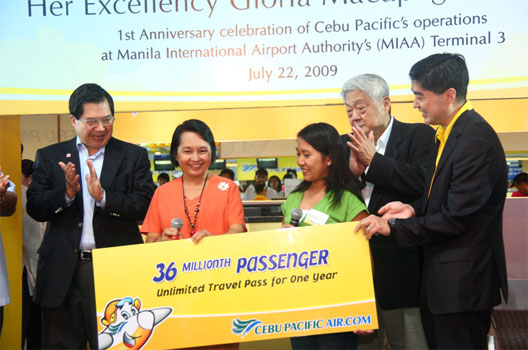
| At Ninoy Aquino International Airport (the main international gateway to the Philippines) lucky passenger Grace Geloca - (green t-shirt) looks bewildered as she claims the impressive prize from James Go, JG Summit Holdings’ CEO (owners of Cebu Pacific), Gloria Macapagal-Arroyo, (President) and Lance Gokongwei, Cebu Pacific’s CEO. |
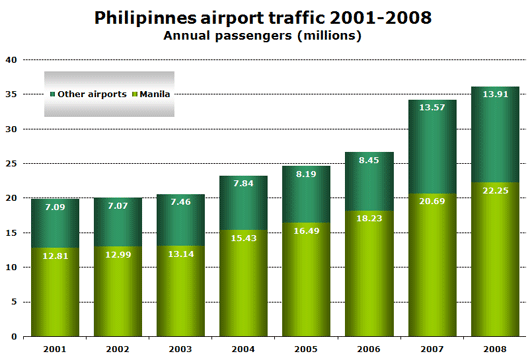
The Philippines consists of over 7,000 separate islands in the western Pacific Ocean and with an estimated population of over 90 million, air travel is playing a critical part in the country’s rapid economic development. According to OAG data there are currently 38 airports offering scheduled services. Of these just six offer international flights and three of them have just two weekly international services. This leaves Ninoy Aquino International Airport in Manila (MNL), Mactan-Cebu (CEB) and Diosdado Macapagal (CRK) as the only real international gateways. Diosdado Macapagal is also known as Clark, a reflection of its former life as Clark Air Force Base before the eruption of Mount Pinatubo in 1991.
![]() |
| Source: CAAP |
Traffic growth has been impressive in recent years though the 2006 figure for ‘Other’ airports would appear to be an underestimate as Cebu’s traffic data appears to be missing for much of the year. In 2007 Mactan-Cebu handled just over four million annual passengers while Clark processed just over half a million passengers.
Cebu Pacific and PAL dominate domestic markets
Domestic air travel is dominated by two major airlines, Cebu Pacific and Philippine Airlines. Between them they account for over 85% of the scheduled domestic capacity.
| Airline | Frequency share | Capacity share | Domestic routes |
| Cebu Pacific | 44.6% | 47.3% | 50 |
| Philippine Airlines | 34.0% | 38.3% | 37 |
| Zest Air | 11.7% | 9.2% | 18 |
| Air Philippines | 4.1% | 3.9% | 7 |
| Seair | 5.5% | 1.1% | 7 |
| Source: OAG Max Online for w/c 6 July 2009 | |||
Cebu Pacific’s position is impressive given that it only started operations after local deregulation in 1996. It now operates a fleet of some 30 aircraft, a mix of A319/A320s and ATR 72-500s. Zest Air (formerly known as Asian Spirit) will soon be launching several new routes from Cebu to further increase its market share.
The busiest domestic airports after Manila and Cebu are Davao (DVO), Iloilo (ILO), Caticlan (MPH) and Cagayan de Oro (CGY). Both Davao (1.7 million) and Iloilo (1.1 million) handled more than one million passengers in 2008.
![]() |
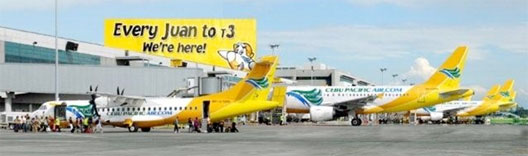
| Cebu Pacific moved all its domestic and international services into Manila’s (once unused) Terminal 3 last year. The fleet comprises 21 A319 and A320s and 8 ATR 72-500s - all fly to 32 domestic and 14 international destinations. |
Hong Kong leading international market
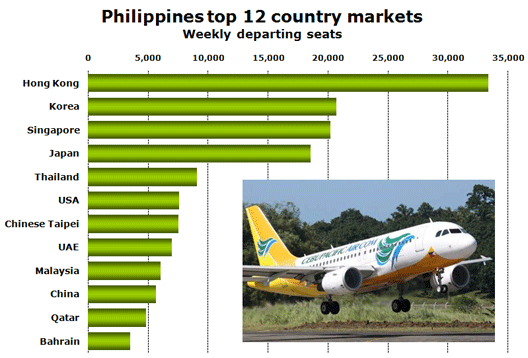
A total of 23 countries can be reached non-stop from airports in the Philippines. The leading country market is Hong Kong with 130 weekly departures. Cathay Pacific, Cebu Pacific and Philippine Airlines all offer at least four daily flights from Manila, while Cebu Pacific also operates daily from Cebu and Clark.
![]() |
| Source: CAAP |
Non-stop flights to the US are provided by Philippine Airlines to Honolulu, Los Angeles and San Francisco, while the airline also serves Vancouver. The MEB3 airlines are all present and correct with at least daily departures to Abu Dhabi, Doha and Dubai, while Gulf Air and Saudi Arabian also serve Manila from their home bases.
The only non-stop service to Europe is currently provided by KLM which operates daily flights to Amsterdam.
See also
- 14 November, 2008 (Saturday 8 November - Friday 14 November): (14 November, 2008)">New routes launched during the last week
(Saturday 8 November - Friday 14 November): - 20 February, 2009(Saturday 14 February - Friday 20 February): (20 February, 2009)">New routes launched during the last week
(Saturday 14 February - Friday 20 February): - 18 July, 2008(Saturday 12 July - Friday 18 July 2008) (18 July, 2008)">New routes launched during the last week
(Saturday 12 July - Friday 18 July 2008) - 6 March, 2009(Saturday 28 February - Friday 6 March): (6 March, 2009)">New routes launched during the last week
(Saturday 28 February - Friday 6 March): - 21 November, 2008(Saturday 15 November - Friday 21 November): (21 November, 2008)">New routes launched during the last week
(Saturday 15 November - Friday 21 November):
Thursday, July 23, 2009
Thursday, June 25, 2009
Airlines pull 14m flights in next six months-24 June, 2009
Monday, June 1, 2009
Airlines going discount route
At Noi Bai airport
The economic recession has prompted the national flag air carrier Vietnam Airlines to travel to 
Vietnam Airlines has set up a representative office on one of the most famous and up-scale boulevards in
Moreover, it has announced preferential airfares for travel firms and special airfare programmes for those eligible for the state’s preferential treatment policy.
The budget airline Jetstar Pacific has been following a flexible policy under which it cuts or offers more flights after considering numbers of passengers. On May 26, Jetstar Pacific announced the termination of Hanoi-Can Tho flights from June 1, while it will provide more flights on north-south air routes, increasing the number of Hanoi-Da Nang/HCM City flights.
The budget airfare for the
Jetstar Pacific’s Deputy General Director Nguyen Thi Thuy Binh said that the airline has contacted passengers who booked tickets for Hanoi-Can Tho flights after June 1, and has arranged seats for them on HCM City-Hanoi flights and given every passenger a rebate of 100,000 dong.
Foreign airlines have also been trying to do more things for passengers. Hong Kong Airlines offers $0 fares (passengers only have to pay security fee, fuel and airport tax) to passengers with Vietnamese nationality who have the same birthday as President Ho Chi Minh (May 19) and fly from
VietNamNet/TP
Thursday, January 1, 2009
2009 a Fantasy in Many Parts? - Thursday, 1st January 2009
Friday, December 19, 2008
Bangkok – here I am. But where are the others?
The airport, which opened in 2006, is the second largest in the world and was slated by the government to be Southeast Asia’s major hub handing up to 45 million passengers per year.
But that’s not going to be the case this year because the airport was shut down by protestors. People were stranded in Bangkok and others were forced to bypass the country completely. Tourists have been blocked and diverted. Many people have canceled their travel plans to the region.
After the airport’s reopening, airlines flying in and out of the airport have cut flights and planes aren’t flying at capacity. But now that I’m here, there’s zero feeling of danger. Our itinerary was a victim of the airport’s closure and we were diverted to Singapore before continuing to Laos.
It seems safe to return and there’s lots of roomBangkok, “the City of Angels” is filled with upscale and architecturally dramatic and inviting hotels. It’s estimated room occupancy is down by approximately 70%.
The country’s lucrative tourist industry accounts for up to 12 percent of the country’s GNP. Tourism experts state that the long-term effect could be very damaging to Thailand’s economy.
As December is the country’s high season, the lack of tourists isn’t simply a blow to the hotels and hospitality industry but to retailers as well. Residents from this region traditionally come to Bangkok to do their Christmas shopping. Stores cater to all tastes and budgets.
Deep discounts aboundAlready there are deep-discounted sales in the toniest of shops. A walk through the Bangkok’s famed Night Market is distressing.
Contrasted with my last visit, there was a sense of depression visible on the faces of the vendors. One said that between the airport’s closing and the downturn in the economy, she wondered whether or not things would ever be the same.
Rather than negotiating for a pair of $10 pants, (and that’s always been a part of the give and take), it was easier on my conscience to pay the full asking amount.
Twenty-four boutique hotels and eleven travel agents have launched a “One Price for All Destinations” campaign to spur domestic tourism. The package features special room rates of 2,000 baht ($60) per night per person, including accommodations, breakfast and dinner plus airport transfers.
The participating hotels are in Bangkok, Phuket, Chiang Mai, Hua Hin, Pran Buri, Krabi, Chumpon, Chiang Rai, Sukhothai, Samui and Koh Phangan. Bookings are open both for Thai and foreign tourists booked now until Feb 28 allowing eligible stays until June 30th. Normally these boutique hotels would cost about 5,000 to 6,000 baht ($150-$180) per night.
Thailand’s resorts are quiet and now is the time to snag a deep-discounted luxury villa you could never have imagined affording.
Even medical tourism is sufferingMedical tourism has become a viable and growing industry in recent years. People from all over the world are checking into private hospitals and clinics for essential procedures as well as tummy tucks and other cosmetic procedures. But, even that side of tourism has suffered; at least in the short run. One plastic surgeon said his clinic’s business has taken a dramatic drop.
It’s sad to think that Travel & Leisure magazine conducted an online poll where Bangkok was picked as the best vacation destination city. And now, it’s begging for visitors. If only I could stay longer and enjoy what the city has to offer. But I have to be home for Christmas.
Karen Fawcett is president of BonjourParis and is sorry her trip to Asia is coming to an end.
Published on December 19, 2008 ·
Friday, December 12, 2008
Asia-Pacific see internation traffic fall in Q3
Cathay Pacific celebrated the expansion of services to India in August, with 20 more flights added to make the total 28 per week. It now operates 14 flights per week to Delhi, 10 to Mumbai and four to Chennai.
The Association of Asia Pacific Airlines currently consists of 17 members - Air New Zealand, All Nippon Airways, Asiana Airlines, Cathay Pacific Airways, China Airlines, Dragonair, EVA Airways, Garuda Indonesia, Japan Airlines, Korean Air, Malaysia Airlines, Philippine Airlines, Qantas Airways, Royal Brunei Airlines, Singapore Airlines, Thai Airways International and Vietnam Airlines. Each month the association reports provisional international traffic figures for all its members combined. Analysis of year-on-year data reveals that growth has been positive for most of the last three years until July of this year.
Source: AAPA
In the third quarter of 2008 international passenger numbers fell by 3.6% to 35.9 million. Average load factors fell around 3% as capacity remained broadly unchanged. This compares with the second quarter of 2008 when international passenger numbers were still increasing by 2.6%.
The disruption caused by recent events in Thailand will do doubt have some effect on the figures for November and December as Bangkok is the region’s fourth busiest airport.
Taipei has most seats per aircraft movement
An analysis of the top 15 Asian airports reveals that for this winter at three of the top 15 airports the average aircraft size exceeds 250 seats. Taipei leads the way with 269 followed by Tokyo Narita (with 265) and Hong Kong (with 260).
Source: OAG Max Online for w/c 1 December 2008
For comparison, the average aircraft movement at London Heathrow this winter has 193 seats. At Amsterdam the average aircraft movement has 140 seats while at Frankfurt it has 161.