Showing posts with label manila. Show all posts

Thursday, February 5, 2015

Manila says China starts dredging at another reef in disputed waters

Manila says China starts dredging at another reef in disputed waters


1631996-eastseaatuj-xuli

Recommend stories


An alleged Chinese land reclamation project on what is internationally recognized as the Johnson Reef in the East Sea, the Vietnamese term for the South China Sea. Photo credit: AFP/JIJI

China has started dredging around the disputed Mischief Reef in the South China Sea, a Philippine navy commander said on Thursday, signalling Beijing may be preparing to expand its facilities in the area.

Last year, Chinese President Xi Jinping tried to set Southeast Asian minds at ease over the country’s regional ambitions, but Beijing’s reclamation work in the Spratlys underscore its drive to push claims in the South China Sea and reassert its rights.

China has already undertaken reclamation work on six other reefs it occupies in the Spratlys, expanding land mass five-fold, aerial surveillance photos show. Images seen by Reuters last year appeared to show an airstrip and sea ports.

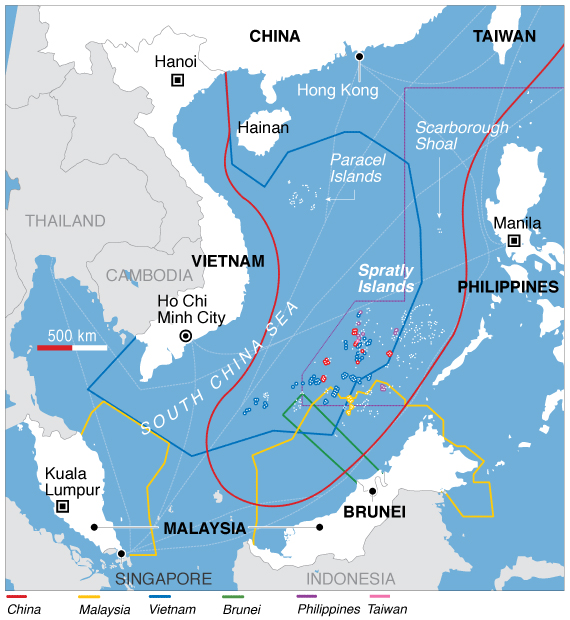
China has claims on almost the entire South China Sea, which is believed to have rich deposits of oil and gas. Brunei, Malaysia, the Philippines, Vietnam and Taiwan also have claims on the sea where about $5 trillion of ship-borne trade pass every year. Vietnam calls the waters the East Sea.

Rear Admiral Alexander Lopez, commander of the Philippine military’s western command, told reporters on Thursday a Chinese dredging ship was spotted at Mischief Reef, about 135 km southeast of the island of Palawan.

“We don’t know what they plan to do in Mischief,” he said. “They have long been doing that, only that it was Fiery Cross that got a lot of attention because that was on a bigger scale.”

IHS Jane’s said in November images it had obtained showed the Chinese-built island on the Fiery Cross Reef to be at least 3,000 meters (1.9 miles) long and 200-300 meters (660-980 ft) wide.

Lopez did not say when China started the dredging work or give any details on the extent of reclamation at Mischief Reef, saying only the work had been “substantial”.

Surveillance photos that were taken of Mischief Reef last October showed no reclamation work in the area.

The photos, seen by Reuters, showed two structures, including a three-storey building sitting on an atoll, equipped with wind turbines and solar panels.

China occupied Mischief Reef in 1995, building makeshift huts, which Beijing claimed provided shelter for fishermen during the monsoon season. But, China later built a garrison in the area, deploying frigates and coast guard ships.

In 2002, Southeast Asian states agreed with China to sign an informal code of conduct in the South China Sea to stop claimant states from occupying and constructing garrisons in the disputed Spratlys.

Last year, the Philippines and Vietnam protested China’s reclamation work as a violation of the informal code.

North of Mischief Reef, China on Thursday defended the actions of a coast guard vessel in the Scarborough Shoal after the Philippines accused it of ramming three fishing boats.

China’s coast guard sent a dinghy to drive them away and slightly bumped one of the fishing vessels,” Chinese Foreign Ministry spokesman Hong Lei said at a daily news briefing in Beijing.

“We ask that the Philippines strengthen education and indoctrination of its fishermen to prevent such incidents from happening again.”

A Philippine military spokesman, Colonel Restituto Padilla, described China’s action as “alarming” saying the local fishermen were trying to seek shelter due to bad weather.

Tuesday, July 31, 2012

Hanoi and Manila angry at Chinese bullying

Challenging Beijing in the South China Sea

Hanoi and Manila Take Different Approaches
Vietnam and the Philippines are both angry at what they see as Chinese bullying in the South China Sea, but Hanoi and Manila are taking different approaches to the standoff over rival maritime claims.
Vietnam is strengthening military ties with the United States, India, Singapore, Japan, Australia, and Russia, building what Joshua Kurlantzick of the U.S. Council on Foreign Relations calls a “web of ad hoc bilateral relationships to shore up their security.”
With Vice Admiral Viktor Chirkov in talks to return Russia’s navy to Cam Ranh Bay, Kurlantzick says Hanoi is sending a clear signal to Beijing that it is not alone in the South China Sea.
Philippines President Benigno Aquino III tells his parliament July 25 that Manila will stand firm against Chinese territorial claims on the Spratly Islands in the South China Sea. Photo: AP
“It speaks to Vietnam’s utilization of many different partners in order to back itself up,” says Kurlantzick, a Southeast Asia specialist. “Vietnam is in a stronger position that the Philippines simply because for years the Armed Forces of Philippines basically did nothing to upgrade its navy.”
Filipino President Benigno Aquino III is trying to catch up, placing an order for more attack helicopters after China opened a new base in the Paracel Islands to patrol waters claimed by both Vietnam and the Philippines.
Now, more powerful countries such as Vietnam are looking to other solutions after China managed to stymie an attempt to address the maritime claims through the Association of Southeast Asian Nations (ASEAN). But weaker nations such as the Philippines are trying to broaden the mediation effort by taking the dispute to the United Nations.

ASEAN or the United Nations
That move has little support in Washington, says Bonnie Glaser, a senior fellow on China studies at the Center for Strategic and International Studies (CSIS). She says the Obama administration is pushing instead for direct code-of-conduct talks between China and ASEAN.
“The United States doesn’t view this as a U.S./China issue,” Glaser says. “Taking it to the U.N. would make it seem like a U.S./China issue because none of the other permanent Security Council members really have any stake in this issue at all.”
“The Philippines is throwing everything at the wall because they are in the weakest position and they want to see what sticks,” Kurlantzick says. “You have senior Philippine national security officials coming repeatedly to the U.S. and asking for certain types of upgrades. You have them sort of trying to maneuver the U.S. into confirming that because of our relationship with them in the past, the South China Sea would come under that” Mutual Defense Treaty.
Though weaker militarily, Kurlantzick says the Philippines has a more open and democratic political system than Vietnam and is less susceptible to public anger over Chinese aggression.
“Certainly President Aquino has taken some strong steps, and he is not going to back down on certain issues. But at the same time, it’s a much more mature political system,” Kurlantzick says. “So I think public pressure works a number of different ways, and the government is less straightjacketed by nationalistic tendencies because its legitimacy can rest on a number of different foundations.”
Demonstrators march through Hanoi July 22 protesting China’s claims on South China Sea territory also claimed by Vietnam. Photo: Reuters
With regular, carefully-guided Sunday protests against China in both Hanoi and Ho Chi Minh City, the Vietnamese government is trying to stay ahead of public opinion at a time when Glaser says nationalist sentiments are running high in Vietnam, the Philippines, and China.
“This has certainly become imbued with a sense of, ‘These are our rights.’ It has become a very sensitive issue,” Glaser says. “On the blogosphere all over China, Chinese citizens, netizens, are calling for their government to defend their interests. And I do believe that the Chinese leadership is very wary of being seen as too soft and not protecting Chinese sovereignty and territorial integrity.”
This is especially so as Washington makes its “Asia Pivot” in military strategy, repositioning Marines and aircraft carrier task forces in the Pacific.
China is pressing huge territorial claims, outlined in red, in the South China Sea region. The Philippines, Vietnam and others are also making claims.

Washington’s ‘Asia Pivot’
“Countries are worried about U.S. staying power, about whether or not there will be a counter-weight to China,” Glaser says. “We are trying to say, ‘Yes. We will be there to ensure peace and security in the region.’ It’s problematic because we don’t want to embolden other countries to engage in a confrontation with China.”
To the extent that they do, Glaser says that would be an unintended consequence of the Asia Pivot.
“Perhaps some of the actions taken by the Philippines might not have been taken if this series of events had taken place at a time when the United States was not seeking to refocus on Asia.
“When we are asked by President Aquino to say something more forcefully about how we will defend the Philippines if it is attacked, this puts the U.S. in a very difficult position,” the CSIS regional expert says. “We don’t want to leave the Philippines in a weak position. But at the same time we don’t want to tell the Philippines, ‘We’ve got your back.’”

Saturday, April 28, 2012

S. China Sea–the next big power playground | The Jakarta Post

S. China Sea–the next big power playground

Kor Kian Beng, Asia News Network (The Straits Times), Beijing | Wed, 04/25/2012 12:39 PM
A | A | A |
Despite strenuous efforts by China to keep other global powers out of the South China Sea, recent movements suggest that Beijing has failed.
The United States, whom China is most keen to block, has boosted its presence there in the last week. It is holding military exercises with the Philippines and having a naval exchange with Vietnam.
As if that is not irritating enough for Beijing, even Russia has muscled in. Its state gas giant Gazprom signed a deal this month with Vietnam to explore reserves in the resource-rich sea.
It mirrored a similar exploration pact that India signed with Hanoi last year, and comes on the back of Japan's long-held influence in the region through years of infrastructure investments in ASEAN.
The waters China regards as its backyard are fast becoming the world's “next big power playground”, say observers.
And much like the Balkan states in the last century, when big countries fought proxy wars in the region, many fear that the sea could become a conflict zone.
Singapore’s Institute of Southeast Asian Studies senior fellow Ian Storey calls it a potential “focal point” of great power competition.
The big boys hunger for control over the sea lanes where one-third of the world's shipping trade passes through, he said.
“As tensions continue to simmer in the South China Sea, and the waters become increasingly crowded with new warships, I think it's just a question of time before we see a clash at sea leading to fatalities,” he added.
None of the global giants wants to give China free rein over such a precious piece of watery real estate. They have the support of smaller ASEAN countries that are contesting China's claims and seeking to bolster their claims by internationalizing the situation, say observers.
Foreign policy expert Yang Cheng from the East China Normal University said some claimants see merits in playing one major power against another.
Doing so could help the smaller players glean some benefits from the major powers clamoring for their support, he added.
“It seems like the tragedy of great power politics is now the smaller countries' comedy,” said Yang.
He said claimants could also become bolder in challenging China, believing that its army, the world's largest, would be restrained in its response so as to avoid conflicts with major powers.
This could be why Manila took a more hardline approach in the two-week stand-off with China over the Scarborough Shoal, which lies north of the Spratly Islands claimed by China, the Philippines and Vietnam, among others.
“But such mindsets could be dangerous. There is a limit to China's tolerance, especially as the solution to the territorial issues directly relates to the legitimacy of the authorities and many Chinese want the government to be more hardline now that the country is stronger,” said Yang.
Also, conflicts may occur if major powers misread conflicting signals and inconsistent policies emanating from China – a possible result of a struggle for money and power between agencies and local governments, said the International Crisis Group in a report this week.
The International Crisis Group’s Northeast Asia project director Stephanie Kleine-Ahlbrandt said: “Some agencies are acting assertively to compete for a slice of the budget pie, while others such as local governments are focused on economic growth, leading them to expand their activities into disputed waters.”
“Their motivations are domestic in nature, but the impact of their actions is increasingly international.”
To assert its primacy, Beijing has been on a public relations drive to win more ASEAN friends.
Thai Premier Yingluck Shinawatra met top-ranked Chinese leaders in Beijing last week, while China's fourth-ranked leader Jia Qinglin visited Brunei.
Analyst Li Mingjiang of the S. Rajaratnam School of International Studies believes the visits are examples of China reassuring its neighbors of its “benign and cooperative intention”.
“These efforts will partly be helpful in stabilizing the South China Sea contention,” he added.

Friday, October 2, 2009

Tens of thousands in Philippines flee new typhoon

MANILA, Philippines Filipinos braced Friday to be whipped by powerful winds and pelted with rain from a second typhoon in eight days, fleeing by the tens of thousands from low-lying areas and suspending cleanup operations in the flooded capital.

President Gloria Macapagal Arroyo declared a nationwide "state of calamity" and ordered mass evacuations of six provinces in the path of Typhoon Parma, which was expected to hit the main island of Luzon midafternoon Saturday.

Parma threatened to expand more than a week of destruction in the Asia-Pacific region that has claimed more than 1,500 lives so far: an earthquake Wednesday in Indonesia; a tsunami Tuesday in the Samoan islands; and Typhoon Ketsana across Southeast Asia.

*
photo gallery Thousands evacuated ahead of Philippine storm
*
23 dead as Typhoon Ketsana roars into Vietnam
*
Flood kills 246 in Philippines, survivors seek aid
*
Flood kills 246 in Philippines, survivors seek aid

Cedric Daep, a top disaster official in the Philippines' Albay province, said officials there had evacuated almost 50,000 people to shelters on higher ground.

Police and the military were helping people to leave flood- or landslide-prone areas across the north and east, where heavy rain fell on Friday.

"Our objective is zero casualties," Daep told The Associated Press.

Parts of the capital, Manila, were still awash from the worst floods in 40 years caused by Ketsana on Sept. 26. Almost 300 people were killed and more than 2 million had swamped homes.

In Quezon City, where muddy brown water was still chest-deep, residents turned from cleaning up after Ketsana to trying to secure their belongings from the risk of more flooding.

"We do not know what to do or where we can go," said resident Bebang De Los Santos. "We don't have a way out and this is the only place that is safe, but we don't have any shelter."

In Albay, laundry worker Mely Malate fled with her husband and six children to an evacuation center, spurred by memories of a storm three years ago.

"During the last typhoon, we were trapped inside the house by the flood waters and we had to climb to the roof," she said. "We are scared whenever there is a storm. When we left this morning, the river was already higher than normal."

Arroyo's "state of calamity" declaration of frees up government funds to respond to emergencies.

Parma was forecast to cross the coast of the main island of Luzon north of Manila, packing sustained winds of up to 120 mph (195 kph), gusting up to 140 mph (230 kph). If the sustained winds reach 133 mph (215 kph) Parma will get the official designation "super-typhoon," the government's weather bureau said.

It was expected to continue east into the South China Sea by Sunday, though it's direction from there was uncertain. As many as 20 major storms buffet the region each year.

In southern Taiwan, the county where about 700 died when Typhoon Morakot hit in August plans to evacuate several villages prone to flooding and mudslides if a warning for Parma is issued, said county chief Yang Chiu-hsing.

Earlier this week, the storm that flooded the Philippines, Ketsana, then hit Vietnam, Cambodia and Laos; 293 died in the Philippines, 99 in Vietnam, 14 in Cambodia and 16 in Laos.

Lake Laguna on the edge of the capital rose by more than 3.3 feet (one meter) as Ketsana passed and was in danger of spilling over into districts near Manila housing some 100,000 people, said Ed Manda, general manager of the Laguna Lake Development Authority.

At a briefing Friday evening, weather bureau administrator Frisco Nilo said a high-pressure system near Hong Kong had caused Parma to slow slightly and might cause it to change direction, though it was still likely to hit the main northern Philippine island of Luzon.
Associated Press writers Teresa Cerejano and Oliver Teves in Manila, Annie Huang in Taipei, Taiwan, Minh Van Tran in Hanoi, Vietnam, and Ambika Ahuja in Bangkok contributed to this report.

Friday, July 24, 2009

Manila dominates Philippines traffic as Cebu Pacific and Philippine Airlines vie for domestic dominance

Manila dominates Philippines traffic as Cebu Pacific and Philippine Airlines vie for domestic dominance

24th July 2009 | Country Feature | No Comments »
Image: 36 millionth passenger
At Ninoy Aquino International Airport (the main international gateway to the Philippines) lucky passenger Grace Geloca - (green t-shirt) looks bewildered as she claims the impressive prize from James Go, JG Summit Holdings’ CEO (owners of Cebu Pacific), Gloria Macapagal-Arroyo, (President) and Lance Gokongwei, Cebu Pacific’s CEO.

The Philippines consists of over 7,000 separate islands in the western Pacific Ocean and with an estimated population of over 90 million, air travel is playing a critical part in the country’s rapid economic development. According to OAG data there are currently 38 airports offering scheduled services. Of these just six offer international flights and three of them have just two weekly international services. This leaves Ninoy Aquino International Airport in Manila (MNL), Mactan-Cebu (CEB) and Diosdado Macapagal (CRK) as the only real international gateways. Diosdado Macapagal is also known as Clark, a reflection of its former life as Clark Air Force Base before the eruption of Mount Pinatubo in 1991.

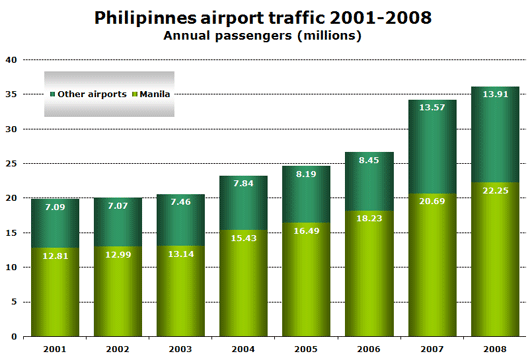
Chart: Philipinnes airport traffic 2001-2008
Source: CAAP

Traffic growth has been impressive in recent years though the 2006 figure for ‘Other’ airports would appear to be an underestimate as Cebu’s traffic data appears to be missing for much of the year. In 2007 Mactan-Cebu handled just over four million annual passengers while Clark processed just over half a million passengers.

Cebu Pacific and PAL dominate domestic markets

Domestic air travel is dominated by two major airlines, Cebu Pacific and Philippine Airlines. Between them they account for over 85% of the scheduled domestic capacity.

Airline Frequency share Capacity share Domestic routes
Cebu Pacific 44.6% 47.3% 50
Philippine Airlines 34.0% 38.3% 37
Zest Air 11.7% 9.2% 18
Air Philippines 4.1% 3.9% 7
Seair 5.5% 1.1% 7
Source: OAG Max Online for w/c 6 July 2009

Cebu Pacific’s position is impressive given that it only started operations after local deregulation in 1996. It now operates a fleet of some 30 aircraft, a mix of A319/A320s and ATR 72-500s. Zest Air (formerly known as Asian Spirit) will soon be launching several new routes from Cebu to further increase its market share.

The busiest domestic airports after Manila and Cebu are Davao (DVO), Iloilo (ILO), Caticlan (MPH) and Cagayan de Oro (CGY). Both Davao (1.7 million) and Iloilo (1.1 million) handled more than one million passengers in 2008.

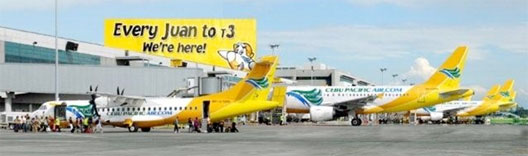
Image: Cebu Pacific
Cebu Pacific moved all its domestic and international services into Manila’s (once unused) Terminal 3 last year. The fleet comprises 21 A319 and A320s and 8 ATR 72-500s - all fly to 32 domestic and 14 international destinations.

Hong Kong leading international market

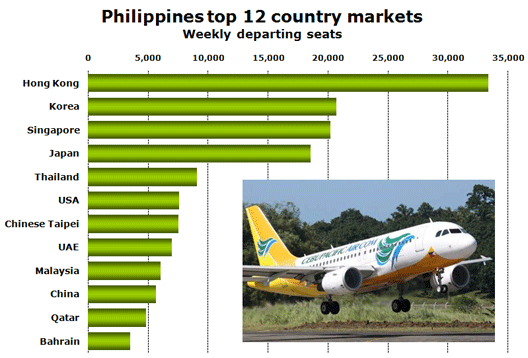
A total of 23 countries can be reached non-stop from airports in the Philippines. The leading country market is Hong Kong with 130 weekly departures. Cathay Pacific, Cebu Pacific and Philippine Airlines all offer at least four daily flights from Manila, while Cebu Pacific also operates daily from Cebu and Clark.

Chart: Philippines top 12 country markets
Source: CAAP

Non-stop flights to the US are provided by Philippine Airlines to Honolulu, Los Angeles and San Francisco, while the airline also serves Vancouver. The MEB3 airlines are all present and correct with at least daily departures to Abu Dhabi, Doha and Dubai, while Gulf Air and Saudi Arabian also serve Manila from their home bases.
The only non-stop service to Europe is currently provided by KLM which operates daily flights to Amsterdam.


See also

Saturday, June 20, 2009

Nuclear power emerges as green option for Asia

MANILA: Nuclear power is emerging as a key option as a source of "green energy" for most developing Asian countries, as they seek to stem the spike in greenhouse gas emission that came with the region's economic success, experts who participated in a Manila forum said.

The growing concern over climate change and how it will hurt the region's environment, human health and economy has forced economic planners, advocates and business leaders in Asia to search for a stable energy source that can moderate the carbon emissions, China's Xinhua news agency cited them as saying.

"Developing Asian countries whether they like it or not should take a look at nuclear power as a source of energy," said Piyasvasti Amranand, chief advisor of the Bangkok-based Energy for Environment Foundation and former Thai energy minister at the closing of the Asia Clean Energy Forum on Friday.

The three-day forum was organised by the Asian Development Bank (ADB) and the United States Agency for International Development.

Piyasvasti said renewable energy sources such as wind power and biofuels were indeed environment-friendly, but they might not be enough to meet the needs of the fast-growing region.

In Thailand, for instance, Piyasvasti said it would be difficult to rely on biofuels for its energy requirements as it doesn't have enough land for fuel crops like oil palm.

"Nuclear power is proven technology and it won't contribute to greenhouse gas emissions," Piyasvasti said.

From 1990 to 2006, the average annual 3.5 percent GDP growth rate in Asia resulted to annual energy consumption growth rate of 3.2 percent.

But the region's dependence on fossil fuels has also raised its greenhouse gas emissions, and now accounts for 30 percent of the world's nearly 30 billion metric tonnes carbon emissions, the Tokyo-based Asia Pacific Energy Research Centre (APERC) said in a report.

According to APERC, Asia consumed 2,558 million tonnes of oil equivalent (MTOE) in 2006, most of which were sourced from coal and oil.

The threat of climate change won't stop Asian economies from using fossil fuels, but they will definitely include other energy sources that won't contribute to global warming.

Naoko Doi, senior economist at the Institute of Energy Economics in Japan, said that the trend is moving towards the development of low-carbon technology and diversifying of energy sources which include renewable and nuclear power.

China and India, the twin biggest economies and largest energy consumers in Asia, are actively developing nuclear power in line with their respective policies on energy security and clean energy.

China's top economic planning body the National Development and Reform Commission in May announced that it has developed an energy development plan that focuses on increasing the share of nuclear power and renewable energy such as wind and solar power to their total energy sources.

Currently, coal accounts for 70 percent of the roughly 980 MTOE that China consumes each year, while renewable and nuclear energy only account for less than 10 percent.

The Indian government, on the other hand, plans to increase the production of nuclear power generation from its present capacity of 4,000 megawatts to 20,000 megawatts in the next decade, according to data issued by the Asian Development Bank.

Last year, the Indian government sealed a nuclear pact with the U.S. government.

The pact will give India access to nuclear reactors, fuel and technologies from the U.S. and supported India' s plan to develop its nuclear power capacity.

The Intergovernmental Panel on Climate Change (IPCC) had endorsed nuclear energy as one of the "commercially available climate change mitigating technologies," IPCC chairman Rajendra K. Pachauri, described nuclear energy as a "green technology" as it doesn't contribute to carbon emission that causes the global warming.

But not everyone agrees with this view.

Environmental watchdog Greenpeace International has been actively campaigning against nuclear energy, arguing that it's not only expensive and inefficient but also harmful to the environment.

"When it comes to combating climate change, nuclear energy cannot deliver the necessary reductions in greenhouse gas emissions in time; any emissions reductions from nuclear power will be too little, too late and come at far too high a price," according to a paper issued by Greenpeace in April.

Greenpeace said that no one has yet found a solution to the hazards posed by nuclear waste.

"Despite the billions already invested in research and development for dealing with radioactive waste, new experiments are still being presented as 'solutions'; methods that will not be ready for a long time, may never be commercially viable or do little to solve the long term waste problem," the group said.

For Pachauri, nuclear energy may be an option for those who want to develop green technology.

But he admits that nuclear power isn't for everyone.

"Nuclear energy provides a solution (to our climate change problem), but it’s not a solution (fit) for every country in the world.

“You need a certain infrastructure, engineering skills and safety standards that are followed very strictly.

“Not every country can ensure that," he said. - Bernama

Sunday, January 18, 2009

Kidnappers demand 5 million dollars for kidnapped ICRC staff | TopNews Law

Manila - Islamist militants holding captive three staff of the International Committee of the Red Cross (ICRC) are planning to demand at least 5 million dollars in ransom for their hostages' freedom, military sources said Sunday.
According to military intelligence sources, Swiss Andreas Notter, Italian Eugenio Vagni and Filipino Mary Jean Lacaba are being held in the jungles of Indanan town on Jolo island, 1,000 kilometres south of Manila.
The kidnappers, estimated to number 25, are led by rebel commander Albader Parad and Akmad Jumdail alias Dr. Abu Pula of the Islamist Abu Sayyaf group.
The sources said "Parad is planning to demand 5 million dollars while Dr. Abu is reportedly planning a still unknown political demand" for the safe release of the ICRC team, who were abducted on January 15.
The Philippine military officially declined to comment on the information or give updates about efforts to rescue the three abducted ICRC staff.
"We are suspending operational updates on the military's efforts on the kidnapping," said military spokesman Lieutenant Colonel Ernesto Torres.
"This is being done to avoid the possibility of compromising our operations and unnecessarily risking the safety of the victims," he added.
Abdusakur Tan, governor of the Sulu province, which includes Jolo island, said he was heading a coordinating centre that was overseeing the hostage situation.
But he also refused to give out updates on the kidnapping.
"I cannot say at the moment because we have many plans and we don't want to reveal our actions," he said, when asked if the kidnappers have made contact or issued any demands.
Tan urged the ICRC not to negotiate directly with the kidnappers, saying this would be "costly."
On Saturday, the ICRC said the three staff had been able to call their office and told colleagues that they were unharmed.
The agency has declined to say if ransom has been demanded for the ICRC staff, who were in Jolo to oversee a water and sanitation project in the provincial jail when they were abducted.
Jean-Daniel Tauxe, head of the ICRC delegation in Manila, said the agency had no additional information about the whereabouts of the abducted staff or who is holding them.
"We are not in a position to comment further, since our main priority is ensuring that nothing jeopardizes their safety, but it goes without saying that their families, as well as their colleagues, are hoping for their safe and swift return," he said.
The al-Qaeda-linked Abu Sayyaf rebel group has been responsible for deadly terrorist attacks in the Philippines.
It is also notorious for high-profile kidnapping-for-ransom cases, including the abduction of 21 European tourists and Asian workers from a Malaysian resort island in 2000. The hostages were ransomed off for millions of dollars before they were freed months later. dpa