Showing posts with label Laos. Show all posts

Friday, January 16, 2015

Vietnam, Cambodia reach 2015 anti-crime plan — Talk Vietnam

Vietnam, Cambodia reach 2015 anti-crime plan


1621764-avatar


Scene at the talk between Vietnam’s Ministry of Public Security and Cambodia’s Ministry of Interior. Photo: VNA

Vietnam’s Ministry of Public Security and Cambodia’s Ministry of Interior have signed a plan on their cooperation in 2015 following talks between the two ministers in Phnom Penh on January 16.

During the talks, Minister of Public Security Tran Dai Quang and Cambodian Deputy Prime Minister and Minister of Interior Sar Kheng agreed on measures to fight hostile forces’ plots and attempts aimed at undermining the traditional friendship between the two countries and harming national security and social order in each country.

They said the two sides will jointly work to combat criminal and economic offenders, especially those engaging in the trafficking of drug, women and children, cross-border smuggling by road and air, and criminals on the wanted list.

They consented to ensure security and order in border areas and the development triangle as mentioned in a joint statement of Vietnamese, Cambodian and Lao Prime Ministers during the eighth summit of Vietnam – Cambodia – Laos development triangle in Vientiane, Laos on November 25, 2014 and a joint statement reached at the second Cambodia-Laos-Vietnam ministerial meeting on anti-crime cooperation in Vietnam on July 29, 2014.

The same day, meeting with Cambodian Prime Minister Samdech Hun Sen later, Minister Quang informed the host of the outcomes of his talks with the Interior Minister.

He expressed his belief that the Cambodian people will reap more successes on their path to prosperity.

PM Hun Sen voiced his hope for stronger bilateral cooperation to ensure security and order, defeat all undermining plots and activities by hostile forces, prevent terrorism and fight all kinds of crime.


Vietnam, Cambodia reach 2015 anti-crime plan — Talk Vietnam

Sunday, October 19, 2014

Monday, February 11, 2013

Vietnamese enjoy TET


Posted: 11 Feb 2013 09:43 PM PST
A dance at the gathering in Chile
In the first days of the 2013 Year of the Snake, Vietnamese in Laos flocked to Phat Tich and Bang Long pagodas to ask for peace, wealth and luck, as well as to extend New Year greetings to each other.
It is also a chance for younger generations of Vietnamese in Laos to discover their culture.
They also prayed for the further development of the traditional relations between Laos and Vietnam, to make their work or business in Laos more comfortable.
On the first day of the Lunar New Year (February 10), a ceremony was held in Truc Lam Pagoda in Villebon-sur-Yvette , France , to pray for peace for Vietnamese people living in Paris and its neighbouring regions.
More than 300 people including Ambassador Duong Chi Dung participated in the ceremony hosted by Buddhist Monk Thich Phuong Duong.
After the ceremony, the visitors had a chance to enjoy Vietnamese vegetarian food provided by the pagoda.
On the same day, representatives of Vietnamese monks studying in India worked with the Vietnamese Embassy in the country to hold a ceremony to greet the New Year and ask for peace.
Ambassador Nguyen Thanh Tan wished the monks good health and briefed them on Vietnam’s achievements over the past year.
On the evening of February 9 (last day of the 2012 lunar year), the Vietnamese Embassy in Sri Lanka organised a ceremony to welcome the 2013 Lunar New Year.
Among the participants were guests from the host country, ambassadors and diplomatic representatives from a number of countries, overseas Vietnamese, and Vietnamese students.
In Chile, a warm gathering was held by the Vietnamese Embassy to bring in the New Year. It attracted not only overseas Vietnamese but also guests from the host country.
Ambassador Ha Thi Ngoc Ha highlighted achievements in the relations between Vietnam and Chile in 2012, including the highest ever rise in two-way trade, which reached US$561 million, an increase of 15.26% from 2011.
(VNA)

Friday, January 18, 2013

a proposal for a Chinese power company to build a dam at Sambor

Vietnam and Cambodia tell Laos to stop $3.5bn Mekong River dam project


Food security issues lead to disagreement over concerns that dam will hit livelihood of tens of millions

Mekong River in Vientiane, Laos
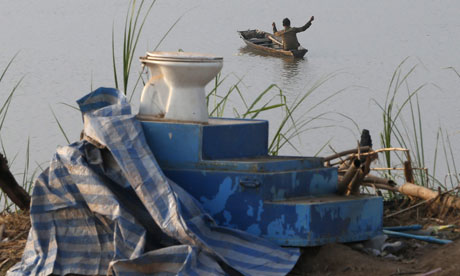
An abandoned toilet bowl sits on steps on the banks of the Mekong river, as a Laos fisherman fishes, at the river front of Vientiane. Photograph: Barbara Walton/EPA
Vietnam urged Laos to halt construction of a $3.5bn (£2.2bn) hydropower dam on Mekong River pending further study, environmental activists said on Friday.
Cambodia, downriver from the Xayaburi dam, accused Laos of failing to consult on the project, activists said. The Mekong River commission (MRC), made up of member states Vietnam, Cambodia, Laos and Thailand, held a three-day meeting in northern Laos to discuss river development projects.
The dam in northern Laos, the first of 11 planned for the lower Mekong River running through south-east Asia, threatens the livelihood of tens of millions who depend on the river's aquatic resources, activists say.
"Vietnam requested that no further developments on the Mekong mainstream occur until the ... dams study agreed upon at least year's council meeting is completed," International Rivers, an NGO devoted to river conservation, said in a statement.
"The Cambodian delegation asserted that Laos had misinterpreted the Mekong agreement." Officials from Cambodia and Vietnam were not available for comment.
The MRC is bound by treaty to hold inter-governmental consultations before dams are built. But members have no veto.
"In the absence of an agreement, other countries can disagree if they like but this can't stop Laos," said Jian-hua Meng, a specialist in sustainable hydropower at the World Wildlife Fund. "The role of the MRC is now being questioned along with the level of investment put in the organisation."
In December 2011, MRC member states agreed to conduct new environmental impact assessments before construction proceeded, but last August Ch Karnchang PCL, the Thai construction company behind the project, said it had resumed work.
A groundbreaking ceremony in November signalled the formal start of construction, said Meng.
Ch Karnchang's 50%-owned subsidiary, Xayaburi Power Co, has received a 29-year concession from the Laotian government to operate the dam's power plant and Thailand is set to buy 95% of the electricity generated.
Milton Osborne of the Lowy Institute, an Australian foreign policy thinktank, said Xayaburi marked a turning-point that would enable others to build their own dams, including Cambodia.
He described as a "monstrous disaster" a proposal for a Chinese power company to build a dam at Sambor in northeastern Cambodia, on a tributary of the Mekong. "It would be so disastrous, blocking one of the main fish migratory systems," he said.
Laos, Thailand, Vietnam and Cambodia share the lower stretches of the 2,500-mile (4,000km ) Mekong. Activists say dams could threaten food security in Cambodia and Vietnam.
The river provides up to 80% of the animal protein consumed in Cambodia and sediment and changes to river flow threaten the Mekong Delta, which contributes half of Vietnam's agricultural GDP.
Cambodia approved its own hydroelectric dams in November.
A second Cambodian project, the Lower Sesan dam in northern Stung Treng province, is a joint venture between Cambodian, Chinese and Vietnamese companies. Campaigners say it would reduce the fish catch in a country with malnutrition issues.

Saturday, September 24, 2011

Vietnam, Laos, Cambodia & Myanmar join to develop tourism


Vietnam prepares for “four countries – on destination” program


LookAtVietnam - The fact that four countries including Vietnam, Laos,
Cambodia and Myanmar join forces to develop tourism is believed to bring new big
opportunities to travel firms. However, there are still many things to be done
in order to reap the fruits.
New opportunities
Ha Long Bay, Vietnam
The participants at the 7th International Tourism Exhibition (ITE) held in HCM
City several days ago all forecast a new wave of investments in infrastructure,
hotels, resorts and entertainment complexes in Vietnam, Laos, Cambodia and
Myanmar in the time to come. Therefore, joining forces in the “four countries –
one destination” program will clearly help attract more international investors.
The Lao General Department of Tourism said that the country now has 1028 tourism
sites which are awaiting investments. Laos allows to have 100 percent foreign
ownership ratio in hotels and restaurants, and 30-70 percent foreign ownership
ratios in the travel firms. Tourism is the second foreign currency earner, just
after to mining, in Laos, where the tourism growth rate has been stable in the
last 20 years at 29 percent per annul.
In Myanmar, investors need to have at least 300,000 dollars to set up a legal
entity in the service sector. Foreign investors can team up with domestic
companies to set up joint ventures, while they have to contribute at least 35
percent of capital. Myanmar now has 36 hotel projects with 6560 hotel rooms, of
which 31 projects have been completed.
The international tourism organization has forecast that the tourists in the
world tend to flock to South East Asia and East Asia. In 2010, the region
surpassed America to become the second biggest region in the world, just after
Europe, in terms of the tourists, accounting for 22 percent of the world’s
market share. Meanwhile, the figure is expected to increase to 27 percent by
2020.
Statistics show that ASEAN now attracts 36 percent of the total number of
tourists worldwide, and 38 percent of the total revenue from tourism industry in
the region.
Analysts have also pointed out that joining forces with regional countries to
develop tourism is a wise move. The national flag air carrier Vietnam Airlines
said that four out of every 10 international tourists to Vietnam tend to visit
many different destinations, and three of them choose to visit Laos, Cambodia,
or Myanmar.
Great efforts needed
This is not for the first time regional countries sit together to discuss the
cooperation for tourism development. Vietnam, Laos and Cambodia once put forward
the idea of joining forces to attract tourists. A project on the tourism
sustainable development in Mekong sub-region was initiated and funded by ADB,
which aimed to develop infrastructure for tourism and push up the sub-regional
cooperation. However, the initial achievements remain modest
Therefore, Vietnamese travel firms say they need to prepare well for the “four
countries – one nation program). Tran Hung Viet, General Director of
Saigontourist, said that the travel firm has conducted a program on surveying
the trans-Indochina and Myanmar tours, and has released the publications
providing information about the four countries.
Meanwhile, Vietnam Airlines has increased the frequency of the flights on the
air routes to Siem Reap, Phnom Penh in Cambodia, and Vientiane in Laos to 106
flights per week from 59 flights currently.
Vuong Dinh Hai from CFIS Vietnam, a foreign investment research center, said
that it is necessary to make heavier investment in infrastructure in order to
pave the way for tourism development. More and more tourists travel to Vietnam
by sea, while cruises still have to dock at cargo ports, because there still are
no specific ports for receiving tourists.
Meanwhile, there has been no legal document on the development of the ports for
tourism. The overall strategy on seaport development until 2020 also does not
show the investment scale and the details of the tourism ports.
Source: TBKTVN

Wednesday, May 4, 2011

7-billion-dollar Lao-China railway project runs into delays - Monsters and Critics

7-billion-dollar Lao-China railway project runs into delays - Monsters and Critics: "Vientiane - Laos' ambitious plan build a 7-billion-dollar high-speed railway track linking its border with China to Vientiane has stalled on Chinese politics and social-environmental concerns.

A ground breaking ceremony planned on April 25 for the Laos-China Railway project didn't happen.

Lao Deputy Prime Minister Somsavat Lengsavat, the minister overseeing the project, blamed the missed deadline in part on the February 25 sacking of Chinese Minister of Railways Liu Zhijun for 'severe violations of discipline.'

'Frankly speaking, the ministerial reshuffle has slowed down the project a little bit because they had to conduct an internal adjustment,' Somsavat told the German Press Agency dpa.

Liu signed a memorandum of understanding on the project with the Civil and Transport Works of Laos on April 7, last year.

Over the past ten months the two sides conducted feasibility and social/environmental impact studies on the 421-kilometre rail route, which would run from Boten, Luang Namtha province to Vientiane, the capital.

The studies proved insufficient in details, particularly on the social impact of the route which will displace hundreds of families and run through important tourist destinations such as the ancient capital of Luang Prabang, a World Heritage Site.

'The on-site survey didn't meet our expectations,' Somsavat said. 'But the two sides have decided to pursue their (impact-study) efforts so we can launch this project within the year,' he added.

The Laos-China rail route would provide a 120-kilometres-per-hour freight and 200-kilometres-per-hour passenger train link from Kunming, the capital of China's Yunnan province to the China-Lao border and then on to Vientiane and Thailand, where another high-speed track is planned between Nong Khai, just across the border from Vientiane, and Bangkok.

Laos' current rail network consists of a 3.5-kilometre link over the Thai-Laos Friendship Bridge between Nong Khai and Vientiane. It is popular mainly among foreign tourists.

The giant railway expansion plan is not without its detractors.

'This is a landmark project for the government, but how much poverty will be reduced by a train link between China and Thailand,' asked one international aid official. 'The real benefits of the project go to China and Thailand; Laos is just a transit point.'

Laos is one of the world's poorest countries, with few export industries other than minerals and hydro-electricity, neither of which require high-speed train transport.

Another question is how Laos will pay for the project.

Under the MOU signed last year, China and Laos will set up a joint venture state enterprise in which China will hold 70 per cent and Laos 30 per cent.

China will provide the finance, construct the rail link with 50,000 labourers (presumably Chinese), and provide the trains, equipment and technology.

Laos' contribution, other than the land on which the track is built, remains unclear.

Somsavat discounted reports that Laos would provide China with land concessions extending 10 kilometres on both sides of the rail link.

'The Lao government has decided to use one of our mineral resources to pay back the money we have borrowed from the Chinese,' Somsavat said.

That will require a lot of minerals. Laos' gross domestic product is estimated at 6.5 billion dollars, just shy of the 7 billion that the rail link would cost.

Total mineral exports, mainly copper and gold, over the past six months amounted to about 800 million dollars, all from foreign-run mines.

There have been reports in the state-run local press, usually not known for its criticisms of the government, of people whose properties will be affected by the project openly objecting to it.

'I think if you took an opinion poll, some 60 to 70 per cent of the Lao people would be against the project,' said one professor at the National University of Laos, who asked to remain anonymous.

But in Laos, the final decision on such landmark projects lies with the communist party chiefs.

'This a decision taken by the politburo, and whatever decision the politburo takes the entire communist party and Lao people would follow suite,' Somsavat said.

'If Laos is the first country in South-East Asia to have a high-speed train it would be a great source of pride for the Lao nation,' he added.


- Sent using Google Toolbar"

Tuesday, December 14, 2010

India tempts more travellers from Viet Nam | Look At Vietnam - Vietnam news daily update

LookAtVietnam - The
Indian Consul General Abhay Thakur last week said there was good potential to
make more direct flights between Viet Nam and India, and visa facilitation for
Vietnamese travellers to the South Asian nation.


Speaking at the
presentation Incredible India: Buddhist Destination on, Abhay Thakur, stressed
Indian Prime Minister Manmohan Singh’s announcement during his visit to Viet Nam
in October that the country would grant visas on arrival to nationals of Viet
Nam, Cambodia, Laos and the Philippines from beginning of next year.

“There are at least
28,000 people travelling between India and Viet Nam every year, or about 540
travellers every week,” Thakur said at the opening of the presentation, which
was attended by leading tour operators, tourism and hospitality companies.

Thakur said there was
a good chance direct flights would be increased to two or three times weekly
between the two countries.

“It will make it
easier for Vietnamese to travel to India,” he said.

Currently, AirAsia,
Thai Airways International and Malaysia Airlines fly between Viet Nam and India
via their hubs in Bangkok and Kuala Lumpur.

Buddhist train
tour

At the presentation,
Nalin Shinghal, director of tourism and marketing at the Indian Railways
Catering and Tourism Corporation, introduced the Mahaparinirvana Buddhist
circuit train package in India to attract more Vietnamese to visit India’s
Buddhist sites, as the country is a major Buddhist pilgrimage destination.

Shinghal said the tour
starts in Delhi and takes in major Buddhist sites including Bodh Gaya where
Buddha attained enlightenment and Sarnath where Buddha preached his first
sermon.

The eight-day tour by
train also visits Lumbini in Nepal where Buddha was born and Rajgir where the
first Buddhist Council was held after Buddha attained Nirvana.

There will be two
train package tours every month until March next year, Shinghal said.

VietNamNet/Viet
Nam News

Wednesday, November 3, 2010

Laos Visa Scam in Hanoi

Laos Visa Scam in Hanoi

Hanoi, Vietnam

I want to warn travellers in Vietnam who are planning on going to Laos to be wary of hotels and guesthouses that offer to get your 1 month Laos visa for you. I had my hotel in Hanoi do it for me, and they totally scammed me. The name of the hotel is Camillia Star Hotel / T & T Travel. A tout came up to me after getting off the Sinh Café bus early in the AM from Hue and took me there. I stayed there several days. They seemed nice at first, but later when I was leaving, I was surprised how rude they were to me. Two days before leaving, I asked them to get me a one month Visa from the Laos embassy and they agreed to do it for 43 dollars. They brought back my passport the next day and I took a look at it. Nowhere on the Laos Visa does it tell you HOW LONG it is for, so be very careful. My visa has the code TR-B63 on it. I asked them if this was for a month, just to confirm. “Yeah yeah, one month, don’t worry.”
When I got to the boarder, I was informed by the Laos boarder guards that my Visa is in fact a 5 day transit visa. That’s right, it’s only good for 5 days, and is apparently for people who are just skipping through Laos on their way to Thailand or China. According to my Lonely Planet Laos book, it costs 15 dollars. So my hotel ripped me off for 28 dollars. That’s not the worst of it: Once I arrive in Vientiane, I tried to get a 15 day extension for my crappy visa, and was told that I couldn’t. My only option was to leave Laos and come back, paying another 31 dollars for the 15 day boarder visa (no 1 month visa is available at the boarder), and yet another 30 dollars at immigrations again for an additional 15 day extension. So I ended up paying over 100 dollars for my 1 month visa, and had to go through considerable time and effort to get it all straightened out, all because of those bastards at Camellia Star Hotel. Your 1 month Laos visa should say something like NI-B36, not TR-B36. Laos customs really needs to make their visas with the DURATION stamped on it (like most OTHER visas in the world), or else crooks like my guesthouse will continue to rip people off. Again, the hotel is called Camilla Star Hotel/T&T Travel.,PTE. The address is 37 Yen Thai Street, Hanoi. The guy who got my visa is named Ban. Please avoid them at all costs and warn other travelers to do the same.

    Thursday, March 18, 2010

    Luxury Travel Vietnam to Launch a New 6 Day Tour “laos for Families”

    Luxury Travel Vietnam to Launch a New 6 Day Tour “laos for Families” - SBWire: "Hanoi, Vietnam -- (SBWIRE) -- 03/17/2010 -- Luxury Travel Co., Ltd (http://www.luxurytravelvietnam.com ), Southeast Asia’s the leading destination management is pleased to announce the launch of a new 6 day tour “Laos for Families”.

    Luxury Travel Co has announced the launch of a new 'Laos for Families' six day tour. The trip includes the current capital Vientiane and the former capital Luang Prabang, the two most visited destinations of Laos.

    “This trip has been specially designed for families traveling to Laos from Bangkok or Hanoi. You are certain to be entertained by the Lao people, history, color and culture” said David Nguyen, Sales and Marketing Manager for Luxury Travel Company (http://www.luxurytravelvietnam.com).

    With stunning nature, rich in heritage and friendly people, Laos really is an undiscovered gem in Southeast Asia.

    Upon entering Vientiane, travelers will be surprised at the relaxed atmosphere and small-town charm of this capital city. This capital city is characterized by an eclectic mix of colonial-French buildings and ancient temples along with colorful markets.

    Nestled in the valleys of the mountainous north is Luang Prabang, a former royal capital and now a World Heritage Site listed by UNESCO. This enchanting city, dominated by golden-roofed temples and bright saffron-robed monks, exudes a spiritual essence that is sure to capture your soul.

    The six day tour offer includes accommodation in deluxe rooms at some of the best hotels in Laos, private boat trips on Mekong River, most meals, private transfers, excursions, elephant rides, private pick up and drop off service with an escorted English or French speaking tour guide. The tour can be booked last minute and customized to suit individual interests and schedules.

    Guests can also request, restaurant reservations, meetings with artists, cooking instructors and designers, shopping recommendations, spa reservations, tours with special-interest lecturers, and exclusive access to local activities and cultural events for an additional charge.

    For tour information and online booking, visit: http://www.luxurytravelvietnam.com"

    Saturday, March 6, 2010

    Drought drops Mekong River to nearly 2-decade low

    BANGKOK (AP) - Severe drought has dropped the Mekong River to its lowest level in nearly 20 years, halting some cargo traffic and boat tours on the Asian waterway that is the lifeblood for 65 million people in six countries, a draft report said.

    The decrease was caused largely by an early end to the 2009 wet season and low rainfall during the monsoons, rather than dams built upstream in China, according to documents drafted by the Mekong River Commission.

    "At this stage there is no indication that the existence of dams upstream has made the situation more extreme than the natural case," said the draft report seen by The Associated Press on Wednesday.

    Nongovernmental organizations have long blamed China for shrinking the Mekong and causing other ecological damage by building dams. A dozen exist or are planned on the river in the country where it originates.

    But dams have also been built or planned in other countries, principally on the river's many tributaries in Laos.

    Senior officials from Cambodia, Laos, Thailand and Vietnam met Wednesday in Luang Prabang, Laos, to discuss the river. China and Myanmar, the other two riparian countries, are not commission members.

    The report said the river level in southwestern China is the lowest in 50 years, with only half the volume that would be normal in February. Levels at mainstream measuring stations in Laos and northern Thailand are below those in 1992.

    River tour operators have stopped services on stretches of the river in Laos and cargo vessels have been halted in China's Yunnan province, the report said.

    The commission said the water scarcity has sparked fears of food shortages, lack of access to clean water and impoverishment in some of Southeast Asia's poorest regions.

    "This situation represents a wide regional hydrological drought affecting all countries in the upper part of the (Mekong) basin," the report said. It also noted the commission will hold further discussions with China but gave no details.

    Tuesday, February 23, 2010

    Special Dogs Assist in Wild Tiger Conservation Efforts in Cambodia |

    In the Asian zodiac, this is the year of the tiger but conservationists say wild tiger populations are quickly disappearing. In Cambodia, there is hope that a pair of special dogs from the United States can help save the tiger.
    A female tiger, Neang Sros, gapes while her taking a rest at the Tuek Chhou Zoo in Kampot province, some 150 kilometers south of the  Phnom Penh, Cambodia
    Photo: AP

    A female tiger, Neang Sros, gapes while her taking a rest at the Tuek Chhou Zoo in Kampot province, some 150 kilometers south of the Phnom Penh, Cambodia

    In Vietnam, Laos, and Cambodia conservationists estimate hunting and poaching have reduced tiger numbers to fewer than 30 in each country.

    In eastern Cambodia's Mondulkiri Protected Forest, conservationists have brought in unique specialists to track down the few remaining tigers.

    Sadie May and Scooby Doo are black Labrador retrievers. They are part of Conservation Canines, a project at the University of Washington in the U.S. that trains dogs to sniff for wild animal feces - also called scat.

    Scooby's handler, Jennifer Hartman, says the dogs are much faster than human researchers at finding tiger scat.

    "And we train them to sit at them, which shows us that they have something," she said. "And, we come and check it out. And, all of our dogs are extremely ball driven - they love to play. So, their reward for finding a scat is they get to play ball for two to three minutes and that keeps them good all day long."

    The handlers note where the scat is found and take a sample for analysis to determine if it is from a tiger and to check the animal's health.

    Sadie's handler, Elizabeth Seely, says they can learn a lot from animal droppings.

    "We can get hormone levels, physiological data, disease status," she said. "And, all of it combined will give us an overall population health."

    Cambodia's Mondulkiri Forest was once rich in wildlife, including tigers, but hunting and poaching largely emptied the region and killed off almost all the tigers.

    Lean Kha was a soldier with the communist Khmer Rouge in the early 1980s and admits he killed wildlife for food and trade, including 14 tigers.

    He says he became a forest ranger to make up for what he calls his past sins.

    "There were a lot of animals when I was with the Khmer Rouge and less afterwards," he said. "But, since I became an animal protector it seems like wildlife numbers are increasing."

    Conservation Canines has teamed up with Cambodian rangers and the conservation group WWF to protect wild tigers. The big cats once roamed throughout Asia, into Siberia, but conservationists say only a few thousand tigers remain in the wild; far more live in captivity. Without immediate action, the WWF says, by 2022, there may no longer be any wild tigers.

    Nick Cox, the WWF's Dry Forest and Tiger Program coordinator for the countries along Southeast Asia's Mekong River, says the forests of Cambodia's eastern plains offer an intact habitat for reviving wild tigers.

    "These are some of the largest protected areas in this part of Asia and particularly important for conservation because they hold huge potential for recovering wildlife populations including tiger," he said.

    The WWF has set up cameras in parts of the forest to capture images of elusive wildlife.

    But the last photo they got of a tiger was in 2007.

    Conservationists hope that Sadie May and Scooby Doo will find some fresher evidence of wild tigers - and help efforts to save them.

    Wednesday, January 27, 2010

    13 countries meet in bid to save wild tigers -

    HUA HIN, Thailand -- Efforts to save the wild tiger are at a critical point and it will take greater political will and cooperation from Asian countries to prevent the big cats from becoming extinct, conservationists and the World Bank warned Wednesday.

    The dire message was offered to 13 tiger range states attending the first Ministerial Conference on Tiger Conservation. The aim of the three-day meeting is to convince countries to pledge to spend more on tiger conservation and set targets for boosting their numbers - vows that would then be finalized by heads of state in September at a meeting in Vladivostok, Russia.

    "There will be no room left for tigers and other wildlife in Asia without a more responsible and sustainable program for economic growth and infrastructure," World Bank President Robert Zoellick said in a video message to the 180 delegates.
    ad_icon
    Click here!

    "The tiger may be only one species, but the tigers' plight highlights the biodiversity crisis in Asia," he said.

    Thailand's Minister of Natural Resources and Environment Suwit Khunkitti told delegates the time had come for his fellow ministers to commit to "bold commitments and actions so that we can collectively turn the tide of extinction on the tiger."

    Tiger numbers have plummeted because of human encroachment, the loss of more than nine-tenths of their habitat, and poaching to supply the vibrant trade in tiger parts. From an estimated 100,000 at the beginning of the 20th century, the number today is less than 3,600.

    John Seidensticker, head of conservation ecology at the Smithsonian National Zoological Park and chairman of the Save the Tiger Fund, recalled how he watched the Javan and Bali tigers disappear in the 20th century, adding that "losing a tiger is like losing a very close, dear relative and I'm still saddened by that experience."

    He said conservationists have over the years been successful in banning trade in tiger parts, outlawing hunting and boosting protection measures. But he said he and others never foresaw the breakneck economic development in Asia that would "pave over" key tiger forests and grasslands and create a market for tiger parts that has caused poaching to skyrocket.

    Still, Seidensticker and others said the meeting itself offered hope, showing that the bid to save tigers has gone beyond passionate environmentalists and scientists and is now being embraced by government officials and key donors like the World Bank.

    The meeting is being organized by Thailand and the Global Tiger Initiative, a coalition formed in 2008 by the World Bank, the Smithsonian Institute and nearly 40 conservation groups. It aims to double tiger numbers by 2022.

    "That this meeting is happening is hugely important," said John Robinson, executive vice president of conservation and science for the New York-based Wildlife Conservation Society.

    Robinson said the political will to save the tigers must be strengthened, funding increased for impoverished countries where tigers remain and forests expanded to ensure that tigers and humans don't clash - a problem especially common in India and Indonesia.

    Relocating communities is an option as long as the villagers are compensated adequately, Robinson said.

    The World Bank said countries must work to minimize the impact of roads, bridges and other infrastructure projects on tiger habitat - something the bank has vowed to do in projects it funds. It also called on countries to better train and equip their forest rangers and reduce corruption in the government agencies tasked with running national parks and protected areas.

    "Corruption has been rampant and all pervasive in some of the countries as far as forest management is concerned," said Keshav Varma, the Global Tiger Initiative's program director, told delegates. "Corruption is gradually and persistently nibbling away at our natural resources. The politics of money is drowning out the weak voices of the tiger and the poor."

    The 13 countries attending the meeting are Bangladesh, Bhutan, Cambodia, China, India, Indonesia, Laos, Malaysia, Myanmar, Nepal, Russia, Thailand and Vietnam.

    Thursday, January 21, 2010

    4 new routes Vietnam to Laos & Cambodia

    The government has permitted Vietnam Airlines to set up four new air routes from Vietnam to Laos and Cambodia.


    The new routes comprise Na San – Ladon – Aksag, Nam Ha – Vilao – Pakse, Cam Ranh – Mesox and Phu Cat – Bunta.

    The Na San – Ladon – Aksag will help shorten flights from Hanoi to France, Germany, Russia and vice versa.

    The Nam Ha – Vilao – Pakse routes is expected to shorten flights from Hanoi and Da Nang to Siem Reap and Phnom Penh (Cambodia). Flights from Hanoi to Siem Reap will be 25 minutes shorter.

    The Cam Ranh – Mesox route will make flights from Japan and South Korea to HCM City three to four minutes shorter while flights between HCM City – HCM City and Northwestern Asia will save between four and six minutes thanks to the Phu Cat – Bunta route.

    PV

    Tuesday, December 29, 2009

    Repatriation of Hmomg Refugees from Thailand to Laos Completed

    The repatriation of over 4,000 Hmomg ethnic refugees from a camp in Thailand to Laos was completed Tuesday morning, said Lieutenant General Niphat Thonglek, director-general of the Border Affairs Department under Thailand's Supreme Command.
    The repatriation was completed at 6.30 a.m., local time as all of the Hmong refugees are now at a shelter in Bolikhamsai Province in Laos, Lieutenant General Niphat said, Thai News Agency reported.
    The repatriation was smooth and there was no violence during the repatriation process, Lieutenant General Niphat explained.
    The repatriation was done on a humanity basis, Lieutenant General Niphat said.
    The government early Monday morning began deporting the over-4, 000 ethnic Hmong from the refugee camp in a Thai northern province of Phetchabun across the border to Laos.
    The move to clear the Huay Nam Khao refugee camp in Phetchabun began at 5:30 a.m. local time (2230 GMT Sunday), carried out by about 5,000 soldiers, officials and assisting civilian volunteers.
    After the repatriation, the empty camp is to be formally closed soon.


    Sunday, December 20, 2009

    Vietnam meets targets, finishes second at 25th SEA Games

    Vietnam meets targets, finishes second at 25th SEA Games


    Vietnam finished second in overall SEA Games rankings as the curtains came down on the 25th edition of the sporting event in Laos’s Vientiane on Friday.

    On the final day of the regional sporting event, Vietnamese shooters hit two more gold medals to add to Vietnam’s total medals tally, but the nation finished three golds adrift of champions Thailand.

    The final tally for Vietnam was 83 gold, 75 silver and 57 bronze medals.

    Despite some disappointment in a few events, the Vietnamese athletes successfully achieved the initial goal of winning more than 70 gold medals and being among the top three nations at the event.

    The shooters grabbed the most medals with 11 gold, 12 silver and eight bronze medals, followed by finswimming with eight gold, eight silver and three bronze medals.

    Vietnamese athletes earned seven gold medals each in wushu, wrestling, track and field, and judo; six golds each in pencak silat and karatedo; five golds in taewondo; four golds in shuttlecock; three golds in billiards & snooker; and two golds each in petanque, weightlifting and cycling. They won one gold each in muay, table-tennis, swimming, women’s football, springboard diving and archery.

    Thailand finished on top of the medal table with 86 gold, 83 silver and 97 bronze medals while Indonesia, the hosts of the next 26th SEA Games, came in third with 43 gold, 53 silver and 74 bronze medals.

    Malaysia was fourth with 40 gold, 40 silver and 59 bronze medals, ahead of the Philippines with 38 gold, 35 silver and 51 bronze medals. Singapore at sixth had 33 gold, 30 silver and 35 bronze medals while hosts Laos finished seventh with 33 golds, 25 silvers and 52 bronzes.

    Myanmar, Cambodia and Brunei were in the eighth, ninth and 10th spots with 12, three and one gold medal respectively. East Timor finished at the bottom with just three bronze medals.

    Source: Thanh Nien, SGGP

    Tuesday, November 24, 2009

    Hewlett-Packard extends music service to Southeast Asia

    SINGAPORE - Hewlett-Packard (HP) is entering Southeast Asia's music download market through an expanded partnership with Universal Music.

    The free service, which will be available in 18 countries across South and Southeast Asia from 28 November, gives HP customers access to Universal’s music library. The service allows 1,120 songs to be downloaded during a 12-month period, 120 of which can be downloaded for indefinite ownership. The rest will be available with a validity of one year.

    The service will specifically be available in Bangladesh, Bhutan, Brunei, Cambodia, Hong Kong, India, Indonesia, Laos, Malaysia, Maldives, Nepal, Pakistan, Philippines, Singapore, South Korea, Sri Lanka, Taiwan and Thailand.

    According to the company, this is the first music-service partnership between Universal Music and HP in Southeast Asia. “Consumers are increasingly streaming and storing their favourite music files on their PC,” said Dennis Mark, VP of marketing for HP Personal Systems Group for Asia-Pacific and Japan. “Our partnership with Universal Music will amplify consumers’ entertainment gratification and make their notebook a one-stop shop for all their multimedia needs.”

    HP’s expansion into the sector mirrors similar services launched in the region to attract young consumers. This year, Nokia rolled out its
    Comes With Music platform in the region. Motorola’s MotoMusic, which enjoyed success in China after its 2006 debut but was slower to gain ground elsewhere in the region, also launched in Singapore last year. That service closed down in June.

    HP initially launched this service in other Asia-Pacific markets last month.

    Tuesday, September 15, 2009

    First-ever conference ib Tourism Vietnam, Laos, Cambodia in

    The first-ever regional conference to encourage businesses to invest in tourism in Vietnam, Laos and Cambodia will be held in Ho Chi Minh City from September 30 to October 1.

    The HCM City Municipal Department of Culture, Sports and Tourism says that using the theme of “Three Nations – One Destination”, the conference will promote the three countries as an ideal region for tourism investment and development.

    The event will be attended by government delegations from the three countries and many other international delegates who will discuss issues related to tourism investment and development in Vietnam, Laos and Cambodia.

    The conference will provide a forum in which tourism organisations of the three countries can introduce their latest development strategies to international businesses.

    The event is being held on the sidelines of the 5th international tourism exhibition taking place in HCM City from October 1-10. This exhibition is expected to attract more than 150 international travel agents from 15 countries and territories.

    Sunday, August 16, 2009

    mekong river-Hydro Power works

    "A quiet consultation between the US and the four Mekong River ‘downstream countries’(Cambodia, Laos, Thailand and Vietnam) last month has attracted considerable attention. Here Doanh Nhan Saigon Cuoi Tuan (Saigon Businessmen’s Weekend) analyzes the unusual event.


    The Cai Rang floating market on the Mekong River (Can Tho city).


    For two reasons, the meeting organized on the sidelines of the ASEAN Foreign Ministerial Meeting in late July was special.

    One, it was the first dialogue between the ‘downstream countries’ and the US, reportedly at
    the initiative of the US Secretary of State Hillary Clinton. The five countries met to discuss cooperation on common concerns, including environment, climate change, healthcare, education and infrastructure development.

    Two, the meeting was connected to recent events: China is building many dams in the upper Mekong River basin, including the 292m Xiaowan Dam. The Chinese construction program has caused scientists to worry about harmful impacts on the lower reaches of the Mekong River.

    According to Yale Global online magazine (US), 18 dams have been built, are being built or are planned along the river’s 4350 kilometer length.

    Professor Pham Hong Giang, Chairman of the Vietnam Great Dams and Water Resources Development Association, said that the big hydro-power works on the major stream are being implemented at different phases. The construction of big dams has finished. The remaining projects have their designs completed. The water volume impounded by these hydro-power reservoirs will total around 55 billion cubic meters. The total power-generating capacity of the plants will reach 24 GW.

    Throughout history, the world has witnessed many confli"

    Friday, May 16, 2008

    Caravan, an emerging brand of Vietnam tourism

    Caravan tours are becoming a new brand of Viet Nam tourism, the head of the Travel Department under the National Tourism Administration said recently.

    Mr. Vu The Binh said about 2,000 international caravan cars have visited Viet Nam over the past three years since this way of traveling started in the country.

    If the Government approves regulations to allow both left-hand and right-hand drive cars to enter Viet Nam, the number of caravan tours to the country this year would be equal to the total of all previous years.

    Recently, the National Tourism Administration have organized different programs to further promote the domestic hospitality industry to overseas markets, such as a caravan tour through six Southeast Asian countries, and carrying out surveys in Laos and Cambodia to prepare for a planned program called “three countries – one destination”, and designed to attract more tourists to the three Indochinese nations.