Showing posts with label China. Show all posts

Friday, June 12, 2015

China building illegal islands in East Sea

US urges China to stop illegal island building in the East Sea


(VOVworld) – US Secretary of Defense Ashton Carter has asked China to stop building artificial islands in the disputed waters in the East Sea.
Fan Changlong, Vice Chairman of China's Central Military Commission and US Secretary of Defense Secretary Ashton Carter (R) in Washington, DC (Photo: Paul J. Richards/ AFP)
Carter made the call at a reception in Washington on Thursday for the visiting Fan Changlong, vice chairman of China’s Central Military Commission. The Pentagon said in a statement that Carter reiterated the US’s concern over the East Sea situation and called on all parties to seek a peaceful solution to territorial disputes in accordance with international law

Earlier Carter accused China of being out of step with international rules in its conduct in the East Sea.
The same day, the Philippines’ media quoted former Environment Minister Angel Alcala who is also an internationally prestigious scientist as saying that China’s construction in the East Sea can cause negative impacts on biodiversity, ecological balance, and fisheries resources adding that Vietnam and the Philippines will likely be the most affected.
Also on Thursday Australian Foreign Minister Julie Bishop reiterated Canberra’s stance, rejecting China’s possible establishment of an air defence identification zone (ADIZ) in the East Sea.
Speaking to the Lowy Institute in Sydney, Bishop said Australia was concerned that any unilateral action in the region could raise tensions and could ultimately end in some form of conflict.
She said Australia would object if Beijing unilaterally announces an ADIZ in the East Sea

Thursday, February 5, 2015

Manila says China starts dredging at another reef in disputed waters

Manila says China starts dredging at another reef in disputed waters


1631996-eastseaatuj-xuli

Recommend stories


An alleged Chinese land reclamation project on what is internationally recognized as the Johnson Reef in the East Sea, the Vietnamese term for the South China Sea. Photo credit: AFP/JIJI

China has started dredging around the disputed Mischief Reef in the South China Sea, a Philippine navy commander said on Thursday, signalling Beijing may be preparing to expand its facilities in the area.

Last year, Chinese President Xi Jinping tried to set Southeast Asian minds at ease over the country’s regional ambitions, but Beijing’s reclamation work in the Spratlys underscore its drive to push claims in the South China Sea and reassert its rights.

China has already undertaken reclamation work on six other reefs it occupies in the Spratlys, expanding land mass five-fold, aerial surveillance photos show. Images seen by Reuters last year appeared to show an airstrip and sea ports.

China has claims on almost the entire South China Sea, which is believed to have rich deposits of oil and gas. Brunei, Malaysia, the Philippines, Vietnam and Taiwan also have claims on the sea where about $5 trillion of ship-borne trade pass every year. Vietnam calls the waters the East Sea.

Rear Admiral Alexander Lopez, commander of the Philippine military’s western command, told reporters on Thursday a Chinese dredging ship was spotted at Mischief Reef, about 135 km southeast of the island of Palawan.

“We don’t know what they plan to do in Mischief,” he said. “They have long been doing that, only that it was Fiery Cross that got a lot of attention because that was on a bigger scale.”

IHS Jane’s said in November images it had obtained showed the Chinese-built island on the Fiery Cross Reef to be at least 3,000 meters (1.9 miles) long and 200-300 meters (660-980 ft) wide.

Lopez did not say when China started the dredging work or give any details on the extent of reclamation at Mischief Reef, saying only the work had been “substantial”.

Surveillance photos that were taken of Mischief Reef last October showed no reclamation work in the area.

The photos, seen by Reuters, showed two structures, including a three-storey building sitting on an atoll, equipped with wind turbines and solar panels.

China occupied Mischief Reef in 1995, building makeshift huts, which Beijing claimed provided shelter for fishermen during the monsoon season. But, China later built a garrison in the area, deploying frigates and coast guard ships.

In 2002, Southeast Asian states agreed with China to sign an informal code of conduct in the South China Sea to stop claimant states from occupying and constructing garrisons in the disputed Spratlys.

Last year, the Philippines and Vietnam protested China’s reclamation work as a violation of the informal code.

North of Mischief Reef, China on Thursday defended the actions of a coast guard vessel in the Scarborough Shoal after the Philippines accused it of ramming three fishing boats.

China’s coast guard sent a dinghy to drive them away and slightly bumped one of the fishing vessels,” Chinese Foreign Ministry spokesman Hong Lei said at a daily news briefing in Beijing.

“We ask that the Philippines strengthen education and indoctrination of its fishermen to prevent such incidents from happening again.”

A Philippine military spokesman, Colonel Restituto Padilla, described China’s action as “alarming” saying the local fishermen were trying to seek shelter due to bad weather.

Sunday, October 19, 2014

Sunday, August 3, 2014

Cambodia welcomes 2.2 million foreign arrivals in H1 — TalkVietnam

Cambodia welcomed 2.2 million foreign visitors in the first six months of 2014, up 5.2 percent over the same period last year, according to statistics from the Cambodian Tourism Ministry.

The Southeast Asian country is expect to receive 4.6 million foreign arrivals this year to enjoy a rise of 10 percent over 2013, Cambodian Minister of Tourism Thong Khon was quoted as saying.

By 2020, the figure is hoped to reach 8 million, helping Cambodia earn a revenue of about 5 billion USD from tourism, he added.


The statistics also showed that Vietnam, China and the Republic of Korea were the largest markets of Cambodian tourism sector.

In recent years, tourism has been one of the four major pillars of the Cambodian economy, contributing about 16 percent to the country’s GDP.

Last year, Cambodian tourism sector earned 2.5 billion USD from serving 4.2 foreign arrivals.-VNA


Cambodia welcomes 2.2 million foreign arrivals in H1 — TalkVietnam

Tuesday, June 11, 2013

Vietnamese girl travels 2 yrs 25 countries


Vietnamese girl travels to 25 countries with US$700
 VietNamNet Bridge – With only $700 in her pocket, Khanh Huyen traveled to 25 countries in Asia and Africa. In two years of travelling, the Hanoi girls learned how to cook many dishes, row, hike, act in films and write.


Khanh Huyen in Egypt. Photo: NVCC

After graduating from the high school for gifted students of the National University of Hanoi, Nguyen Thi Khanh Huyen decided to work immediately without studying at college. 

When Huyen was tired of work her job in Malaysia, she flashed the idea to travel to some countries. However, the trip lasted for two years, taking her to 25 countries.

"When I was young, I used to say to my mum that I wanted to travel around the world. At that time she only smiled and though that I told a joke. I also thought that was my outburst and I could not do it. But it is amazing that I had such a long journey," Huyen said.

In May 2010, Huyen left Malaysia to some countries in Asia and Africa. She stayed in India for four months, then three months in Nepal 3, another three months in Israel.

In two years travelling over different lands, Huyen always looked for ways to save money for the trip. As a member of the Couch Surfing network in the world (sharing accommodations), Huyen was provided with free accommodations in the countries she visited by other members of the Couch Surfing network. They also helped her integrate into local communities to learn about their lives and culture. 

Huyen was also willing to sleep at bus stops, on the street, and on the beach as long as they gave her the sense of security. She even slept in police stations several times.

"Once I slept on the beach of the Red Sea (Israel). The weather was very hot during the day but it was very cold at night. I had to wear all of my clothes in my backpack but I was still cold. In Nepal, I had to sleep at police stations several times. I had to be very patient to explain for local people that I was traveling. Perhaps I looked naïve so they had compassion for me," Huyen said with a smile.

She regularly walked, for up to 40-50km a day, or hitched a ride because according to Huyen "hitchhiking is very simple. I stood on the road to catch people for a ride." 

Once she hitchhiked a truck in Ethiopia and overslept in the car. The car took her 200km over her scheduled destination. The driver dropped Huyen in a strange city that she had never heard of its name. But Huyen found out that this was a very interesting place after a few days discovering the city.

She traveled from one place to the other. When she was out of cash, she found a job to do. In India, she starred as a popular actor and played in commercial ads. In Nepal, she participated in organizing parties for a club. She wrote for a website in Israel, worked in a casino in Tanzania... 

Huyen said that these jobs did not require in-depth knowledge, just a vivacious, dynamic, bold person. These simple works were paid for the hour, immediately, so she still had time to explore destinations.

"Each passing day I had different memories and different experiences. In two years, I learned many things which are as important as the knowledge that I learnt for 12 years at the school," Huyen said. 

She said she learned many things such as designing websites, making a film in India, Buddhism in Tibet, rowing, hiking cooking dishes from different countries, making jewelry from recycled materials and others.

Khanh Huyen and her friends in Africa. Photo: NVCC.


Travelling alone but Huyen never fell sad because she could quickly make friends with local people. 

"When I was sad, I went to the market to find local people to get acquainted with them. I never stayed in hotels. I always tried to stay with local people," Huyen said. 

On a bus in the evening in India, a young man invited Huyen to stay with his family for one night. But Huyen stayed there for a week and learned how to cook Indian cuisines learned about the culture, customs of Indian people. The family presented her gifts when she left.

In her journey, Huyen met accidents and risks. She had a motorcycle accident, causing leg fracture and she had to stay in Nepal for a month to care for the injury. She experienced persistent illness in the winter in the Himalayas. She was snatched, pick-pocketed and was nearly kidnapped.

At the border of Kenya and Somalia in the evening, a group of young people pressed a knife to her neck and robbed her backpack. Although she chased after them and shouted for help, people around did not help her. At that time, she fell helpless, resentment, and very alone.

"The trip really helped me mature. Situations taught me how to live independently, comfortably, strengthened my adaptability and endurance. I have become bolder and stronger after the journey," Huyen said.

Talking about her experience in preparing for the journey, Huyen said that the most important thing is preparing a good health and anticipate any circumstance that can happen on the road.

When she returned home with sunburned skin, ragged hair, her mother was poignant, but she assured about her daughter's self-reliance. 

"Vietnam youngsters were wrapped carefully by their families so they are disadvantaged compared to their friends in other countries in the world. In many countries, young people are always facilitated by their families to travel," Huyen said.

Huyen plans to visit South America for a year. She is also building a tourism portal, wishing to turn it into a Lonely Planet site for the Vietnamese. She is also about to release a book that she wrote about her experience in the journey.

Translated by Minh Phuong

Saturday, May 25, 2013

Michael Sestak sold thousand of Visas for up to $70,000 each.

Posted: 24 May 2013 09:43 PM PDT
US Foreign Service officer Michael T. Sestak who once worked at the US Consulate General in Ho Chi Minh City has been charged with receiving millions of dollars in bribes from Vietnamese residents seeking visas last year.
Sestak, 42, was arrested last week in South California for the visa-for-money scam and will be escorted to Washington for prosecution, according to US State Department investigators.
Sestak worked as the head of the non-immigration visa department of the consulate general in Ho Chi Minh City from August 2010 until September 2012, when he left the position to pepare for active-duty service with the Navy.
During the period, Sestak, led a visa-for-money ring comprising of five persons and any Vietnamese people who want to obtain visa to the US had to pay up to US$70,000.
Sestak’s accomplices told visa seekers that the charge would be between $50,000 and $70,000 per visa but they would sometimes charge less, according to State Department investigator Simon Dinits.
The ring encouraged visa brokers to raise the price and keep the amount they charged over the fixed rate as their own commission, Dinits said.
Sestak transferred the money gained from the visa-for-money scam out of Vietnam by using money launderers through offshore banks, mainly based in China, to a bank account in Thailand that he opened in May 2012.
He later used the money to buy real estate in Phuket and Bangkok, Thailand, Dinits added.
According to investigators, the consulate received 31,386 non-immigrant visa applications and rejected 35.1 percent of them from May 1 to September 6, 2012.
During this period, Sestak handled 5,489 visa applications and rejected only 8.2 percent of them. The rate dropped to 3.8 percent in August, shortly before Sestak left the office.
One of the Sestak’s alleged accomplices was the general director of the Vietnam office of a multi-national company located in Vietnam. The four others were friends or relatives of this person, and all are living in Vietnam, Dinits said.
Last July the consulate general was reported by an informant that 50 to 70 people from one village in Vietnam had illegally paid for their visas, he said.
Tuoitrenews is contacting with the consulate general for more information.Tuoitrenews is contacting with the consulate general for more information.

Monday, March 18, 2013

Chinese think differently about 1979 Border WAR

The Chinese think differently about the 1979 border war
VietNamNet Bridge - The escalating tension in the East Sea and the recent debate of educators about adding the 1979 border war between Vietnam and China in textbooks makes the relationship between Vietnam and China a hot topic. VietNamNet talks with Prof. Dr. Tran Ngoc Vuong, from the University for Social Sciences and Humanity.
 
border war 1979, vietnam-china relations, east sea, tran ngoc vuong, textbook, history
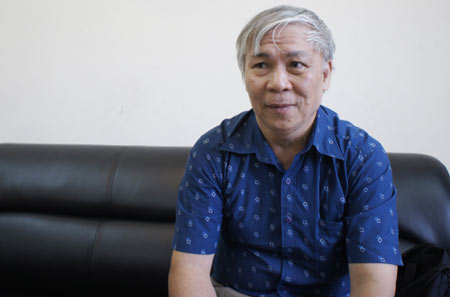
Prof. Dr. Tran Ngoc Vuong.

Should or should not the 1979 border war be in textbooks--is what’s attracting public attention. You have met with many Chinese. How do Chinese people think about this event?

30 years ago, right after the 1979 event, I wrote the article “Idealism of a conception of territory”, trying to explain the war. In 1980, the article was published in the Philosophy Journal. Recently, when the issues between Vietnam and China are more interested, I posted this article on the Internet, because of its topicality.

I used to be a guest lecturer at a Chinese university, so I had the opportunity to meet with many Chinese scholars and people.

I would say that Chinese intellectuals are divided into two groups, who have different cognition and behavior. The first group is the ruling people who stay informed and are responsible for making decision. They have relatively comprehensive information and understand the nature of the issue. The second group is influenced by public information, including the people and officials of various levels, even many scholars.

Part of Chinese intellectuals have a more comprehensive perspective; they have information and more accurate understanding about the nature of the problem. But I think the rate of people who do not have access to accurate information is higher. Chinese people who I met, including many scholars still have negative and inaccurate attitudes about the relations with Vietnam.

In China, the gap of thinking between different social classes is huge, especially between ordinary people and people of the upper class.

What do you think about the 2012 Literature Nobel Prize winner Mo Yan and his book “Comrade-in-arms Reunion”?

I’m sure that Mo Yan did not lack information. He was not confused or mistaken about the border war because at that time he was a propaganda officer for the General Political Department of the Chinese Army. He wrote “Comrade-in-arms Reunion” based on the political direction. Besides, through his works like “Sandalwood Death,” “Big Breasts & Wide Hips” etc., we also can feel the nationalism quite clear.

What should Vietnam do to have independence and its own values?

China is always near to Vietnam, with available knowledge, an organized social system and the long-existed ideology... How can Vietnam escape from that large shadow? Historically, Vietnam has always tried to find its own way.

Vietnam’s innovations often arise when it is under pressure or collides with counterparts that have the equivalence of power.

China has a vast territory, with massive history and culture and China always treat others with the posture of a big country.

Vietnam has to develop its own model, which is invented based on Vietnam’s experience and internal elements. It cannot borrow the development model of other countries. This is true for many countries and territories, not only China and Vietnam.

Among the countries in the region that are influenced by China, Japan is the most successful in maintaining its independence and its own values. Japanese people have exerted efforts to create and maintain the core value - Shinto.

The Japanese believe that Japan was created by a God. All Japanese are descendants of a God – the Sun Goddess. This belief appeared since the founding of Japan and it has been maintained as core national spiritual value. Thanks to that original value, Japanese can retain their independence of thought.

Thanks to that core value the Japanese can keep their independent values. How can we create our own values?

We have the creativity that brought about great efficiency, but we do not review our own history. The dual administration model of the Le – Trinh dynasty is an example.

The dual ruling regime is the model that contains both the Emperor and the Lord, which is different from China.

Throughout its long history, China has never had the coexistence of two dynasties. But in Vietnam, Lord Trinh survived for eight dynasties, totaling 200 years. In some aspects, Vietnam used to have bipolar model of power, unlike China, Japan.

What do you think about the change in Myanmar? What can Vietnam learn from this country?

Just a few years ago, in some standards, Myanmar was considered as one of the poorest countries in Southeast Asia. The positive change in this country recently has turned it into a hot spot, a focus of attention of the international public opinion. I certainly do not see negative reviews, disbelief or blame for the tremendous progress in this country.

There are several questions: Why can Myanmar get those changes? What pressure forces them to change? Is there any mistake and deviation in their ruling authorities? What does the government benefit and lose from these reforms? Where do these reforms lead them to? How about the hostile and the supportive forces? etc.

If seriously looking for answers to those questions, we will have great lessons for Vietnam. And who is the subject of the greatest responsibility to seek answers to these questions? Of course the people who are holding the national destiny!

In my opinion, there are too many lessons for Vietnam which can be drawn from Myanmar. And it is important that I see the change in Myanmar does not harm any group of that country. It is the manifestation of the "win - win" theory.

Hoang Huong

Wednesday, February 27, 2013

China racism case


Posted: 27 Feb 2013 08:45 PM PST

A Vietnamese diplomat in China has said the country will respond “appropriately” to the case of a Chinese restaurant that has openly banned Vietnamese, Japanese and Filipino customers, BBC Vietnamese reported Wednesday.
The unnamed diplomat did not say what the response would be, but stressed that Vietnam’s viewpoint is that mutual respect and friendship has to be maintained.
Meanwhile, speaking to the Tuoi Tre (Youth) newspaper, Zhai Lei Ming, Chinese consul general in Ho Chi Minh City, said the owner’s actions were wrong and did not represent a majority of the Chinese people or the Chinese government’s viewpoint.
When asked why the local government had not done anything despite the sign being posted for a long time, he said it had not been aware of it.
Responding to another question about the Chinese government’s future actions after the case was reported in the media, he said he was just a consul general, not the government or any agency that is supposed to handle it.
Since February 23, four photos that showed a snack shop in Beijing with a sign in both Chinese and English that read: “This shop does not receive the Japanese, the Philippines, the Vietnamese and dog,” have gone viral online and roused public anger.
The photos were taken by Rose Tang, a former CNN journalist who was born in China but is now based in New York, on February 22 during her trip to Beijing, and posted on her Facebook, Tuoi Tre reported.
As of February 27, one photo which is the close-up of the shop named Beijing snacks in the capital city’s Houhai District had been shared by more than 3,700 people. The photos have drawn the attention of the international media, which has reported on the restaurant and its racist sign.
According to Tuoi Tre, it is not known when the shop’s owner, whose surname is Wang, put up the sign, but it was first mentioned on Chinese social sites like Sina and Weibo in September.
The owner was quoted as saying that he posted the notice to speak his mind, but also preferred that the Japanese, the Filipino and the Vietnamese did not read it.
However, in an interview with BBC Chinese, the shop owner said he is proud of what he has done and that he does not care what people say, the newspaper reported.
Meanwhile, speaking to Tuoi Tre, Tang said that she had posted the photos online because she felt obliged to expose what she called “racism with a twist of nationalism.” She hoped that pressure from the public and the media will teach Wang and people like him a lesson.
Many netizens have expressed their outrage on Tang’s personal page, calling the sign and the shop owner’s attitude “shocking” and “ugly.”
In one of the most liked comments, Paul Mooney, a freelance reporter in Beijing, said: “This is the [Chinese] government and Party’s fault. They tell lies about other countries and distort history and so Chinese who don’t know any better respond with ignorance. Very depressing.”
China is currently involved in sea territorial disputes with the Philippines and Vietnam over large areas of the East Sea, internationally known as the South China Sea. China and Japan have a separate dispute over islands in the East China Sea.

Sunday, January 20, 2013

Nong Son thermal power plant left unfinished

China National Heavy Machinery Corporation related stories

The Nong Son thermal power plant in Nong Son District, Quang Nam Province, was left partially finished after the Chinese contractor refused to continue the project, relieving all workers.
Many parts of the construction site deteriorated     Vietnam National Coal and Mineral Industries Group (Vinacomin) invested VND674 billion (USD32.3 million) in the project, which was designed to have a capacity of over 150 kWh per year.
Many parts of the construction site deteriorated Vietnam National Coal and Mineral Industries Group (Vinacomin) invested VND674 billion (USD32.3 million) in the project, which was designed to have a capacity of over 150 kWh per year.
It was hoped that after completion of the project the coal mines in Nong Son District would have been exploited in a more efficient and sustainable fashion. Now, however, it seems that the project has been abandoned.
The key component in the bid package went to the China National Heavy Machinery Corporation (CHMC) in 2008, with VND529 billion. Although they had promised to finish their part by April 2010, it continues to remain unfinished.
Mai Xuan Ha, Chief of Vinacomin’s Nong Son Coal and Power JSC, said the project was 56% completed.
Explaining the stagnancy, Ha said that the economic downturn increased prices for construction materials, which caused problems for contractors. He added that the storm which caused devastation in the area added to their difficulties by damaging equipment, but that the major issue was the inability of CHMC to carry out their part.
Cooperation between CHMC and other contractors was lacking, as well as funds. In April, 2012, CHMC stopped their work completely and sent all their 300 Chinese workers home.
CHMC asked to change the terms of their contract by raising their take, but, according to Ha, their demands were not acceptable. Currently Nong Son Coal and Power JSC is working with CHMC to solve the problems and send a revised proposal for approval by Vinacomin.
The unfinished project is not only a waste of money but also cause troubles to the locals.
Over 100 people from Nong Son who had been trained for employment on the project are now out of work. Nguyen Kim Dung, Chairman of Que Trung Commune’s People Committee, said people in that ward formerly had an average of about 30 ha of farmland, mostly used for agriculture. Since the average size of farmers’ land has been reduced by half because of the power plant project, this leaves them in a tough situation.
He added that pollution from the project has adversely affected agricultural production.
“We are urging Nong Son Coal and Power JSC to complete the project. Otherwise we will be the ones who see the bad effects,” Huynh Tan Trieu, Chairman of Nong Son District’s People’s Committee said.
Nong Son thermal power plant left unfinished

Monday, January 14, 2013

Starbucks expands to Vietnam

Starbucks expands to Vietnam

– Starbucks Corp. will open its first Vietnam café early next month in Ho Chi Minh City as part of its strategy to expand across Asia, the company said.

The Seattle-based chain will be entering a country of coffee lovers that already has an established market. At least two popular homegrown chains have dozens of locations nationwide, and family-run sidewalk cafés dot the streets and alleys of larger Vietnamese cities.

Starbucks said it operates more than 3,300 stores across 11 countries in China and the Asia-Pacific region, but its Vietnam cafés will celebrate the country’s “coffee culture and heritage.”

“We are looking forward to serving our customers in Vietnam in an authentic and locally relevant way,” Jinlong Wang, president for Starbucks Asia Pacific, said in a statement.

Vietnam is the world’s second-largest coffee producer behind Brazil and already provides high-quality beans for Starbucks stores in other countries.

The company said it has designated a subsidiary of Hong Kong-based Maxim’s Group as its licensee in Vietnam.

French colonizers introduced coffee to Vietnam in the nineteenth century, but coffee here typically is stronger than European espresso and can be served with tea.

Starbucks, named after a character in Herman Melville’s nineteenth-century novel Moby Dick, opened in 1971 and has nearly 18,000 retail stores in 60 countries.

Sunday, December 23, 2012

Sex clip in doubt

The public get indignant with sex clip distribution
VietNamNet Bridge - After a series of video clips featuring fights among schoolgirls, the online community has been surprised by sex clips of schoolgirls. This once again sounds the bell of disillusion of the indulgent lifestyle of a small part of the youth today.


On November 30 this year, the police of the northern port city of Haiphong announced to identify the couple in the sex clip that was posted on the Internet in late November.

The woman in the clip is determined as a 21-year-old girl in Kien Thuy district, Hai Phong. The girl graduated from the high school and did not have a job yet. The man in the clip is also 21 years old and also from Kien Thuy district. He is a student of a vocational high school in Hanoi.

Kien Thuy District Police questioned the couple for investigation. The two admitted themselves as the characters in the sex video.

They said they used to be classmates and loved each other. Both wanted to shoot the sex clip to celebrate their love. The clip was filmed by a mobile phone in the middle of June 2012, in the toilet on the second floor at the girl’s home.

The girl and her family sent a denunciation to the police of Kien Thuy District, claiming her privacy was being abused.

The boy said that someone stole the clip from his phone to post on the internet, adversely affecting the image of the couple.

Earlier, on October 10, 2012, Nguyen Thi Minh Khai High School in Mo Cay Nam district, Ben Tre province confirmed that its five students involved in a sex video that had caused a stir on the Internet.

The school expelled two students for a year, including the male student in the sex clip and a student who made the clip.

The school also expelled the female student in this clip for a week. The two students who watched the clip on the phone of the student who made the video and then gave it to other students had to serve a warning.

Earlier, on September 5, five students related to the case drank beer after the opening ceremony. After that two students had sex and was sneakily filmed by a schoolboy, who then showed the clip to two other students.

The clip was then transferred to two other students of Ca Van Thinh high school in Mo Cay Nam district. One of the two students, a 12th grader, posted it on the Internet, caused a stir in the public opinion.

Also recently, the online community was stirred when a sex video of a couple, given as students of a university in the Central Region was leaked. The 30-minute clip made viewers "shock" because of the boldness of the characters.

The incident once again sounds the bell of disillusion of the indulgent lifestyle of a small part of the youth today.

There are many other cases occurred this year.

Le Trong Hung, 17, in Ha Dong district, Hanoi had relationship with two 10th graders named Hue and Lan at the same time. Hung used to study in the same school with them but he dropped out.

Hue was jealous. She gave Hung her cell phone and asked him to videotape his sexual relations with Lan to spread to take revenge against Lan.

On April 11, Hung and Lan dated in a hostel and had sex. Hung filmed their sexual intercourse scenes and gave the 7-minute clip to Hue.  This girl then sent the clip to a number of fellow students and spread to other schools. The case quickly spread and was discovered shortly thereafter.

Ha Dong district police summoned Hung and Hue for investigation. Hung admitted to be more in love with Hue so he agreed to videotape his sexual relations with Lan and gave the clip to Hue.

Fortunately, the police quickly prevented the wide spread of the sex video.

In mid-October, a sensitive clip spread fast. The main character in the clip is said to be a 10th grader of a high school in Cau Giay district, Hanoi.

However, soon after netizens "vindicated" the reputation of Hanoi’s schoolgirls. She found out that the clip came from abroad, not Vietnam.

Compiled by Mai Lan

Vietnam, tourist bring festive cheer

Visitors bring firms festive cheer
VietNamNet Bridge – The upcoming holiday season has heated up the tourism market with an increase in the tours being booked despite the ongoing economic crisis.

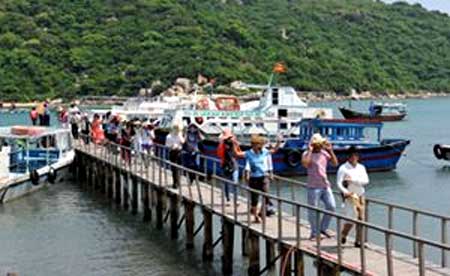
Tourists visit Vinh Hy bay in the southern province of Ninh Thuan. The upcoming holiday has heated up the tourism market.

Several travel agencies say that their Christmas, New Year and Lunar New Year tours are already fully booked.
Nguyen Minh Man, marketing and communication deputy director of Vietravel, said the information that employees would get four days off for the New Year and nine days off for Tet (Lunar New Year) has roused the tourism market.
Vietravel has around 300 inbound and outbound tours to serve customers on these occasions.
Man said Vietravel expected to serve 75,000 customers from end of this month to March 2013, up 25 per cent year-on-year.
He said the number of bookings for the company's tours for the New Year has already reached 75 per cent of the target.
Many tours to the northern and the central regions are already fully booked, he added.
This year, the number of customers choosing to visit domestic destinations including Ha Noi, Sapa, Hoi An, Hue, Da Nang, as well as attractions in the northwest and northeastern part of the country from HCM City has increased significantly in comparison to the same period last year, Man said.
Many tours had to be closed soon because flight tickets were not available, he said.
Saigontourist, a leading travel firm, has launched 50 tours for New Year and 300 tours for the Lunar New Year holidays.
Doan Thi Thanh Tra, head of Saigontourist's marketing department, said one of the company's strengths was serving overseas Vietnamese returning to their motherland to celebrate Tet, or bringing their families and friends over to tour the country.
The company expects to have 6,000 customers for the New Year holiday, up 10 per cent year-on-year.
The company has also tours on land to Da Lat, Phan Thiet and Nha Trang.
It hopes to serve 20,000 tourists during the Tett holiday, 7,000 of whom are expected to use outbound tours, up 15 per cent over last year.
Tra said tours that depart on the second day of Lunar New Year are almost fully booked. Several tours to Europe, America and Australia have few spaces left, she said.
Saigontourist is going to open new tours to respond to customer demands, Tra said. She noted that the company's tours on this occasion have not increased in price, but include additional services.
The prices of several tours to Thailand and Singapore have gone up by 5-7 per cent due to increases in airfares, she added.
The Viet Media Travel company is offering a special promotion under which discounts of up to VND3 million are being offered for bookings made before end of this month for tours depart during the Tet holiday.
Group bookings will receive additional discounts, a company representative said.
He said Viet Media Travel expects to serve 6,000 customers this Tet, 60 per cent of whom will take outbound tours.
Lien Bang Travelink has also launched new outbound tours to Taiwan, America, Singapore and Malaysia as its existing tours are almost fully booked.
Besides, the company is offering discounts of VND200,000 to VND400,000 on domestic tours booked before the end of this month.
Source: VNS

Saturday, November 3, 2012

Cops want crackdown on tourist hustlers - News VietNamNet

Cops want crackdown on tourist hustlers
VietNamNet Bridge – Those who have disturbed, cheated and scammed foreign tourists should be strictly punished and even face criminal proceedings to effectively and comprehensively control the situation and maintain social order in the capital of Ha Noi, police have said.


A vendor gouges foreign tourists at a street in Ha Noi's Old Quarter.
There have been around 130 cases of foreign tourists being harassed
and overcharged since the start of the year. — Photo www.antd.com.vn


Colonel Nguyen Phu Thang, deputy head of Hoan Kiem District Police Office, told An ninh Thu do (Capital Security) newspaper that street vendors, shoeshiners and beggars mostly gathered around Hoan Kiem Lake and the Old Quarter to persistently follow tourists, offering services and products and overcharging for them.

"As well as charging exorbitant prices, some regularly use tricks such as pretending to be social workers representing charity organisations in order to make money. Others even rob unsuspected tourists," he said.

Figures provided by the districts police show that since the beginning of this year municipal police reported 130 cases of foreign tourists facing harassment and overcharging. As many as 41 vendors and shoeshiners were arrested in a campaign held between August 16 and 28. Most of them were immigrants.

However, these people were only kept in custody for 12 hours and fined VND150,000 (US$7.5) each for causing public disorder and not carrying ID cards with them. The punishments were not severe as the arrestees did not directly rob foreign tourists of their possessions.

Lieutenant colonel Pham Van Ung, deputy head of Ly Thai To Ward's Police Office in Hoan Kiem District, said that prosecutions were rare as few foreign tourists reported cases to the police, even if they have had items stolen. He added that police found it hard to track down and check on offenders at their places of residence, as most were immigrants and changed location constantly. He also called for a review of the punishments faced by wrongdoers, arguing that the current level of fines were not strict enough to prevent violators from re-offending.

Police have said that those who relapsed into criminal behaviour of this kind should be sent to social centres for between three and six months. For those under the age of 18, local authorities and families should keep a close watch to ensure that they do not violate again.

Recently, eight people were arrested for robbing foreigners in tourism areas over the course of a week. Six of these were prosecuted and two were sent to rehabilitation centres.

About 50 workers from the Hoan Kiem Lake Management Board and a group of police have been charged with patrolling and inspecting crime hotspots in a crackdown on criminals cheating tourists to try and alleviate the problem.

John Smith, an Australian who has lived in Viet Nam for four years, said that common sense and knowing how to bargain for things was the most necessary skill to avoid being ripped off.

"Many people complain about being overcharged, but it's usually fine if you try to bargain when buying something," he said.

"Sometimes sellers have asked for VND100,000 ($5) for some fried cakes, and I have just left. If in doubt, the best way is to go to the supermarkets where there are price tags on all products," he added.

Nguyen Van Tuan, director of the Administration of Tourism, said that creating jobs for immigrant labourers such as vendors and beggars would better help solve the problems, as they were those who most commonly disturb tourists.

He added that local residents and managers of tourist sites should be more observant and report cases of these crimes to authorised agencies in a timely fashion.

VietNamNet/VNS

Saturday, October 13, 2012

McDonald’s and the great challenges it faces when entering Vietnam - News VietNamNet

VietNamNet Bridge – Experts believe that McDonald’s, though being a global well-known brand, will still face a lot of big changes in the Vietnamese market.


The presence of McDonald’s or the announcement of the fast food giant to land in a market always catches the special attention from the public.

The idea of penetrating the Vietnamese market has become more realistic when a high ranking manager of McDonald’s in late August arrived in Vietnam, where he had working sessions with some competent agencies. The purpose of the visit was reported as “seeking the business opportunities in the lucrative market.”

The fast food giant, who has been present in 119 countries all over the world, was thought to keep indifference to the Vietnamese market. While other big fast food franchisors, including KFC, Lotteria or Jolibee, have been in Vietnam for some years already, McDonald’s is still outside the market.

However, McDonald’s has unexpected released the plan to join the Vietnamese market, a part of its plan on quick business expanding towards Asia.

The economic crisis in Europe has badly affected the business growth of McDonald’s in the market which brings 40 percent of the total revenue. The traditional North American market, which makes up 30 percent of the total revenue, has also become saturated.

In fact, the board of directors of McDonald’s understands that it should not expect too much from the European or North American markets. Therefore, the giant believes that it needs to speed up the plan to go toward the east.

In the vast market of China, McDonald’s, with the network of 1100 shops, has to compete with KFC (YUM!), a redoubtable rival which has 3500 shops.

Though Kenneth Chan, Managing Director of McDonald’s China stated that the giant does not intend to compete in terms of the number of shops, but it strives to provide best quality products and best services, the hamburger giant understands that it needs to enlarge its network as soon as possible.

Therefore, besides the shops opened by the company itself, it has been also trying to expand the network under different modes – franchising, licensing and developmental licensing, hoping to obtain 2200 shops by the end of 2102.

What will challenge McDonald’s in Vietnam?

South East Asia, including Vietnam, has become a favorite market not only for McDonald’s, but also for other big names such as Burgerking, Wendy’s, Starbucks, Yum!, Subway.

However, experts can see great challenges McDonald’s would meet when joining the Vietnamese market. These might be also the reasons that explain why McDonald’s comes to Vietnam later than other fast food giants like KFC, Lotteria or Jolibee.

The challenges could be the material sources which still cannot satisfy the demand of the company, the special taste of Vietnamese consumers. McDonald’s might foresee that it would not only have to compete with the other fast food giants, but also with the take-away shops on pavements – the favorite style of Vietnamese people.

However, what the public expects to see is the pricing policy to be applied by McDonald’s in Vietnam.

The prices of Big Mac, one of the main products of the chain, is considered the index for McDonald’s to assess an economy. The Big Mac price in China is now the lowest among the company’s markets.

In general, in the first phase of operation, McDonald’s would target high income earners, and would target medium income clients later, when the network becomes large enough to cut costs. And experts believe that the same policy would be applied in Vietnam.

If McDonald’s plans to expand its network through franchising, very few Vietnamese partners would be able to cooperate with the giant, because very few investors can spend 800,000-1.3 million dollars to set up a shop with the brand. So this would be a great challenge for McDonald’s in implementing its plan to obtain 100 shops in Vietnam.

Another challenge would relate to French fries. The overly high import tariff on the products would badly affect the business efficiency. J. Simplot, an US agriculture expert, once noted that it would be very costly for the US fast food chains to maintain the typical characteristics of the US potatoes.


DNSG

Monday, September 10, 2012

Japan infuriates China by buying disputed isles - World News

Japan infuriates China by buying disputed isles

TOKYO -- Japan has agreed to buy a group of islands at the center of a territorial dispute with China, a government official said on Monday, prompting an angry rebuke from Beijing a day after Chinese President Hu Jintao warned against such an "illegal" move. 
Japan aimed to nationalize the uninhabited islands in the East China Sea as soon as possible to control them in a peaceful and stable manner, Chief Cabinet Secretary Osamu Fujimura said. 

The islands, called Senkaku in Japan and Diaoyu in China, are near rich fishing grounds and potentially huge maritime gas fields and have been at the heart of long-running territorial disputes between the world's second and third-largest economies. 
Japan’s government held a cabinet meeting on Monday and officially endorsed a plan to buy the islands from their private owner, despite denunciations from China, for a reported sum of $26 million.
Clinton urges cool heads in Japan-South Korea island dispute‎
Tension flared anew last month when Japan detained a group of Chinese activists who landed on the islands. But the row may now be having an economic impact, intensifying from merely an exchange of rhetoric, with a Chinese official saying Japanese car sales may have been hit in the world's biggest auto market. 
"This is just the ownership of land, which is part of Japan's territory, moving from one (private) owner to the state, and should not cause any problem with other countries," Fujimura said. 
"Having said that, we don't want the Senkaku issue to affect overall Sino-Japanese relations. Because it is important to avoid misunderstanding and unforeseen development, we have been closely communicating with China through diplomatic channels to this day." 
Much at stake for US as tensions rise in troubled China Seas‎
But China was firm in its opposition to what it saw as a "political trend". 
"This is a serious infringement of China's sovereignty and has seriously hurt the feelings of 1.3 billion Chinese..." the Foreign Ministry said in a statement. "The Chinese government and people express their resolute opposition and protest strongly." 
Chinese Foreign Minister Yang Jiechi called in Japanese Ambassador Uichiro Niwa to lodge a strong protest, while state-run Xinhua news agency cited Premier Wen Jiabao as saying China would "never yield an inch" of territory. 
The Japanese otter was declared extinct today by the Japanese government after not being spotted for over 30 years. NBCNews.com's Richard Lui reports.
Japanese govt spokesman Osamu Fujimura stressed that the purpose of the purchase is for Japan to maintain its peaceful and stable control of the islands, suggesting that no new structures will be built, and access to the islands will remain restricted.

Saturday, August 25, 2012

China-a hungry dragon in the East Sea


China – a hungry dragon in the East Sea
VietNamNet Bridge – After implementing the closed-door policy for a long period of time, China has begun to compete with other countries and raise big claims in the East Sea. 


China's Ocean Oil 981 oilrig in the East Sea.
In his recently-published book “Vietnam’s Imprints in the East Sea,” Dr. Tran Cong Truc, former chief of the Border Committee, analyzed China’s marine policy. Below is an extract from the book.

China’s goal is to become a superpower of the same rank with the US by 2050, based on reform, open-door policy and peaceful rise. China believes that from now to 2020 is the best time for development. Therefore, China’s foreign policy in the coming years is trying to solve inside and outside conflicts, avoid the use of extreme measures and confrontation with the US, develop friendly and cooperative relations with neighbors and maintain peaceful environment.

On the other hand, after a long period of time leading the world for economic growth rate, China has become a big country in the world.

In 2005, its gross domestic product (GDP) exceeded US$2.2 trillion to become the fourth largest economy in the world.

Because of robust economic development, China has become a hungry dragon for fuel and materials. 

From 2003, China has become the second largest importer of oil in the world, after the US. China has been spreading to the world to seek and exploit natural resources and energy to satisfy its demand of development and ensure its energy security. The ocean is considered an important source.

To facilitate transportation of fuel and goods, China now attaches importance to the freedom of navigation and maritime commercial safety. With around 70 percent of its imported oil transported via the East Sea, China sees the East Sea as its life-line.

China has raised the biggest claims in the East Sea. After implementing the closed door policy for a long time, this country began eyeing and encroaching into the East Sea. The process has happened as below:

In 1909 it began to occupy Hoang Sa (Paracel) Archipelago. 

In 1946 it drew the U-shaped line, which covers around 80 percent of the East Sea. However until May 2009 it made the line public. At the same time it occupied eastern islands in Hoang Sa Archipelago and Ba Binh Island in Truong Sa (Spratly) Archipelago.

In 1956, the People’s Republic of China occupied the eastern part of Hoang Sa while Taiwan held Ba Binh Island in Truong Sa. 

In 1958, the People’s Republic of China officially raised its sovereignty claims over Hoang Sa and Truong Sa.

In 1974, this country occupied the western part of Hoang Sa. It continued to occupy some islands in Truong Sa in 1988 and Vanh Khan Island of Truong Sa in 1995.

China claims sovereignty over the whole Hoang Sa Archipelago. It considers Hoang Sa and the adjacent waters as its natural territory. It also claims sovereignty over the entire Truong Sa Archipelago and its adjacent waters, but admits to have disputes. 

From the 90s, along with China’s fast economic development and the improvement of China’s position in the international arena, China began building and implementing a new marine policy. Under this policy, China has strengthened its control and exploitation of the sea to serve its goal of becoming a maritime superpower. China believes that it cannot become a real superpower if it is not a maritime superpower.

China’s policy is exploring the far waters firstly and then to the near waters, the disputed waters firstly and then its waters; diplomatic methods go firstly, followed by naval force; sowing division among members of the Association of Southeast Asian Nations (ASEAN); taking advantage of and restricting the US and Japan.

In terms of cooperation mode, China focuses on bilateral cooperation and multilateral cooperation when China holds the key role. Its main direction in the sea is the East Sea, where natural resources are abundant, big countries do not have military bases and related small countries are weak at military ability.

Tran Cong Truc

Saturday, August 18, 2012

Best Vietnamese chess players to compete at Chess Olympiad

Best Vietnamese chess players to compete at Chess Olympiad
VietNamNet Bridge – The top chess players of Vietnam will be sent to the Istanbul 2012 World Chess Olympiad in Turkey from August 27 to September 10.


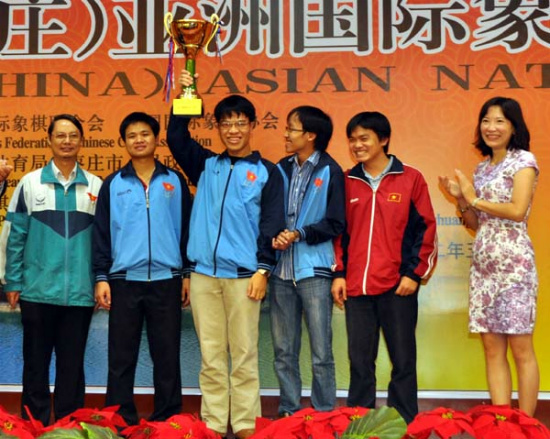
Vietnamese chess team at the Asian Chess Championships 2012.
According to the Turkish Chess Federation, this will be the largest ever Olympiad, with competitors coming from 162 countries and territories.

Vietnam will compete in men’s and women’s team events.

The men’s team consists of Le Quang Liem, Nguyen Ngoc Truong Son, Dao Thien Hai, Nguyen Duc Hoa and Nguyen Van Huy. As Vietnam’s leading male chess player, International Grand Master Le Quang Liem will seat at Table 1 in all rounds.

The women’s team includes: Pham Le Thao Nguyen, Le Kieu Thien Kim, Nguyen Thi Mai Hung, Pham Bich Ngoc and Hoang Thi Nhu Y. Except for Le Kieu Thien Kim, all female chess players are very young.

The coaching board hopes that the women’s team will be successful at the tournament. The men’s team used to rank tenth at the Chess Olympiad 2010.

Earlier, the Vietnamese chess team performed very well at the Asian Chess Championships in May, winning six gold, three silver and four bronze medals, ranking third after China and India.

The men’s team won the championship while the women’s team ranked second for blitz chess event.

Vietnam also won three individual medals for Tables 1, 2 and 5 for men (Le Quang Liem, Nguyen Ngoc Truong Son and Dao Thien Hai) and a gold and a bronze medal for Pham Le Thao Nguyen and Hoang Thi Bao Tram, Tables 4 and 3.

The Chess Olympiad is a biennial chess tournament in which teams from all over the world compete against each other. The event is organized by FIDE, which selects the host nation.

Each FIDE recognized chess association can enter a team into the Olympiad. Each team is made of up to five players, four regular players and one reserve.

The trophy for the winning team in the open section is the Hamilton-Russell Cup, which was offered by the English magnate Frederick Hamilton-Russell as a prize for the 1st Olympiad (London 1927). The cup is kept by the winning team until the next event, when it will be consigned to the next winner. The trophy for the winning women's team is known as the Vera Menchik Cup in honor of the first Women's World Chess Champion.

The 2010 Olympiad was held in Russia. The 2012 Olympiad is going to be held in Turkey and the 2014 Olympiad in Norway.

Compiled by S. Tung

China ecites public opinion, slanders Vietnam

China excites public opinion, slanders Vietnam
VietNamNet Bridge – To realize its ambition of controlling the entire East Sea, Chinese newspapers have published articles to excite public opinion, slander countries in the region, especially Vietnam.


China's greedy U-shaped line in the East Sea.
Dr. Tran Cong Truc, former head of the Government Border Committee, analyzed China’s plot to monopolize the East Sea in his newly-published book entitled “Vietnam’s Imprints in the East Sea.” Below is an extract from the book.

To implement its marine strategy and its ambition to totally control the East Sea, China has applied many domestic and foreign measures, on negotiation table and on the field, to confirm its sovereignty in the East Sea.

China officially raised its U-shaped line claim in May 2009, by attaching a map with this line to a diplomatic note to the United Nations in protesting Vietnam’s report and the joint report of Vietnam and Malaysia on the boundary of the continental shelf. Accordingly, China claimed sovereignty over Hoang Sa (Paracel) and Truong Sa (Spratly) Archipelagos and the exclusive economic zone (EEZ) and continental shelf of the two archipelagos.

China used the regulations on island nation of the UN Convention on the Law of the Sea 1982 (UNCLOS) to outline the baseline for Paracel Islands. It stated to draw the baseline for the Spratly Islands, to claim EEZs and continental shelves for the two archipelagoes.

However, China’s claim is contrary to the UNCLOS; so in general, other countries did not agree with the claim.

To speed up propaganda on China’s sovereignty claims over the East Sea, the Chinese media has systematically published articles to excite the public opinion and slander countries in the region, especially Vietnam--of appropriating China’s marine resources.

China has published many maps and publications, organized international contests and supplied online maps related to China’s marine sovereignty.

This country has also collected documents associated with the East Sea and built up historical evidences to prove its sovereignty in the East Sea.

China has been seeking any measure to prove and defend its legal viewpoint on its process of establishing and implementing historical sovereignty over Hoang Sa and Truong Sa.

However, China’s ambition contradicts its documents. A lot of ancient documents clearly described and outlined that Hainan Island is China’s southern-most territory.

Mr. Pham Hoang Quan, an independent researcher on China’s history and geographic history, said that from the Han Dynasty to the Qing Dynasty, all official historical books did not note a single word about Hoang Sa and Truong Sa. It is the evidence that China has never considered the two archipelagoes as its territory. All books noted that Hainan Island is China’s southern-most territory.

After researching documents showed off by China, Prof. Monique Chemillier Gendreau, from the Paris VII Denis Diderot University, former Chair of the European Association of Lawyers for Democracy and World Human Rights, concluded: Chinese knew about islands scattered in the East Sea along time ago, but China’s evidence is not enough to defend the argument that China was the first country that discovered, explored, exploited and managed the two islands.

Tran Cong Truc

Sunday, August 12, 2012

Vietnamese travel firms scrambling for Chinese tourist

VietNamNet
Scrambling for Chinese travelers, Vietnamese travel firms killing themselves
VietNamNet Bridge – Every year, Quang Ninh province receives 90,000 Chinese travelers who go to Vietnam by land. However, Vietnamese travel firms do not earn much money from the Chinese market due to their uncooperative attitude.

50 billion dong in revenue lost in half a year

Since travel firms try to slash tour fees to scramble for Chinese travelers, the tour fees have decreased dramatically to the levels, which cannot bring profits to anyone.

No one could imagine that an international tour lasting four days and three nights at Ha Long Bay and nearby destination points designed for Chinese travelers only costs 250 yuan, or 815,000 dong. The modest sum of money is not even high enough for Vietnamese people to travel within their localities.

The low tour fee is the result of a long lasting cutthroat competition among Vietnamese travelers, which have been trying to attract Chinese clients from Chinese partners.

According to the Mong Cai Travel Firms’ Club, which represents 28 travel firms specializing in serving Chinese travelers, most travel firms charge the fees which are 50 percent lower than the floor fee.

As such, the club has estimated that in the first six months of the year, with 60,000 Chinese travelers arriving in Vietnam by land through the Mong Cai border gate, Vietnam has lost at least 50 billion dong in tour fees.

Meanwhile, domestic travel firms have said that Chinese partners have been trying to force the tour fees down, threatening to transfer clients to other firms if the Vietnamese partners do not accept the tour fees they set.

Especially, not only the members of the club compete with other travel firms, but the members of the club have also been competing with each other. Some member firms have broken their commitments about the floor tour fee when joining the club.

Admiring Ha Long bay and drinking… clean water

Nguyen Thi Minh Thu, Director of Mekong travel firm, related that one day, she heard the complaint from a Chinese traveler about the services at Ha Long Bay.

“The Ha Long Bay is wonderful. Why did you only give us clean water to drink?” the traveler asked.

The traveler, like many other Chinese travelers, could not imagine that Chinese travel firms have misappropriated the money paid by Chinese clients and only have paid Vietnamese travel firms the money enough to provide… clean water.

Travel firms all have affirmed that with the tour fee of 815,000 dong for the tour lasting four days and three nights, they would certainly incur heavy loss. Therefore, in order to ease loss, a lot of Vietnamese travel firms have to cut some services, or force domestic travel firms to reduce the service fee.

A lot of travelers on the same buses, or frugal meals are the images which can be seen regularly in Ha Long City.

“You should not be surprised if you are told that travelers have to stay at low quality hotels instead of star-hotels as promised,” Director of a travel firm said.

The director also said that Chinese partners have been trying every possible way earn more money from Chinese travelers in Vietnam.

“Some Chinese tour guides even sell souvenirs right on the buses. Some others force travelers to drop into souvenir shops run by Chinese people in Mong Cai City, where they have to buy products at the prices 10 times higher than the actual value,” he said.

Meanwhile, Chinese travelers were explained that the products were expensive because they are bought from Vietnamese duty free shops.

Source: Lao dong

Sunday, August 5, 2012

China protests US State Department remarks on South China Sea - World News

BEIJING - China's Foreign Ministry has called in a senior U.S. diplomat to protest remarks by the U.S. State Department raising concerns over tensions in the disputed South China Sea.
In a statement released late on Saturday, China's Foreign Ministry said Assistant Foreign Minister Zhang Kunsheng summoned the U.S. Embassy's Deputy Chief of Mission Robert Wang to make "serious representations" about the issue.
The State Department on Friday said it was monitoring the situation in the seas closely, adding that China's establishing of a military garrison for the area runs "counter to collaborative diplomatic efforts to resolve differences and risk further escalating tensions in the region."
Advertise | AdChoicesThe South China Sea has become Asia's biggest potential military flashpoint as Beijing's sovereignty claim over the huge area has set it against Vietnam and the Philippines as the three countries race to tap possibly huge oil reserves. Beijing and Washington are already at odds over numerous issues, including the value of China's currency, Tibet and Taiwan.
Zhang said the U.S. statement "disregarded the facts, confused right with wrong, sent a seriously wrong signal and did not help with efforts by relevant parties to maintain peace and stability in the South China Sea or the Asia Pacific.
"China expresses its strong dissatisfaction and resolute opposition, urges the U.S. side to immediately to mend the error of its ways, earnestly respect China's sovereignty and territorial integrity and do more to genuinely benefit stability and prosperity in the Asia Pacific," he added.
Stay informed with the latest headlines; sign up for our newsletter
A separate statement by ministry spokesman Qin Gang repeated that China had absolute sovereignty over the sea and its myriad islands and had every right to formally set up a city to administer the region, which it did last month.
"Why does the U.S. turn a blind eye to the facts that certain countries opened a number of oil and gas blocks, and issued domestic laws illegally appropriating Chinese islands and waters?" Qin said.
"Why does the U.S. avoid talking about the threats of military vessels to Chinese fishermen by certain countries and their unjustified claims of sovereignty rights over Chinese islands?" he added.
Watch World News videos on NBCNews.com
In all, six parties have rival claims to the waters, which were a central issue at an acrimonious ASEAN regional summit last month that ended with its members failing to agree on a concluding statement for the first time in 45 years.
The stakes have risen in the area as the U.S. military shifts its attention and resources back to Asia, emboldening its long-time ally the Philippines and former foe Vietnam to take a bolder stance against Beijing.
The United States has stressed it is neutral in the long-running maritime dispute, despite offering to help boost the Philippines' decrepit military forces. It says freedom of navigation is its main concern about a waterway that carries $5 trillion in trade -- half the world's shipping tonnage.