Showing posts with label cultural. Show all posts

Saturday, May 3, 2014

Vietnam Women's Museum

Vietnam Women’s Museum, an exciting place in Hanoi
"Top destination", "A museum to see", "This is also interesting for men", "An honest museum".... These are comments foreign visitors made after visiting the Vietnam Women’s Museum in Hanoi. It is a beautiful museum that highlights Vietnamese women’s image. Radio the Voice of Vietnam reports.
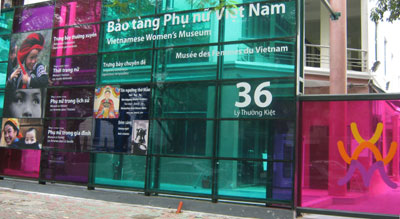


Vietnam Women’s Museum


The Vietnam Women’s Museum is located on Ly Thuong Kiet street, 500m from Hanoi’s Old Quarters. Founded in 1987, the museum is known as the Gender Museum, which researches, preserves and displays tangible and intangible cultural heritages of Vietnamese women as well as the Vietnam Women’s Union.
It is also a cultural center for Vietnamese and foreign women to exchange cultural activities for equality, development and peace of women.
Covering 2000 square meters, the museum has nearly 25,000 documents and objects reflecting Vietnamese women’s contributions to history and contemporary life.
The museum in a 4-storey building is arranged like a history book, where visitors can enjoy the exhibits like turning pages of a history book.
Tran Thu Huyen, a guide of the museum said: “Each floor is a chapter of the book with vivid images, documents, and diverse objects, through which visitors can better understand Vietnamese women."
In the museum’s lobby on the first floor, visitors are memorised by the statue called "Vietnamese mother ". This statue won the first prize in a sculpture competition organised by the Museum and the Fine Arts Association of Ho Chi Minh City in 1995.
Huyen said: "The statue represents a Vietnamese mother carrying her son on her shoulders. The mother seems to be trying to protect her child from difficulties and dangers. Sculpted by Nguyen Phu Cuong, the statue shows the beauty and strength of Vietnamese women."
The second floor is devoted to permanent exhibitions featuring different topics: marriage, child birth, and family life, and female figures in history, fashion, cosmetics and jewelry.
Huyen says:“The first theme of the permanent exhibit here is women in the family. The exhibits are arranged in a story-telling way, which is about a Vietnamese woman’s life from her adulthood to marriage, becoming a wife and a mother. This part is divided into three main themes: marriage, child birth and family life”.
The 3rd floor reflects Vietnamese women’s contributions to and sacrifices for national independence. Moving images depicting the torture, interrogation and imprisonment that Vietnamese women suffered during the war show us their courage and indomitable spirit.
Huyen says that this is the most popular part of the museum, especially for foreigners. The visitors are also interested in the exhibition of activities of the Vietnam Women's Union, memories and gifts from our friends around the world.
On the top floor is an exhibit of traditional Vietnamese costumes throughout history. Tom Watt, an Austrian visitor said that he was captivated by the beauty of the traditional clothes presented, which are old and different from those of today.
There are also clothes of women from different ethnic minority groups in Vietnam. These costumes reflect the skill and sophistication of Vietnamese women in dressing.
To better entertain visitors, the museum has modern facilities allowing visitors to learn more about the lives of Vietnamese women. Audio guides are also available in some exhibit rooms.
Elected by the travel website TripAdvisor as the most exciting place in Hanoi from over 80 attractions in Hanoi for two consecutive years, 2012 and 2013, the Vietnam Women’s Museum is a good place for those who want to learn more about Vietnam, its culture and people.
Source: VNA
 
*
*
*
  Send


Tuesday, June 12, 2012

Cultural activities mark ‘National Tourism Year 2012’ | Look At Vietnam

Cultural activities mark ‘National Tourism Year 2012’

June 12, 2012
The
organisers of ‘National Tourism Year 2012’ and authorities of Thua Thien-Hue
province have announced that a number of cultural activities will take place
during the months of June, July and August.


All the cultural activities aim to promote tourism in the country and lure domestic and international tourists.
- 13th
ASEAN International Open Chess Tournament will take place in the
central province of Thua Thien-Hue from June 10 to 19. Participants will
be divided into different age groups ranging from 8 to 20, and over 50,
to compete for 78 sets of medals in accordance with the Swiss system.

- ‘Central
Coastal Food Festival 2012’ will be organised by the Vietnam National
Administration of Tourism, Vietnam Hotel Association, and departments of
Culture, Sports and Tourism of   Thua Thien-Hue Province and the
northern coastal provinces at Hue Sports Centre from June 28-July 1.

- Lang
Co Festival- World’s Most Beautiful Bay will open on June 16-17 in Phu
Loc District. Lang Co was declared the ‘World’s Most Beautiful Bay’ in
2009, becoming Vietnam’s third bay to be so named after Ha Long Bay and
Nha Trang Bay. Lang Co beach, 30 kilometres north of Hue City, is a
peaceful fishing village famous for its spectacular natural landscapes,
surrounded by mountains and the boundless blue sea with waves playing on
its fine sand beaches. Between the mountains and the sea lies the
mysterious Lap An lagoon, home to flocks of white storks that return to
their nests every evening.

- 39th National Long-Course Swimming Competition will be organised at the Tu Tuong Park from June 18-30.
- 300
artists from 19 art troupes will participate in the National Drama
Stage Festival at Hue City Cultural Centre from July 14-28.

- U17
National Football Champion 2012 will kick off in Tu Do Stadium from
July 11-20. Matches will be broadcast live by Vietnam Television.

- U18 Tennis Championships will take place in An Cuu New Urban from June 18-26.
- Traditional Martial Arts Competition will be held at Hue Sports Centre from August 23-September 1.
SGGP

Friday, October 1, 2010

Culture, Sports & Tourism Week in Vietnam

LookAtVietnam - The Culture, Sports and Tourism Week took place in Mu Cang Chai in Yen Bai province from September 27-30 with activities featuring the unique culture of northwestern people.
Crossbow shooting performance.
Stick fighting.
Tug of war.
Pao throwing.
Horserace.
The terrace fields in three communes in Mu Chang Chai were recognized as national landscape in October 207.
H’mong women performed upland rice growing procedure.

The site for the festival is surrounded by terrace fields.
A mountain fair, the festival’s highlight.
Source: VNE

Saturday, May 8, 2010

A U.S.-Vietnam cultural courtship through music

A U.S.-Vietnam cultural courtship through music - latimes.com: "Critic's Notebook: A U.S.-Vietnam courtship with music
Southwest Chamber Music plays a role in the first large-scale cultural exchange between the countries.

American and Vietnamese musicians at the Hanoi Opera house in Hanoi, Vietnam on March 19 in the concert of Southwest Chamber Music. (Chau Doan, For The Times / May 9, 2010)
Click here to find out more!

On the last day of April, 35 years ago, the few Americans who remained in Saigon were hastily airlifted out as North Vietnamese troops entered the city and and ended the long war. It had been 10 years since U.S. Marines had waded ashore in Danang, yet we as a country had learned little about Vietnamese culture or customs. Good luck if you hoped to find a dan bau, the wonderful monochord instrument, in San Francisco or New York. Meanwhile, Vietnam's communist regime closed its doors to American influence for the next two decades.

But we also celebrate a happier anniversary this year — the 15th since the U.S. normalized relations with Vietnam. We have become contented trading partners. We send our tourists and outsource our business to a booming nation of 90 million, which exhibits remarkable economic growth under its reportedly corrupt capitalist/communist system. We enjoy Vietnam's marvelous food and films. We wish Hanoi well on a really big anniversary this year — its 1,000th.

During a recent trip to Vietnam, I noticed an awareness of American culture as well. In Hanoi and Ho Chi Minh City (the former Saigon), 'Avatar' was being pushed off a limited number of 3-D screens to make way for 'Alice in Wonderland,' just as it was in Hollywood and Chino. Pirated DVDs of current Hollywood blockbusters were displayed in the shops, along with the latest pop CDs. Teenage girls in tight jeans browsed bookshops for vampire fiction. Gustavo Dudamel's Los Angeles Philharmonic gala DVD (in dubious Chinese packaging) sold in the warrens of Hanoi's old quarter for about the price of a bowl of pho on the street.

The fact is, though, that despite a half-century of our countries' entanglements, our cultures remain, in many areas, mutually exclusive. Good luck, even now, if you happen to need a dan bau player in San Francisco or New York.


Last week, the first large-scale cultural exchange between the U.S. and Vietnam concluded. It was initiated by Southwest Chamber Music, the Pasadena ensemble with a passion for new music and a calling for cultural outreach, and it was sponsored by the U.S. State Department. Southwest selected 19 U.S. musicians and composers and 19 from the Vietnam National Academy of Music (including a dan bau virtuoso) to join in workshops and present concerts for three weeks in Vietnam followed by three more weeks in Southern California.

By paying this kind of cultural respect, a State Department official in Washington explained to me over the phone, we build a foundation of trust. 'Vietnam is a country, not a war,' was the mantra of Jeff von der Schmidt, Southwest's artistic director.

These were sentiments I shared as I accompanied the Americans on the Vietnam segment and dropped in on as much as I could during the American leg of the exchange. Good can only come out this exchange. But the best art always has a mind of its own. And cultural attractions are like sexual attractions: You never know what might turn on an artist. Nor is music the universal language many diplomats wish it were. Musical notations and the meaning of its sounds need translation. This is a very early phase of our cultural courtship, and it is nervous and awkward.

Nor can Americans undo history. Avoiding condescension or the slightest hint of imperialism is probably next to impossible no matter how delicately we tread. One of Von der Schmidt's goals was to help Vietnamese composers gain acceptance in their own country. Many of the musicians are Russian or Eastern European trained, and the classical music scene is quite conservative.

Von der Schmidt introduced American music by Aaron Copland, John Cage and Elliott Carter that was little known in Hanoi. He programmed music by two senior Vietnamese composers, Nguyen Thien Dao and Ton That Tiet, who immigrated to Paris in the '50s. He commissioned new works from two young American composers, Alexandra du Bois and Kurt Rohde, and two young Vietnamese composers, Vu Nhat Tan and Pham Minh Thanh. Little such new music by any of the above normally gets performed in Vietnam.

American composers and musicians held master classes in Hanoi and Ho Chi Minh City. Vietnamese musicians gave demonstrations to our schoolchildren and jammed with jazz students at Hamilton High. The Vietnamese were treated to workshops on administrative procedures. Clearly cultural windows were opened.

But it was never quite clear who wanted what and how much. The Vietnamese did not appear to warm to most modern American music, which really is foreign to them. For the Americans, on the other hand, the more different kinds of Vietnamese musics they could learn about, the better.

Both Du Bois and Rohde included a dan bau in their new pieces. Given their inability to find an actual dan bau or player (Du Bois lives in New York; Rohde in San Francisco), the composers ordered CDs and trawled the Internet for information. Yet it was only once they had arrive in Hanoi and after their pieces were written that they could consult with Bui Le Chi, the Vietnamese dan bau player, to be sure they had treated the instrument appropriately.

The young Vietnamese composers also put the dan bau in their commissioned pieces, but they used it however they pleased. Tan, an unusually edgy composer for Vietnam, played around with music from the central highlands that sounded exciting and fresh to my ears. But he confessed to me that he was slighting tradition. Nor did the Vietnamese composers hesitate to write for Western instruments in ways that suited their music.

We think we know, from our experience, what the Vietnamese need, but we have a harder time discerning what they want. At one point, Von der Schmidt noted how he'd like to see portraits of Vietnamese composers alongside Mozart and Brahms on the walls of the academy. So would I. But do they? Nothing I saw suggested it.

The Americans absorbed rich and wild Hanoi street life and went on shopping sprees, filling large suitcases with gongs and drums and all sorts of folk instruments. The Vietnamese visited the house in which Schoenberg lived, but what they talked about was Hollywood. They bought instruments too, seeking out fine-quality violins and cellos hard to come across in Hanoi. Tan had a field day picking up electronic equipment at Sam Ash.

The bulk of time in the exchange was spent in rehearsal and in workshops, including some demonstrating American busisness models useful for promoting music. But our direct approach uses logical chess-like strategy. We follow currents. They, though, ride the undercurrents, especially in their maneuvering of intricate government relations.

Still, we did, to switch metaphors, plant seeds and now we must wait to see what will grow and how. Where we are likely to see the most immediate results is in the work of Du Bois and Tan. Her music has the kind of poetic flow and deep seriousness that the Vietnamese and Americans responded to equally — she was bombarded by requests for pieces from all sides. Tan, who has an impressive command of both traditional Vietnamese music and new American music (he studied briefly in the U.S.) was actively absorbing every new idea and sound that came his way. But he may find, at least soon, a warmer welcome for his music here than at home despite his following on the Vietnamese underground club scene.

It is worth recalling that Copland found his American sound in Mexico and that Lou Harrison helped make the Indonesian gamelan an important influence on American music. In both cases, friendships with composers from those cultures helped the Americans find their own voices, and the interchange also had meaningful musical blowback on other countries."

Monday, March 23, 2009

HCM City’s tourism festival 2009

Ho Chi Minh City’s 5th tourism festival 2009 will be held at Dam Sen Cultural Park from April 3-5 by the municipal Department of Culture, Sports and Tourism and the Vietnam Tourism Association.

Local departments of culture, sports and tourism and travel agencies nationwide have been invited to take part in the event.

The festival will feature various activities, including the tourism summer fair attracting 120 stalls from travel agencies, domestic and foreign airlines, food festivals, art performances and photo exhibitions.

Friday, December 5, 2008

A celebration of Khmer culture at Can Tho festival

The bright colours of traditional Khmer clothes can be seen everywhere in Can Tho as 15,000 of them gather for a four-day festival of culture, sports and tourism that opens today.


Ghe ngo racing is the most popular and eagerly-anticipated event at major Khmer festivals.

The event is aimed at preserving the cultural identity of the Khmers, who are spread over 12 provinces and cities in the south, enriching their cultural life, and contributing to the development of their areas.

It is organised by the Ministry of Culture, Sports and Tourism and the Can Tho City People’s Committee.

An art troupe from each of the provinces and cities – An Giang, Bac Lieu, Binh Phuoc, Ca Mau, Can Tho, Hau Giang, HCM City, Kien Giang, Soc Trang, Tay Ninh, Tra Vinh, and Vinh Long – will perform at the festival.

Each will bring its own local arts and customs.

The festival will include folk performances, traditional costume shows, folk games like ghe ngo boat racing, stick pushing, shell fish chess, kite flying, and other events.

Festival timetable

Friday, December 5
- 6.30am: cross-country race in front of the O Mon District cultural center
- 7.30am to 11am: stick-pushing (first round)
- 8am to 2pm: shell-fish chess, rope-pulling, futsal, cooking show, opening of cultural exhibition at the O Mon District cultural centre and stadium
- 8pm: Opening ceremony, to be broadcast live by VTV1, at the O Mon District cultural centre
- 9.30pm: folk performances and traditional fashion contest
Saturday, December 6
- 7.30am to 2pm: stick-pushing (semi-final and final)
- 8am to 2pm: futsal and shell-fish chess
- 7pm: folk performances and traditional fashion contest
Sunday, December 7
- 8am to 2pm: futsal, shell-fish chess, traditional performances on stage
- 9am: Ghe ngo racing
- 7pm: folk performances and traditional fashion contest
Monday, December 8
- 8am to 2pm: mini football and shell-fish chess (final)
- 9am: Ghe ngo racing (final)
- 8pm: closing ceremony accompanied by release of wind lanterns

An exhibition of photos, artefacts, costumes, traditional music instruments, and other typical cultural objects will be held at the Viet Nam Fine Arts Museum to showcase the Khmers’ special cultural features.


Ghe ngo


is a long, thin traditional boat, often carved from the hollowed-out trunk of a single tree, with each boat capable of holding up to 50 men. Ghe ngo racing is the most popular and eagerly-anticipated event at major Khmer festivals.

The festival is held as a part of the Mekong – Can Tho National Tourism Year.

Deputy director of the local Department of Culture, Sports and Tourism, Le Thanh Phong, said the city has spent around VND70 billion (around US$4 million) on the festival.

"The city travel industry has taken the initiative to collaborate with travel agents across the country to promote activities like orchard tourism, eco-tourism, tours of floating markets and home-stays with local farmers."

It will be the fourth Khmer festival following others held in Soc Trang in 2000, Kien Giang in 2003 and Tra Vinh in 2005.

There are over 1.3 million Khmers living in the southern region.

(Source: Viet Nam News)