Showing posts with label gay. Show all posts

Saturday, January 11, 2014

SAME SEX WEDDINGS OFFICIALLY PERMITTED


Same-sex weddings officially permitted in Vietnam
VietNamNet Bridge - From November 12, the weddings of people of the same gender will be no longer banned in Vietnam.
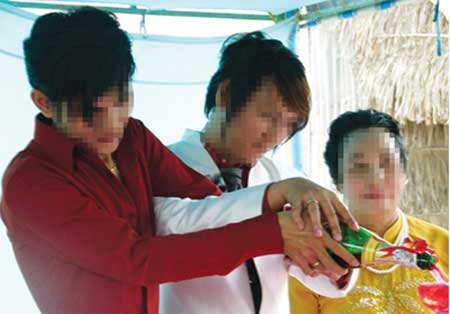


Same-sex weddings, gays, lesbians
A gay wedding in Ca Mau.


In 2012, two weddings of a gay and a lesbian couple were held in the southern provinces of Kien Giang and Ca Mau.
The local authorities intervened and imposed a fine on them, given that the weddings were "contrary to the habits and customs of Vietnam" and the Law on Marriage & Family of Vietnam, which bans marriage between persons of the same sex
However, according to Decree No. 110/2013/ND-CP which took effect on November 12, marriage between people of the same sex has been rejected from the banned cases of marriage. It means that the organization of wedding parties between people of the same sex (without marriage registration) will not be illegal any more and they will not have to pay fine.
The gay couples will have the right to live together and organize weddings.
In the case the local authorities appear to sanction or make intervention, they can take this Decree to protect their legitimate interests.
Mot The Gioi

Wednesday, July 11, 2012

Just gay enough  | Look At Vietnam

Just gay enough 

July 10, 2012
Amateur comedy opens hearts and minds toward a generally ostracized community
 
(From left) The three leading actors in ‘My Best Gay Friends,’ Ngo Xuan Nhat, Huynh Nguyen Dang Khoa and Tran Nguyen Kim Han

"I will not exchange my son for others,” Nguyen Thi Loan Thanh says matter-of-factly.
Thanh’s 21 year old son, Tran Nguyen Kim Han is gay, and she accepts him as such. That she publicly declares her acceptance in a supposedly “conservative, traditional society” has as much to do with Han being an ideal son in all “other” aspects as his participation in a comedy series called “My Best Gay Friends” that has become a Youtube sensation in Vietnam.
The first four episodes of the comedy series has been received well by thousands of viewers after they went online – on Youtube as well as other social websites.
The 20-minute episodes with English subtitles tell stories of friendship between three young gay men from different backgrounds who share an apartment in Ho Chi Minh City – Khoa, who has been sent out by his family to stand on his own feet, Rje, a rice vermicelli seller in the local market, and the mysterious Nhat.
Huynh Nguyen Dang Khoa, a student of the Directing Department at the HCMC Academy of Theater and Cinema, not only plays the leading role of his namesake in the series, but also produces and directs it. Khoa invited his friends, Han, 21, Ngo Xuan Nhat, 19, and others to act in the 15-episode series.
“All of us in the leading roles are gay in real life. We collect and borrow material from daily life to write the script for the film, and hope that people will have a proper, comprehensive and compassionate understanding of homosexuality. They are just normal people, who have their own family, friends, and someone to love,” Khoa said.
Khoa also has experience in making video clips for some local singers, while Han is currently doing a make-up course and Nhat is studying graphic design.
“I made it a comedy to entertain people who have too much pressure nowadays,” Khoa said.
Khoa’s “My Best Gay Friends” is not the first Vietnamese gay film, but it is considered the best made in Vietnam by many, if not most netizens.
“Gay people portrayed in previous Vietnamese films are not real and are just a joke, causing offense and creating misunderstandings in the community. Some film producers and directors without thorough knowledge and understanding about these people have purposely made films with offensive scenes to attract audiences. Some just borrow a certain case or a stereotypical character to add to their film and make it as if the person represents the whole gay community. It’s just unfair,” said Thao Pham, a Facebook member.
Khoa said the response has largely been very positive, especially from the LGBT (lesbian, gay, bisexual, transgender/transsexual people) community. “Many of them have asked to take part in our film,” he said.
Thien Quy Oanh, a Youtube member, commented: “I cannot stop laughing. The actors play their roles well and the film itself is as funny as Korean TV series “High Kick.” I cannot wait to see next episodes. If it was screened in public, it would be a ’blockbuster’.”

RELATED CONTENT
Like us on Facebook and scroll down to share your comment
“The film features daily activities in markets, apartment buildings, rice noodle stands, café and schools, but the actors act so well and naturally, making the scenes as good as possible. Waiting for the next episodes,” said Youtube member gayvn231.
Other viewers were not so impressed.
A netizen whose Youtube nickname is tuankhoa2307, wrote: “I don’t care about your sexuality, but honestly, when you work on a film project, you should pay attention to audience’s taste, instead of satisfying your desire to be an actor. The film’s actors overact and some scenes are not really funny.”
What mothers say
The film’s popularity has brought their close relatives and friends into the picture.
Thanh, Han’s mother, said her son was born gay.
“People themselves want to be either male or female, but my son was born gay and can do nothing to change it. It is ok as long as he is happy and healthy,” she said.
She said Han was luckier than others because his relatives and neighbors are very fond of him. Han is a “good boy”, always behaves himself, and helps his mother do housework.
“I will not exchange my son for others,” Thanh reiterated.
 
Film director Huynh Nguyen Dang Khoa reviews the script before a shot

However, the film director Dang Khoa’s mother Nguyen Thi Be Tu spent days in tears and sorrow on seeing him grow up unlike others. It was hard for her to accept that her son is gay.
“I wished he was a real man and wanted to take him to see experts and hospitals for help. I gradually realized that medicine itself is useless in Khoa’s case because it is innate,” Tu said, crying. “His fate is pitiful,” she added.
Khoa’s mother also said that the film has officially made the sexual orientation of the three protagonists public, but added that even without the film, their gestures and behavior would have made people suspect that they were gay.
Unlike Khoa and Han, since the film’s online debut on April 8, fatherless Xuan Nhat has been condemned by his neighbors and relatives.
“People keep using bad words, gay-related stories to criticize me. They even openly despise me,” said Nhat, who lives with his mother and relatives on his father’s side. The relatives now want to kick him out the house because of the film.
Thu Hong, Xuan Nhat’s mother, said “it is a terrible feeling to be reprimanded and abandoned by our family.
“I hope community has sympathy toward gay people, stop differentiating them, for they are just ordinary people. Being gay is not a sin, and very few of them are involved in social evils. Most of them are talented, useful people for their communities. Don’t be rude and merciless toward them,” she pleaded.
“Mothers with gay children should not abandon them, they should give them even more love so that they can grow up normally,” she said.
Truong An, a Facebook member, said parents should watch the film and consider they way they treated their children when they first found that they were gay.
“They (the parents) should neither impose their opinion on the children nor try to get them out of their real sexuality, but simply love their children the best way they can.”
Like us on Facebook and scroll down to share your comment

Sunday, May 27, 2012

Report warns families to accept gay children or lose them to the street  | Look At Vietnam

Report warns families to accept gay children or lose them to the street 

May 26, 2012
 
Lesbian, gay, bisexual and transgender youths fleeing discrimination at home face a much harder life on the street

Two shoeshine boys working on a street in downtown Ho Chi Minh City. Experts have called for more actions to support LGBT (lesbian, gay, bisexual and transgender) street children.

Years ago, Yen’s father kicked her out of the house.
The transgender, who refused to give her real name, said she has struggled to survive on the street ever since.
“My father told me ‘If you can manage, just go. Once you’re gone, never ever come back!’” she told a team of researchers at the Institute for Studies of Society, Economy and Environment (iSEE).
“Anyhow he’s still my father. Whenever I have money I bring him some. Usually I don’t stay long, only 5 or 10 minutes then leave,” Yen said, refusing to discuss how she earned her living.
Yen was among 25 LGBT (lesbian, gay, bisexual and transgender) street children who agreed to speak to the iSEE team as part of a study which will be published later this month.
Le Quang Binh, director of the iSEE, said LGBT street children constitute a particularly vulnerable group that often goes ignored by mainstream society.
“Street children face threats of hunger, drug addiction, health problems and physical and mental violence,” he said. “But these threats are multiplied for LGBT children.”
Beating at home, bullying at school
The “Situation Assessment of LGBT Street Children in Ho Chi Minh City” was commissioned by the Save the Children in Vietnam. Researchers from iSEE compiled the findings from in-depth interviews with the children, their families and peers.
Many of those interviewed told the same story.
“My father beat me, saying: I won’t accept a homo in my house,” the report quotes a gay male respondent as saying. “You were born a real boy, I cared for you like the rest of my children, why do you do this to me?”
A transgender subject recalled a childhood that consisted of constant torment: “Day in and day out my parents bugged me about my gender problem. They scolded me, saying they could not accept a son like this. They said: ‘you’re something else, you’re not a human being.’ They insulted me everyday, it was terrible.”


RELATED CONTENT
Think pink, even when your life is not
Mekong Delta authorities prevent lesbian couple from marrying
Gay and afraid
Abuse traumatizes gay community Like us on Facebook and scroll down to share your comment
Binh said these children often become worried and embarrassed as soon as they become aware of their sexual orientation, due to the repeated reinforcement of heterosexual values.
“Many drop out of school due to bullying from other students,” he said.
A few respondents opted to enroll in vocational schools, where they continued to face discrimination.
“The school manager told me they would only take male or female candidates. As I appeared to be ‘in-between’ he was afraid that I would have problems getting along with other students because he assumed they were mostly homophobes,” one respondent told iSEE.
Family is key
Vietnam offers little help or hope, outside the traditional family support structure, for LGBT street children. Experts say the first step toward helping this demographic is alleviating the social stigma among families.
“The issues of homosexuality, transgenderism, and bisexuality are not new in Vietnam’s history,” said Natalie Newton, a PhD candidate at the University of California. Despite that fact, she said few Vietnamese NGOs and international organizations work to advocate for this demographic.
Newton, who studies the ways in which the global LGBT human rights movement has influenced lesbian community organizing in HCMC, stressed the importance that family support can play in preventing their children from falling into homelessness.
Donn Colby, medical director of the Harvard Medical School’s AIDS Initiative in Vietnam, said LGBT children have found their own community in the city, but they remain poor with no jobs, no income, and no place to sleep at night.
“Social services and support exist for children without homes or families, but they do not understand the special needs of LGBT children and, in the end, treat them no different than the places these children already escaped from,” he said.
“If families understood and accepted their children, including their sexual orientation, then LGBT children would not have to run away from home and live in the street. We need better information and support for families to accept the sexual orientation of their children.”
Despite a widespread association of the demographic with drug use, most of the respondents reported only occasional marijuana use. They had stayed away from hard drugs, like heroin, for fear that it would seriously damage their health. In some cases, the researchers found that fears about the dangers children might face if cast out of the home (e.g. drug use, prostitution) prompted parents to accept their children’s sexual orientation.
Street dangers
The 25 respondents to the forthcoming iSEE study described life on the street as dangerous on many fronts.
Binh said that young transgenders are often viewed as members of a dangerous subculture or “social evil.”
“Actually, they themselves are the victims of social evils and insecurity,” he said. “The police and militiamen, who are supposed to protect them, also consider them a social threat rather than vulnerable people.”
According to the iSEE study, most of the respondents were engaged in the sex trade; several suffered from HIV/AIDS and other sexually transmitted diseases.
“Hazards existed at all times and a teenage (lesbian) told us she had been tested HIV positive and was pregnant at the time of the interview,” according to the study.
Nearly all participants feared the police or civil defense forces.
Twenty one respondents said they had been taken to a civil-defense post, eight said they had been taken to police precincts and two participants said they had been brought to a transit station to be sent to re-education or social service centers.
The study found that the police often believe these downtrodden street LGBT children are dangerous and should be handed over to state-run social welfare centers which provide shelter and other basic necessities.
“It’s all very clear,” a militiaman told the researchers. “Boys and girls sitting and talking at night is one thing. But two boys embracing each other, murmuring and kissing, what is it then if not evil?”

Wednesday, August 11, 2010

Gay nuptials boost spend

Gay nuptials boost spend: "Gay nuptials boost spend

Posted: Mon 9 Aug, 2010 12:00 AM
Gay nuptials boost spend

Numbers show that destinations that have legalised gay marriage are seeing a boost in tourism dollars, from same-sex couples jet-setting off to tie the knot. It seems that legislation is following the money, with the gay tourism market now making up about 15% of the world tourism market, according to a recent report by the Miami Herald.

A report in the New York Times stated that on July 15, Argentina became the first Latin American country to legalise same-sex weddings. On August 4th a San Francisco federal judge overturned California's ban on same-sex marriages. The next day, on August 5th, Mexico City’s six-month-old law authorising same-sex marriage was declared constitutional.

Gloria Guevara, secretary of tourism, Mexico, was quoted as having said that gays spend more money and time on average, on vacations, than heterosexual couples, and that her country plans to actively target this market. The US gay tourism market alone spends US$65 billion a year, she said. To draw interest, Mexico City authorities offered a free trip to their city to the first Argentine couple who got married under that country’s same-sex marriage law.


Tuesday, May 18, 2010

Denied access to HIV/Aids


Most gay men in Asia-Pacific region 'denied HIV care'

HIV-positive Indian workers march through Delhi in a bid to win more funds for health programmes, 4 May
HIV-positive Indians have been campaigning for better healthcare
Some 90% of gay men in the Asia-Pacific region are denied access to HIV/Aids help because of discriminatory laws in many states, a UN-backed report says.
Almost half the region's countries criminalise gay male sex and the report says this is worsening a situation in which infection rates are climbing.
Repressive laws "often take on the force of vigilantism", it argues.
Governments were urged to reform legal systems and policing to ensure an effective response to the crisis.
The report, produced jointly by the UN Development Programme and the Asia Pacific Coalition on Male Sexual Health, noted that several countries including Nepal, India, the Philippines and South Korea had brought in new laws and policies to address the problem.
"However, these are exceptional developments and action is required to improve the legal environment in all countries," it added.
'Condoms seized'
The report said the high-risk group, which includes homosexuals and bisexuals, can potentially account for between 10 and 30% of new HIV infections in a typical Asian country.
Nineteen out of 48 countries in the region criminalised male-to-male sex and these laws often led to abuse and human rights violations, it said.
Punishments for sex between men ranged from the death penalty in Afghanistan and north-west Pakistan to whipping in Malaysia and Indonesia's Aceh region, the report found.
Even if punishments were not enforced, they provided the basis for extortion, harassment and violence, it said.
Police enforced public order and prostitution laws selectively against gay men in some countries, the report went on.
In Sri Lanka and the Philippines, for example, vagrancy laws were used in this way, the report said.
Another abuse reported in countries such as Thailand and India was the confiscation of condoms as evidence of illegality.
In China and Singapore, the report found, HIV education materials were censored.
"The effectiveness of the HIV response will depend not just on the sustained scale up of HIV prevention, treatment and care, but on whether the legal and social environment support or hinder programmes for those who are most vulnerable," the UNDP's Mandeep Dhaliwal said in a statement.

Thursday, August 27, 2009

Sin city of the Middle East 2009

Lebanon has seen it all: a bloody 1975-1990 civil war, military occupation, high-profile assassinations, and unending political instability. But today, Beirut is earning a reputation as the sin city of the Middle East.


“From nudist beach parties and wild bashes hosted by the likes of Paris Hilton, to gay clubs, gambling and showgirls,” the city is attracting all types, says the Sydney Morning Herald.


A record one million-plus tourists visited Lebanon last month alone, according to the tourism ministry, which is expecting more than two million tourists by the end of 2009, a figure roughly equivalent to half the country's population.


“Clubbers don't bat an eye in popping $1000 for a bottle of champagne to guarantee attention at a trendy nightspot, where less is more as far as women's wear is concerned, and fireworks displays regularly light up the skies,” says the newspaper.


Prices for a bottle of champagne at some clubs run from $200 (USD$243) to a staggering $15,000 (USD$18,250), but regulars at places like Palais Crystal -- modelled after the famed Palais Club in Cannes – told the newspaper it is worth it.

Sunday, July 19, 2009

Everyone's gay in Amsterdam-16 July, 2009


Everyone's gay in Amsterdam

The Netherlands Board of Tourism and Conventions (NBTC) unveiled its new slogan that is not necessarily aimed at gays. Tourism officials say “Everyone’s Gay in Amsterdam” is targeted at all segments of the market.

“The new campaign was intentionally designed to capture the all-inclusive and welcoming vibe of the city of Amsterdam, rather than focusing on gay stereotypes or sexualized images,” said the NBTC.

North America is the number four market for Holland in terms of tourism arrivals. The country represents about 9% of all global arrivals (or about ten million arrivals year, says a spokeswoman.

“Amsterdam has always been well-known for its liberalism and open-mindedness,” said Conrad van Tiggelen, Director, North America for the Netherlands Board of Tourism and Conventions. He added:

“With our new marketing campaign, ‘Everyone’s Gay in Amsterdam,’ our hope is to continue to promote the city’s unique sense of openness and inclusivity that resonates with any visitor to Holland.”

The new print campaign will appear in Here Media’s Out and The Advocate magazines’ August issues, available this month.

The multi-platform campaign with Here Media will include digital content and custom webisodes highlighting Amsterdam on OutTraveler.com, a half-hour travel special on here! Networks featuring Amsterdam, and a series of events co-hosted by the NBTC and Here Media in New York, San Francisco and Los Angeles.

In addition, the NBTC has also launched a new microsite, www.us.holland.com/everyonesgay.

Report by David Wilkening

Tuesday, August 12, 2008

Diary aims to shed light on gay Vietnam

Diary aims to shed light on gay Vietnam
18 hours ago
HANOI (AFP) — His name means bravery, and that's what it took for Nguyen Van Dung to talk about life in "the third world" -- a reference in Vietnam not to poverty but to the gay and lesbian community.
At age 41, he has decided to lay bare almost everything in a tell-all diary called "Bong," a slang term for homosexuals, written by two local journalists after more than 300 hours of taped interviews with him.
Dung is sure many people here won't like his memoir, which has triggered both praise and criticism for its often explicit recollections of sexual adventures and relationships with other men.
But Dung says it was high time to try to change attitudes in Vietnam.
"I don't want to be famous," he told AFP. "Being famous means being notorious, and the price you pay is high. But to achieve my goal, I had to sacrifice my privacy. It wasn't easy. It was a fierce struggle for me."
Very few gay people publicly come out in Vietnam. Homosexuality is still a largely taboo subject in the communist-governed, traditionally patriarchal society, long ruled by Confucian social mores and Buddhist beliefs.
The book had a modest first print run of 2,000 copies. But the fact that it was published at all is considered by many here a sign of changing attitudes and greater tolerance in this fast-changing country.
Many gay men, Dung says in the book, have struggled with deep shame for not meeting societal expectations -- marrying, building a family, taking over the house, caring for their ageing parents and producing male offspring.
"If you were born gay," he writes, "no matter whether you are a man or a woman, you were born at a bad time, on a bad day, in a bad month, in a bad year, under a very bad star."
In one section he speaks of the deep torment he and others have felt.
"If there is the so-called next life, I beg God to let me be an ordinary man or an ordinary woman, whatever gender it may be, but to be as normal as other people. It seems a very simple dream, but for me and my friends being normal is impossible."
The word "bong" can mean shadow or silhouette in Vietnamese and is sometimes used as a moderately derogatory term for homosexual males because it suggests they are mere "shadows of normal men."
Dung, with a tattooed arm and an unusually deep voice, was somewhat of a lady-killer in his 20s, according to friends, but eventually came out three years ago, having spent a lifetime hiding his sexuality.
"I could not pretend to love a woman just to maintain family happiness," he said. "It would have been torture. I cannot live like that. I cannot be another person, rather than myself. I cannot hurt a woman just to cover myself."
He explained in the diary that coming out, or publicly announcing being gay, requires much bravery in Vietnam, saying: "You must be very courageous to rob a beloved son from his parents and to give them back a distorted creature."
Dung started to work with a foreign-funded non-government group in 2005 and last year founded his own self-help gay group called "Green Pine," named after the hardy evergreen tree because it can survive in harsh conditions.
Dung, who used to work in a butcher shop, now devotes much of his time to advocacy work, informing gay and lesbian people about lifestyle and health issues including safe sex, and combating prejudice in the wider society.
"I used to think that I was ill," he writes.
"Only now can I really understand that gays are normal people in terms of health and intellect. We are only different in terms of our sexual tendency."